


Translating Behavior Analysis: a Spectrum Rather than a Road Map
- PMID: 31976415
- PMCID: PMC6701482
- DOI: 10.1007/s40614-018-0145-x
Translating Behavior Analysis: a Spectrum Rather than a Road Map
Abstract
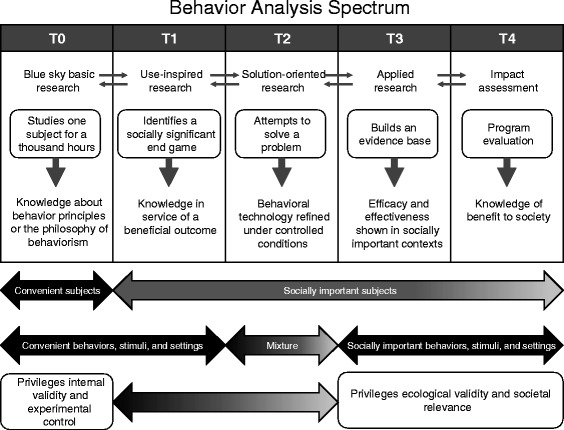
Much has been written about the potential benefits of translational research in behavior analysis, but a lack of consensus about what constitutes "translational" creates a barrier to effective knowledge-practice innovation within the discipline and across other sciences. We propose a tiered system, adapted from a biomedical translational pathway, for classifying behavior analysis research on a basic-applied spectrum. Tier 0 is blue sky basic science in which the subjects, behaviors, stimuli, and settings are selected for convenience. Tier 1 is use-inspired basic science with a socially important end game and research subject. Tier 2 is solution-oriented research that attempts to solve a specific problem in a socially important subject, but 1 or more aspects of the research are selected for purposes of experimental control rather than social importance. Tier 3 is applied behavior analysis research that studies a problem of social significance for the subject and involves behaviors, stimuli, and settings that are socially important. Tier 4 is impact assessment in which behavioral technology is applied with a direct benefit to society. We provide examples of behavior-analytic research in each tier and evaluate the potential benefits of organizing behavior analysis in this way.
Keywords: Applied behavior analysis; Basic–applied continuum; Biomedical model; Experimental analysis of behavior; Internal validity; Scientific consequences; Social significance; Taxonomy; Translational research pathway.
© Association for Behavior Analysis International 2018.
Conflict of interest statement
Conflict of InterestThe authors declare that they have no conflicts of interest.
Figures
References
-
- Adams JU. Building the bridge from bench to bedside. Nature Reviews. 2008;7:463–464. - PubMed
-
- Azrin NH. A strategy for applied research: Learning based but outcome oriented. American Psychologist. 1977;32:140–149.
LinkOut - more resources
Full Text Sources