


Letrozole and human menopausal gonadotropin for ovulation induction in clomiphene resistance polycystic ovary syndrome patients: A randomized controlled study
- PMID: 31977842
- PMCID: PMC7004704
- DOI: 10.1097/MD.0000000000018383
Letrozole and human menopausal gonadotropin for ovulation induction in clomiphene resistance polycystic ovary syndrome patients: A randomized controlled study
Abstract
Objective: To compare the effects of letrozole and human menopausal gonadotropin (HMG) in the treatment of patients with polycystic ovary syndrome (PCOS) resistant to clomiphene citrate (CC).
Methods: A total of 96 clomiphene resistance polycystic ovary syndrome patients infertility were randomly divided into an LE group, and HMG group (n = 48). LE group orally received letrozole at 5.0 mg/d on the 3rd-5th days of menstrual cycle for 5 consecutive days, and 75 U/d HMG was given through intramuscular injection for 5 days starting from the third day of menstrual cycle in HMG group. Number of growing and mature follicles, serum E2 (pg/mL), serum P (ng/mL), endometrial thickness, occurrence of pregnancy and miscarriage were observed.
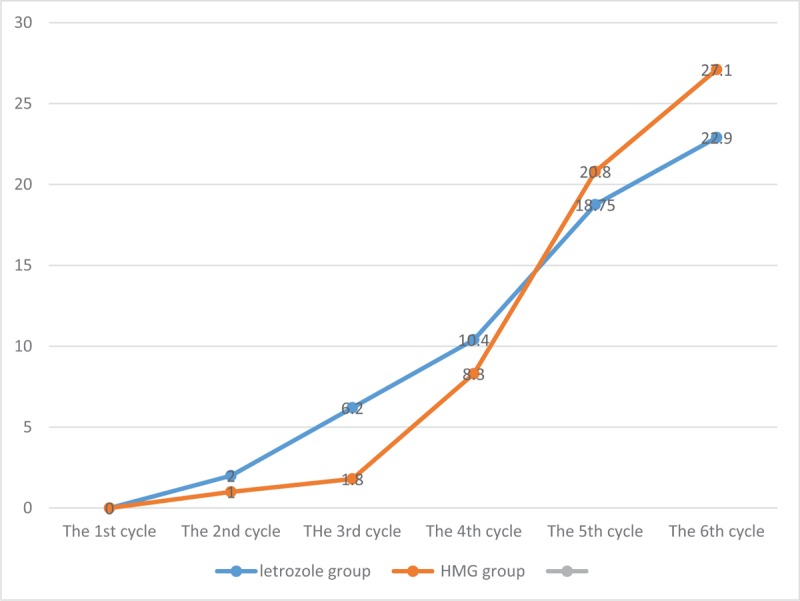
Results: There was no significant difference in the number of ovulation cycles between the 2 groups (53.6% vs 64.7%, P > .05). The number of mature follicular cycles in the HMG group was higher than that of the letrozole group (P < .01). There were no significant differences in the clinical pregnancy rate (22.9% vs 27.1%, P > .05) and abortion rate (6.2% vs 10.4%, P > .05). There was no significant difference in the endometrial thickness between the 2 groups on the day of HCG injection [(9.1 ± 0.2) mm vs (10.7 ± 1.6) mm, P > .05]; the serum estradiol (E2) was lower in the letrozole group. The incidence of ovarian cysts was lower than that of HMG group (P < .05). There was2 ovarian hyperstimulation syndrome in the letrozole group; the incidence of ovarian hyperstimulation syndrome in the HMG group was 12.5%.
Conclusion: Letrozole-induced ovulation can obtain ovulation rate and pregnancy rate similar to gonadotropin, but reduce the risk associated with treatment. It can be used as an effective ovulation option for patients with polycystic ovary syndrome who are resistant to clomiphene.
Conflict of interest statement
The authors have no conflicts of interest to disclose.
Figures
References
-
- Azziz R, Woods KS, Reyna R, et al. The prevalence and features of the polycystic ovary syndrome in an unselected population. J Clin Endocrinol Metab 2004;89:2745–9. - PubMed
-
- Badawy A, Mosbah A, Tharwat A, et al. Extended letrozole therapy for ovulation induction in clomiphene-resistant women with polycystic ovary syndrome: a novel protocol. Fertil Steril 2009;92:200–39. - PubMed
-
- Badawy AM, Metwally M, Fawzy M. Randomized controlled trial of three doses of letrozole for ovulation induction in patients with unexplained infertility. Reprod Biomed Online 2007;14:559–62. - PubMed
Publication types
MeSH terms
Substances
LinkOut - more resources
Full Text Sources
Medical
