Review
. 2020 Mar:170:173-202.
doi: 10.1016/j.biochi.2020.01.009. Epub 2020 Jan 21.

Biophysical approaches for exploring lipopeptide-lipid interactions

Affiliations
Review

Biophysical approaches for exploring lipopeptide-lipid interactions

Sathishkumar Munusamy et al. Biochimie. 2020 Mar.

Abstract

In recent years, lipopeptides (LPs) have attracted a lot of attention in the pharmaceutical industry due to their broad-spectrum of antimicrobial activity against a variety of pathogens and their unique mode of action. This class of compounds has enormous potential for application as an alternative to conventional antibiotics and for pest control. Understanding how LPs work from a structural and biophysical standpoint through investigating their interaction with cell membranes is crucial for the rational design of these biomolecules. Various analytical techniques have been developed for studying intramolecular interactions with high resolution. However, these tools have been barely exploited in lipopeptide-lipid interactions studies. These biophysical approaches would give precise insight on these interactions. Here, we reviewed these state-of-the-art analytical techniques. Knowledge at this level is indispensable for understanding LPs activity and particularly their potential specificity, which is relevant information for safe application. Additionally, the principle of each analytical technique is presented and the information acquired is discussed. The key challenges, such as the selection of the membrane model are also been briefly reviewed.

Keywords: Biophysical techniques; Diffraction methods; Lipopeptides; Microscopic methods; Peptide-lipid interactions; Spectroscopic methods.


Figures

Image 1
Graphical abstract
Fig. 1
Fig. 1
Schematic representation of ideal small-angle scattering experiment (i) as a function of the parallel (qk) and normal (qz) components of the momentum transfer (q). (ii) in the vicinity of the (specular) qz axis. In this study, the qz components (iii) were measured by line scanning under specular conditions (iv). At low qz, the lipid acyl chain correlation maximum (v) is observed. Lorentzian fits yield the lateral lipid chain distance. The width of the acyl chain peak along qk gives information about the lipid ordering (correlation length); the angular width of the peak corresponds to the acyl chain tilt. In addition, superstructures (vi) and peptide geometries (helix maximum, vii) can be observed in some cases. Figure used from https://doi.org/10.1007/s00249-010-0645-4.
Fig. 2
Fig. 2
An illustration of the TR-FTIR spectroscopy technique. An infrared beam is directed onto an optically dense crystal with a high refractive index at a certain angle. This internal reflectance creates an evanescent wave that extends beyond the surface of the crystal into the sample held in contact with the crystal. Figure used from https://doi.org/10.1016/j.bbamem.2012.11.027. Epub 2012 Nov 29.
Fig. 3
Fig. 3
(A) Sketch of the experimental IRRAS setup with the sample and reference troughs. The IR spectrometer is located at the left-hand side. The beam is reflected from the surface to the right-hand side where the MCT detector is located. Figure used from DOI: https://doi.org/10.1016/j.bbamem.2013.04.014.
Fig. 4
Fig. 4
The OCD spectra of an α-helical peptide (red cylinder) arranged in a membrane in a surface-bound S-state (blue line), a tilted T-state (green line) and an inserted I-state (red line). Illustrated is the transition dipole moment μ for the parallel-polarized band at 208 nm interacting with the electric field vector E (gray arrow), which oscillates perpendicular to the propagation direction of light k (yellow arrow). Figure used from DOI: https://doi.org/10.1021/acs.accounts.5b00346.
Fig. 5
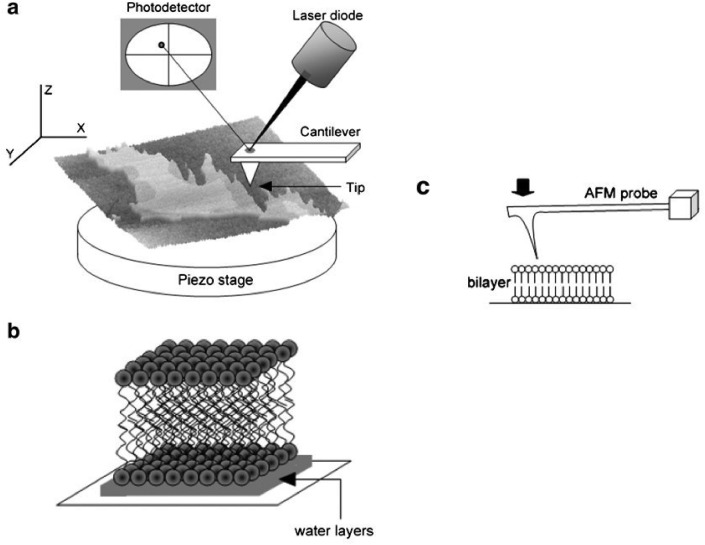
Fig. 5
(a) Schematics of the experimental AFM set-up. (b) Schematics of the lipid bilayer. (c) Schematics of the indentation process on a lipid bilayer using an AFM cantilever tip. Figure used from DOI: https://doi.org/10.1016/j.bbamem.2009.12.019.
Fig. 6
Fig. 6
Schematic representation of analytical methodologies which are used in biophysical studies of membrane interacting peptides.

References

    1. Santos D.K.F., Rufino R.D., Luna J.M., Santos V.A., Sarubbo L.A. Biosurfactants: multifunctional biomolecules of the 21st century. Int. J. Mol. Sci. 2016;17:401. - PMC - PubMed
    1. Chen W.-C., Juang R.-S., Wei Y.-H. Applications of a lipopeptide biosurfactant, surfactin, produced by microorganisms. Biochem. Eng. J. 2015;103:158–169.
    1. Bender C.L., Alarcón-Chaidez F., Gross D.C. Pseudomonas syringae phytotoxins: mode of action, regulation, and biosynthesis by peptide and polyketide synthetases. Microbiol. Mol. Biol. Rev. 1999;63(2):266–292. - PMC - PubMed
    1. Pirri G., Giuliani A., Nicoletto S.F., Pizzuto L., Rinaldi A.C. LPs as anti-infectives: a practical perspective. Cent. Eur. J. Biol. 2009;4:258–273. (2009)
    1. Bunkóczi G., Vértesy L., Sheldrick G.M. Structure of the lipopeptide antibiotic tsushimycin. Acta Crystallogr. D. 2005;61:1160–1164. - PubMed