Review
. 2020 Jan 22;9(2):269.
doi: 10.3390/cells9020269.

Long Noncoding RNA in Myeloid and Lymphoid Cell Differentiation, Polarization and Function

Affiliations
Review

Long Noncoding RNA in Myeloid and Lymphoid Cell Differentiation, Polarization and Function

Imran Ahmad et al. Cells. .

Abstract

Long noncoding RNA (lncRNA) are a class of endogenous, non-protein coding RNAs that are increasingly being associated with various cellular functions and diseases. Yet, despite their ubiquity and abundance, only a minute fraction of these molecules has an assigned function. LncRNAs show tissue-, cell-, and developmental stage-specific expression, and are differentially expressed under physiological or pathological conditions. The role of lncRNAs in the lineage commitment of immune cells and shaping immune responses is becoming evident. Myeloid cells and lymphoid cells are two major classes of immune systems that work in concert to initiate and amplify innate and adaptive immunity in vertebrates. In this review, we provide mechanistic roles of lncRNA through which these noncoding RNAs can directly participate in the differentiation, polarization, and activation of myeloid (monocyte, macrophage, and dendritic cells) and lymphoid cells (T cells, B cells, and NK cells). While our knowledge on the role of lncRNA in immune cell differentiation and function has improved in the past decade, further studies are required to unravel the biological role of lncRNAs and identify novel mechanisms of lncRNA functions in immune cells. Harnessing the regulatory potential of lncRNAs can provide novel diagnostic and therapeutic targets in treating immune cell related diseases.

Keywords: immune responses; long noncoding RNA; lymphoid cells; myeloid cells; polarization.


Conflict of interest statement

The authors have stated explicitly that there are no conflicts of interest in connection with this article.

Figures
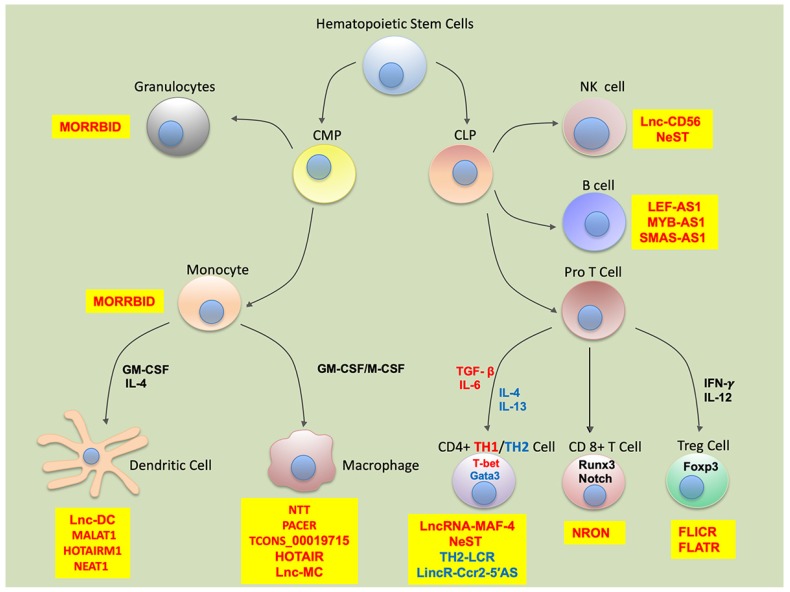
Figure 1
Figure 1
Schematic representation of the long noncoding RNA-mediated regulation of myeloid and lymphoid cell differentiation and function. Hematopoietic stem cells differentiate into various myeloid and lymphoid cells under the influence of molecular factors including cytokines and transcription factors. Several long noncoding RNAs have been characterized with a critical role in myeloid and lymphoid cell differentiation and function. LncRNAs with unique regulatory roles in myeloid or lymphoid cell-specific functions are listed in yellow boxes. In CD4+ differentiation, blue and red font corresponds to Th2 and Th1 cells, polarizing cytokines, or transcription factors. CMP: common myeloid progenitor; CLP: common lymphoid progenitor; Th: T helper; NK cell: Natural Killer Cell.
Figure 2
Figure 2
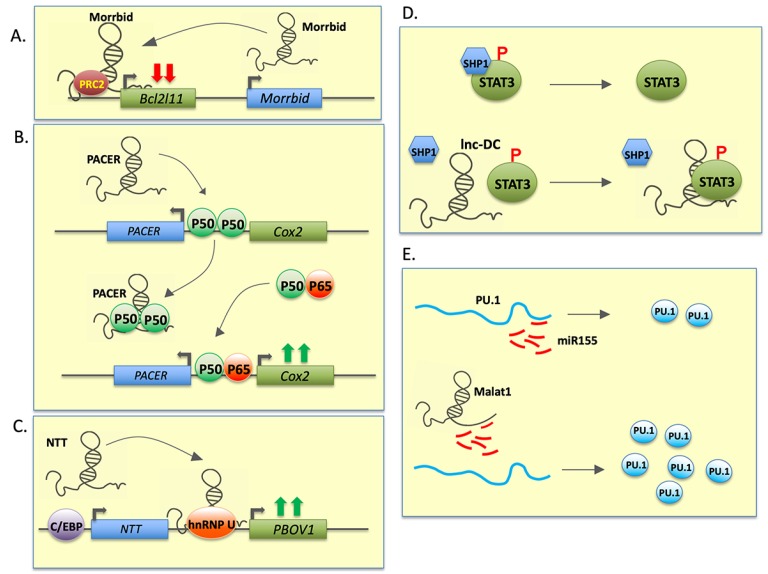
Schematic diagram depicting different long noncoding RNA mechanisms in myeloid cells. LncRNAs are modular molecule and can act as decoys, signals, guides, or scaffolds. In this figure, different characterized mechanisms through which lncRNAs exert their biological functions are listed. Examples of few lncRNA-mediated mechanisms that govern biological pathways in (AC) macrophages or (DE) dendritic cells are provided. (AC) In macrophages, Morrbid, PACER, and NTT recruit specific transcription factors or ribonucleoproteins and regulate target gene expression. (DE) Lnc-DC prevent SHP1-mediated dephosphorylation of dendritic cells specific transcription factor STAT3 to facilitate cell differentiation, while MALAT1 sequesters PU.1-targeting miR-155 and enhances cellular PU.1 levels. Green arrows denote transcriptional activation and red arrows denote transcriptional repression.
Figure 3
Figure 3
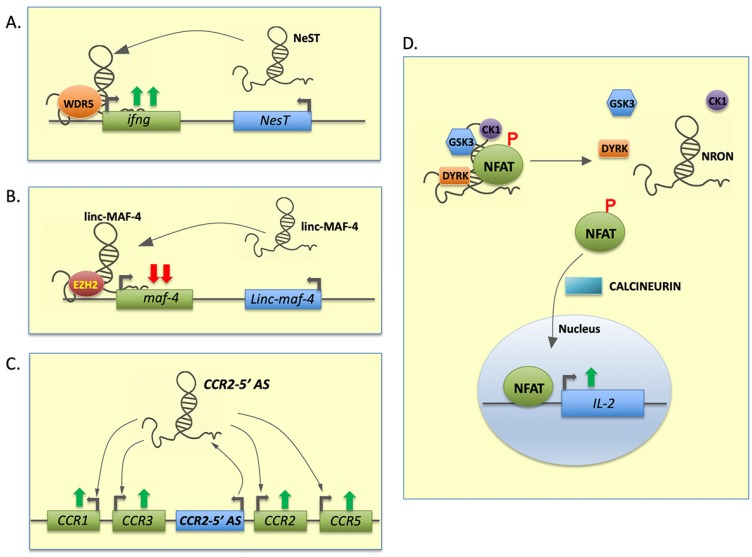
Long noncoding RNA regulates lymphoid cell differentiation and function. Multiple lncRNAs are involved in lymphoid cell differentiation and regulate polarization and effector cell functions. (A,B) NeST and linc-MAF-4 interact with specific transcription factors and guide them to the IFNG and MAF-4 locus, respectively. This directly influences transcription of target genes and promotes the Th1 phenotype. (C) CCR2-5’ AS induces expression of various Th2 cytokines and facilitates GATA3 (critical Th2 transcription factor) function. (D) In resting CD8 cells, NRON sequesters a critical transcription factor NFAT. In activated T cells, calcineurin mediates dephosphorylation and nuclear translocation of NFAT. Green arrows denote transcriptional activation and red arrows denote transcriptional repression.

References

    1. Djebali S., Davis C.A., Merkel A., Dobin A., Lassmann T., Mortazavi A.M., Tanzer A., Lagarde J., Lin W., Schlesinger F., et al. Landscape of transcription in human cells. Nature. 2012;489:101–108. doi: 10.1038/nature11233. - DOI - PMC - PubMed
    1. Salzberg S.L. Open questions: How many genes do we have? BMC Boil. 2018;16 doi: 10.1186/s12915-018-0564-x. - DOI - PMC - PubMed
    1. Dempsey J.L., Cui J.Y. Long noncoding RNAs: A novel paradigm for toxicology. Toxicol. Sci. 2017;155:3–21. doi: 10.1093/toxsci/kfw203. - DOI - PMC - PubMed
    1. Losko M., Kotlinowski J., Jura J. Long Noncoding RNAs in Metabolic Syndrome Related Disorders. Mediat. Inflamm. 2016;2016:1–12. doi: 10.1155/2016/5365209. - DOI - PMC - PubMed
    1. Chen W., Böcker W., Brosius J., Tiedge H. Expression of neural BC200 RNA in human tumours. J. Pathol. 1997;183:345–351. doi: 10.1002/(SICI)1096-9896(199711)183:3<345::AID-PATH930>3.0.CO;2-8. - DOI - PubMed

Publication types

Substances

LinkOut - more resources