Review
. 2020 Jan 23;9(2):145.
doi: 10.3390/plants9020145.

Factors Affecting Organelle Genome Stability in Physcomitrella patens

Affiliations
Review

Factors Affecting Organelle Genome Stability in Physcomitrella patens

Masaki Odahara. Plants (Basel). .

Abstract

Organelle genomes are essential for plants; however, the mechanisms underlying the maintenance of organelle genomes are incompletely understood. Using the basal land plant Physcomitrella patens as a model, nuclear-encoded homologs of bacterial-type homologous recombination repair (HRR) factors have been shown to play an important role in the maintenance of organelle genome stability by suppressing recombination between short dispersed repeats. In this review, I summarize the factors and pathways involved in the maintenance of genome stability, as well as the repeats that cause genomic instability in organelles in P. patens, and compare them with findings in other plant species. I also discuss the relationship between HRR factors and organelle genome structure from the evolutionary standpoint.

Keywords: Physcomitrella patens; chloroplast; genome stability; homologous recombination repair; mitochondrion; repeated sequence.


Conflict of interest statement

The author declares no conflict of interest.

Figures
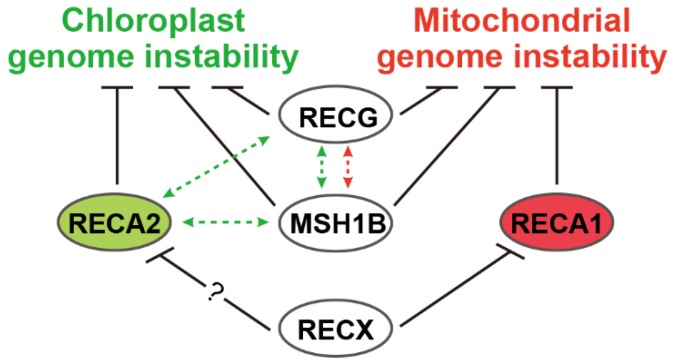
Figure 1
Figure 1
Factors affecting organelle genome stability in P. patens. Factors involving organelle genome stability are summarized with their relationship. Protein localization of the factors are shown by their colors: green (chloroplasts), red (mitochondria), and white (chloroplasts and mitochondria). Suppression and genetic relationship are shown by solid and dashed lines, respectively. RECX shows protein–protein interaction with RECA2, but its involvement in chloroplast genome stability remains unclear.

References

    1. Vidali L., Bezanilla M. Physcomitrella patens: A model for tip cell growth and differentiation. Curr. Opin. Plant Biol. 2012;15:625–631. doi: 10.1016/j.pbi.2012.09.008. - DOI - PubMed
    1. Rensing S.A., Lang D., Zimmer A.D., Terry A., Salamov A., Shapiro H., Nishiyama T., Perroud P.F., Lindquist E.A., Kamisugi Y., et al. The Physcomitrella genome reveals evolutionary insights into the conquest of land by plants. Science. 2008;319:64–69. doi: 10.1126/science.1150646. - DOI - PubMed
    1. Schaefer D.G. A new moss genetics: Targeted mutagenesis in Physcomitrella patens. Annu. Rev. Plant Biol. 2002;53:477–501. doi: 10.1146/annurev.arplant.53.100301.135202. - DOI - PubMed
    1. Lang D., Ullrich K.K., Murat F., Fuchs J., Jenkins J., Haas F.B., Piednoel M., Gundlach H., Van Bel M., Meyberg R., et al. The Physcomitrella patens chromosome-scale assembly reveals moss genome structure and evolution. Plant J. 2018;93:515–533. doi: 10.1111/tpj.13801. - DOI - PubMed
    1. Terasawa K., Odahara M., Kabeya Y., Kikugawa T., Sekine Y., Fujiwara M., Sato N. The mitochondrial genome of the moss Physcomitrella patens sheds new light on mitochondrial evolution in land plants. Mol. Biol. Evol. 2007;24:699–709. doi: 10.1093/molbev/msl198. - DOI - PubMed

LinkOut - more resources
