. 2020 Jan 23;9(2):325.
doi: 10.3390/jcm9020325.

Impact of Using Different Levels of Threshold-Based Artefact Correction on the Quantification of Heart Rate Variability in Three Independent Human Cohorts

Affiliations

Impact of Using Different Levels of Threshold-Based Artefact Correction on the Quantification of Heart Rate Variability in Three Independent Human Cohorts

Juan M A Alcantara et al. J Clin Med. .

Abstract

Heart rate variability (HRV) is a non-invasive indicator of autonomic nervous system function. HRV recordings show artefacts due to technical and/or biological issues. The Kubios software is one of the most used software to process HRV recordings, offering different levels of threshold-based artefact correction (i.e., Kubios filters). The aim of the study was to analyze the impact of different Kubios filters on the quantification of HRV derived parameters from short-term recordings in three independent human cohorts. A total of 312 participants were included: 107 children with overweight/obesity (10.0 ± 1.1 years, 58% men), 132 young adults (22.2 ± 2.2 years, 33% men) and 73 middle-aged adults (53.6 ± 5.2 years, 48% men). HRV was assessed using a heart rate monitor during 10-15 min, and the Kubios software was used for HRV data processing using all the Kubios filters available (i.e., 6). Repeated-measures analysis of variance indicated significant differences in HRV derived parameters in the time-domain (all p < 0.001) across the Kubios filters in all cohorts, moreover similar results were observed in the frequency-domain. When comparing two extreme Kubios filters, these statistical differences could be clinically relevant, e.g. more than 10 ms in the standard deviation of all normal R-R intervals (SDNN). In conclusion, the results of the present study suggest that the application of different Kubios filters had a significant impact on HRV derived parameters obtained from short-term recordings in both time and frequency-domains.

Keywords: Kubios software; autonomic nervous system; children; data processing; middle-aged adults; young adults.


Conflict of interest statement

The authors do not have any conflict of interest to disclose.

Figures
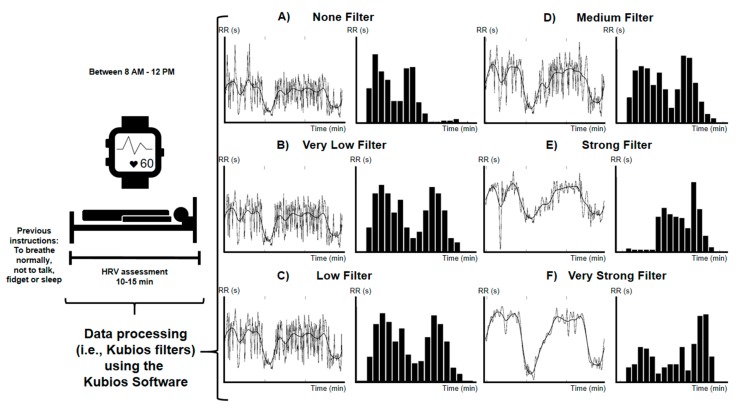
Figure 1
Figure 1
Study design. HRV: heart rate variability. None (A), Very Low (B), Low (C), Medium (D), Strong (E) and Very Strong (F) filters refers to the level of threshold-based artefact correction (i.e., Kubios filter). Graphs are examples of the same best 5 min period (of the whole heart rhythm recoding) that met the selection criteria after using different Kubios filters. RR: R-R intervals; S: seconds; min: minutes.
Figure 2
Figure 2
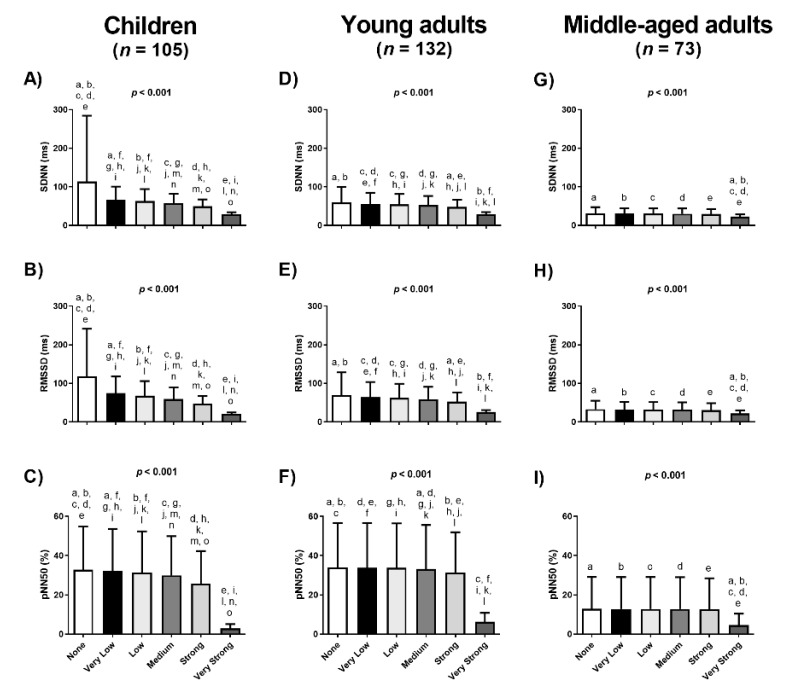
Differences on the Heart Rate Variability (HRV) time-domain parameters using different Kubios filters in three different cohorts. Data are represented as mean and standard deviation. SDNN: standard deviation of all normal R–R intervals (Panels A, D and G); RMSSD: squared root of the mean of the sum of the squares of successive normal R–R interval differences (Panels B, E and H); pNN50: number of pairs of adjacent normal R–R intervals differing by more than 50ms in the entire recording (Panels C, F and I); p value from the ANOVA comparisons; similar letters means Bonferroni post-hoc differences.
Figure 3
Figure 3
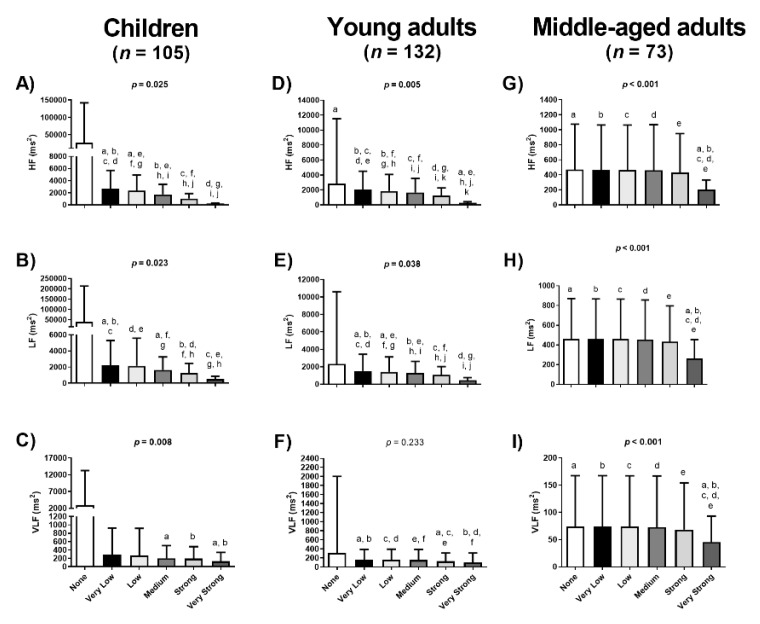
Differences on the Heart Rate Variability (HRV) frequency-domain parameters using different Kubios filter in three different cohorts. Data are represented as mean and standard deviation. HF: power in the high frequency (in absolute units, ms2; Panels A, E and I); LF: power in the low frequency (in absolute units, ms2; Panels B, F and J); LF/HF: ratio of the power in the low frequency divided by the power in the high frequency (Panels C, G and K); VLF: power in the very low frequency (in absolute units, ms2; Panels D, H and L). p value from the ANOVA comparisons; similar letters means Bonferroni post-hoc differences.

References

    1. Task Force of the European Society of Cardiology and the North American Society of Pacing and Electrophysiology Heart rate variability: Standards of measurement, physiological interpretation and clinical use. Circulation. 1996;93:1043–1065. - PubMed
    1. Lahiri M.K., Kannankeril P.J., Goldberger J.J. Assessment of Autonomic Function in Cardiovascular Disease. Physiological Basis and Prognostic Implications. J. Am. Coll. Cardiol. 2008;51:1725–1733. doi: 10.1016/j.jacc.2008.01.038. - DOI - PubMed
    1. Shaffer F., McCraty R., Zerr C.L. A healthy heart is not a metronome: An integrative review of the heart’s anatomy and heart rate variability. Front. Psychol. 2014;5:1–19. doi: 10.3389/fpsyg.2014.01040. - DOI - PMC - PubMed
    1. Gidron Y., Deschepper R., De Couck M., Thayer J., Velkeniers B. The Vagus Nerve Can Predict and Possibly Modulate Non-Communicable Chronic Diseases: Introducing a Neuroimmunological Paradigm to Public Health. J. Clin. Med. 2018;7:371. doi: 10.3390/jcm7100371. - DOI - PMC - PubMed
    1. Zhang J. Effect of Age and Sex on Heart Rate Variability in Healthy Subjects. J. Manip. Physiol. Ther. 2007;30:374–379. doi: 10.1016/j.jmpt.2007.04.001. - DOI - PubMed

LinkOut - more resources