Review
. 2020 Jan 23;21(3):747.
doi: 10.3390/ijms21030747.

The Endocannabinoid System: A Target for Cancer Treatment

Affiliations
Review

The Endocannabinoid System: A Target for Cancer Treatment

Chiara Laezza et al. Int J Mol Sci. .

Abstract

In recent years, the endocannabinoid system has received great interest as a potential therapeutic target in numerous pathological conditions. Cannabinoids have shown an anticancer potential by modulating several pathways involved in cell growth, differentiation, migration, and angiogenesis. However, the therapeutic efficacy of cannabinoids is limited to the treatment of chemotherapy-induced symptoms or cancer pain, but their use as anticancer drugs in chemotherapeutic protocols requires further investigation. In this paper, we reviewed the role of cannabinoids in the modulation of signaling mechanisms implicated in tumor progression.

Keywords: Cannabinoids; angiogenesis; cancer stem cell; metastasis.


Conflict of interest statement

The authors declare no conflict of interest.

Figures
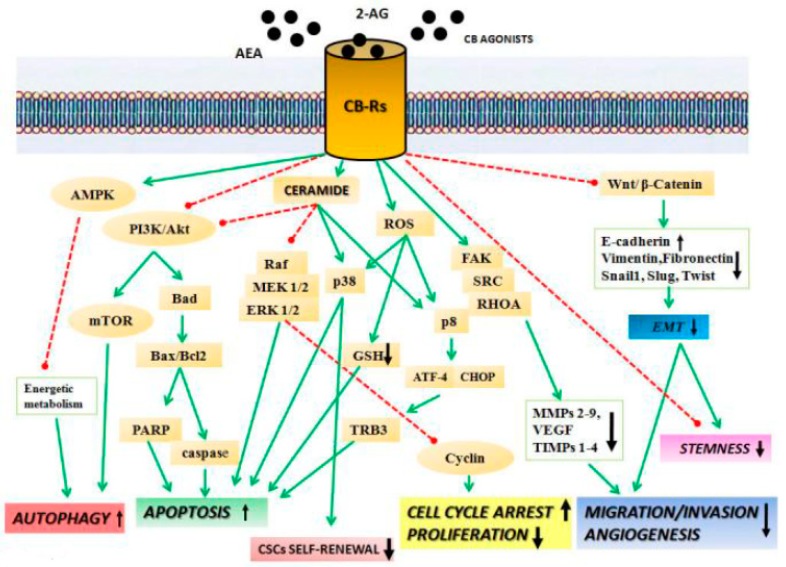
Figure 1
Figure 1
Schematic representation of the main anticancer molecular mechanisms mediated by cannabinoid receptors’ activation “↑, upregulation” and “↓, downregulation”. Cannabinoid receptor (CB-R) agonists inhibit cancer cell proliferation through various receptor-mediated mechanisms. CB-R agonist induces cancer cell death via apoptosis, mediated by the activation of different transcription factors (proapoptotic Bcl2 family transcription factor and mitogen-activated protein kinase (MAPK) pathway) and de novo synthesis of ceramide and reactive oxygen species (ROS) production. CBs block cancer cells’ proliferation by inhibiting extracellular signal regulated kinase (ERK) signaling. They also reduce cell migration and angiogenesis, inhibiting the focal adhesion kinase/proto-oncogene tyrosine-protein kinase Src/transforming protein RhoA (FAK/SRC/RhoA) pathway. CBs prevent cancer epithelial mesenchymal transition (EMT), inhibiting Wnt/β-catenin pathway, and induce autophagy by activation of mammalian target of rapamycin (mTOR) and AMP-activated protein kinase (AMPK) pathways. CBs can impair stemness and cancer stem cells’ (CSCs) self-renewal. (Akt (protein kinase B), PI3K (phosphoinositol-3-kinase) Raf (serine/threonine-protein kinase)).

References

    1. Andre C.M., Hausman J.F., Guerriero G. Cannabis sativa: The plant of the thousand and one molecules. Front. Plant Sci. 2016;4:7–19. doi: 10.3389/fpls.2016.00019. - DOI - PMC - PubMed
    1. Thomas A., Baillie G.L., Phillips A.M., Razdan R.K., Ross R.A., Pertwee R.G. Cannabidiol displays unexpectedly high potency as an antagonist of CB1 and CB2 receptor agonists in vitro. B. J. Pharmacol. 2007;150:613–623. doi: 10.1038/sj.bjp.0707133. - DOI - PMC - PubMed
    1. Khan M.I., Sobocinska A.A., Czarnecka A.M., Krol M., Botta B., Szczylik C. The therapeutic aspects of the endocannabinoid system (ECS) for cancer and their development: From nature to laboratory. Curr. Pharmaceut. Des. 2016;22:1756–1766. doi: 10.2174/1381612822666151211094901. - DOI - PMC - PubMed
    1. Maurya N., Velmurugan B.K. Therapeutic applications of cannabinoids. Chem. Biol. Interact. 2018;293:77–88. doi: 10.1016/j.cbi.2018.07.018. - DOI - PubMed
    1. Ramer R., Schwarz R., Hinz B. Modulation of the Endocannabinoid System as a Potential Anticancer Strategy. Front. Pharmacol. 2019;10:430. doi: 10.3389/fphar.2019.00430. - DOI - PMC - PubMed

MeSH terms

Grants and funding
