Review
. 2020 Jan 24;147(2):dev184754.
doi: 10.1242/dev.184754.

Molecular and cellular mechanisms of tooth development, homeostasis and repair

Affiliations
Review

Molecular and cellular mechanisms of tooth development, homeostasis and repair

Tingsheng Yu et al. Development. .

Abstract

The tooth provides an excellent system for deciphering the molecular mechanisms of organogenesis, and has thus been of longstanding interest to developmental and stem cell biologists studying embryonic morphogenesis and adult tissue renewal. In recent years, analyses of molecular signaling networks, together with new insights into cellular heterogeneity, have greatly improved our knowledge of the dynamic epithelial-mesenchymal interactions that take place during tooth development and homeostasis. Here, we review recent progress in the field of mammalian tooth morphogenesis and also discuss the mechanisms regulating stem cell-based dental tissue homeostasis, regeneration and repair. These exciting findings help to lay a foundation that will ultimately enable the application of fundamental research discoveries toward therapies to improve oral health.

Keywords: Cell heterogeneity; Dental stem cell; Injury repair; Tooth development and homeostasis.


Conflict of interest statement

Competing interestsO.D.K. is a consultant for Stemodontics.

Figures
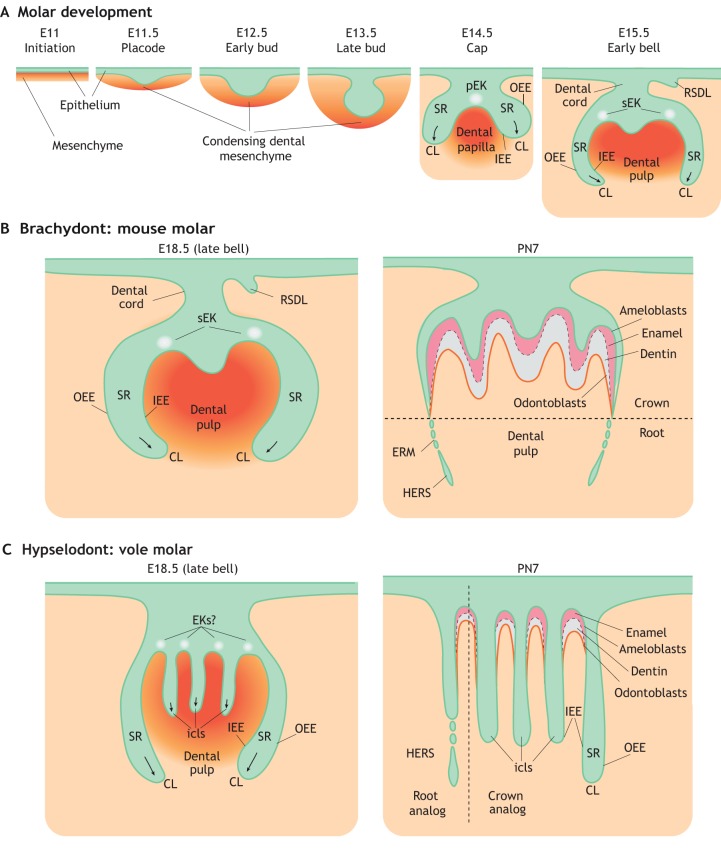
Fig. 1.
Fig. 1.
Schematic of rodent molar development. (A) The initiation of mouse molar formation starts a little later than E11 with the thickening of dental epithelium (green). The tooth bud then forms via invagination of the dental epithelium into the underlying condensing mesenchyme (orange) at E12.5-E13.5. Signals sent from the primary (pEK) and secondary (sEK) enamel knots guide the formation and elongation of the cervical loop (CL), with the inner (IEE) and outer (OEE) enamel epithelium surrounding the stellate reticulum (SR). The rudimentary successional dental lamina (RSDL), which is a transient structure in most species, also begins to form at this time. (B) During the later stages of mouse molar development, the dental epithelium of the CL grows apically to become a transient structure called Hertwig's epithelial root sheath (HERS) and the epithelial cell rests of Malassez (ERM), facilitating root formation. (C) During the later stages of molar development in voles, multiple intercuspal loops (icls) form and persist throughout the postnatal stages. These are then responsible for enamel deposition in between the icls. PN, postnatal day.
Fig. 2.
Fig. 2.
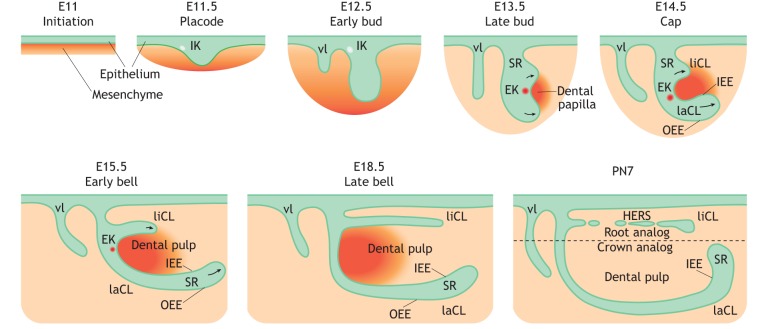
Schematic of mouse incisor development. The development of the mouse incisor initiates at around E11. Dental epithelium (green) invaginates into the mesenchyme (orange), forming the dental placode at around E11.5. A population of non-mitotic cells within the placode accumulates to form an early signaling center termed the initiation knot (IK), which guides the formation of the tooth bud. Vestibular lamina (vl) forms adjacent to the developing tooth bud. During the bud-to-cap transition, the signaling activity of the IK switches to the enamel knot (EK). At the cap stage at around E14.5, lingual and labial cervical loops (liCL and laCL) form on each side of the EK in an asymmetrical pattern along the labial-lingual axis around the dental papilla. Continuous folding further divides dental epithelium into inner (IEE) and outer (OEE) enamel epithelium, surrounding the stellate reticulum (SR) region. The development of the laCL proceeds through the bell stage, whereas the formation of the liCL is disproportionally slower on the medial side. Hertwig's epithelial root sheath (HERS) then forms at the lingual side. PN, postnatal day.
Fig. 3.
Fig. 3.
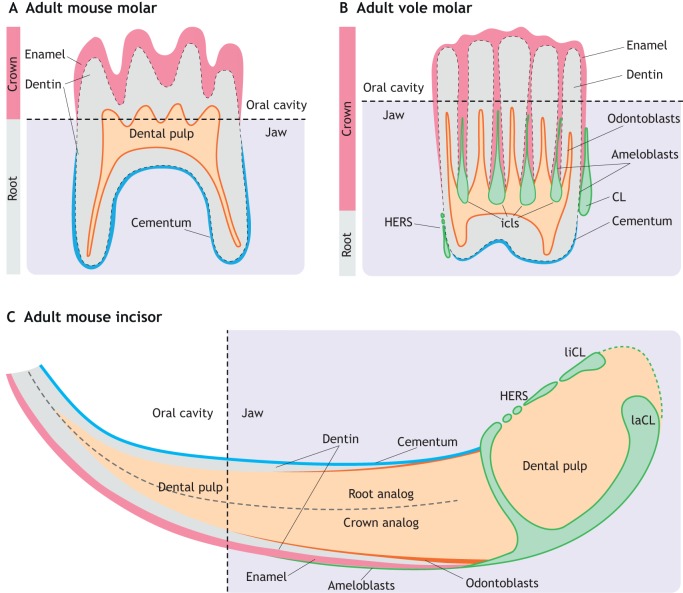
Schematic of adult rodent tooth structure. (A) In the adult mouse molar, crown eruption results in the loss of dental epithelial tissue. Thus, enamel produced by epithelial-derived ameloblasts is only deposited on the surface of the crown part of the molar. Mesenchymal-derived odontoblasts produce dentin around the dental pulp, and cementum mineralization covers the root portion of the molar. (B) In the vole molar, intercuspal loops (icls) persist throughout the adult stages, allowing the continuous growth of the crown. In addition, a larger proportion of the crown is buried inside the jaw bones compared with the mouse molar. Both Hertwig's epithelial root sheath (HERS) and the cervical loop (CLs) are preserved in adult vole molars. (C) In the adult mouse incisor, lingual and labial cervical loops (liCL and laCL) persist throughout the adult stages. Only the laCL contains dental stem cells, allowing a continuous supply of enamel-producing ameloblasts at the labial crown analog of mouse incisors. Dental pulp is enclosed by dentin, produced by mesenchyme-derived odontoblasts. The lingual root analog is covered by cementum, which helps the incisor anchor to the jaw bone.
Fig. 4.
Fig. 4.
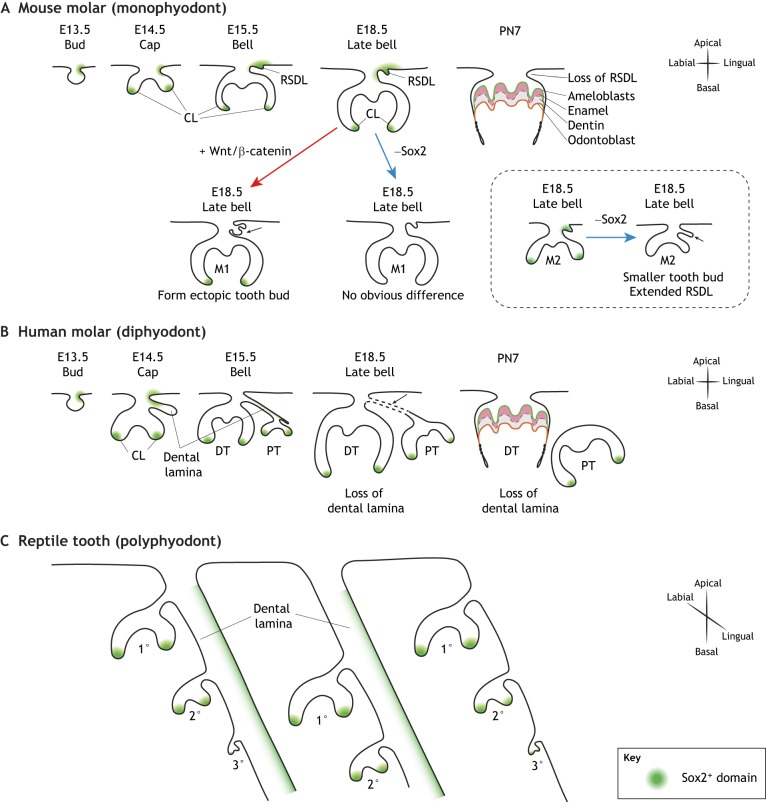
Sox2+ stem cells during tooth replacement. (A-C) Illustration of Sox2-expressing stem cell compartments in monophyodonts (A) compared with diphyodonts (B) and polyphyodonts (C), which exhibit different rounds of tooth replacements. (A) In the developing mouse molar, Sox2 (green) is expressed in the cervical loop (CL) and the transient rudimentary successional dental lamina (RSDL). With the initiation of crown eruption, Sox2+ cells are lost along with dental epithelial tissue. Epithelial activation of Wnt signaling (red arrow) results in ectopic tooth bud formation at the RSDL (black arrow), which lacks Sox2 expression. By contrast, deletion of Sox2 only (blue arrow) affects the formation of the posterior molar (M2), without obvious effects on the first molar (M1). (B) In the case of diphyodonts (e.g. humans), as the initial set of deciduous teeth (DT) grow, the replacement set of permanent teeth (PT) forms along the dental lamina. With the beginning of root formation in the deciduous teeth, the dental lamina degrades and the connection between the permanent and the deciduous tooth buds is lost. (C) In polyphyodonts (e.g. reptiles), the dental lamina persists, ensuring several rounds of tooth generation at different stages of development through the lifetime of these animals. PN, postnatal day.
Fig. 5.
Fig. 5.
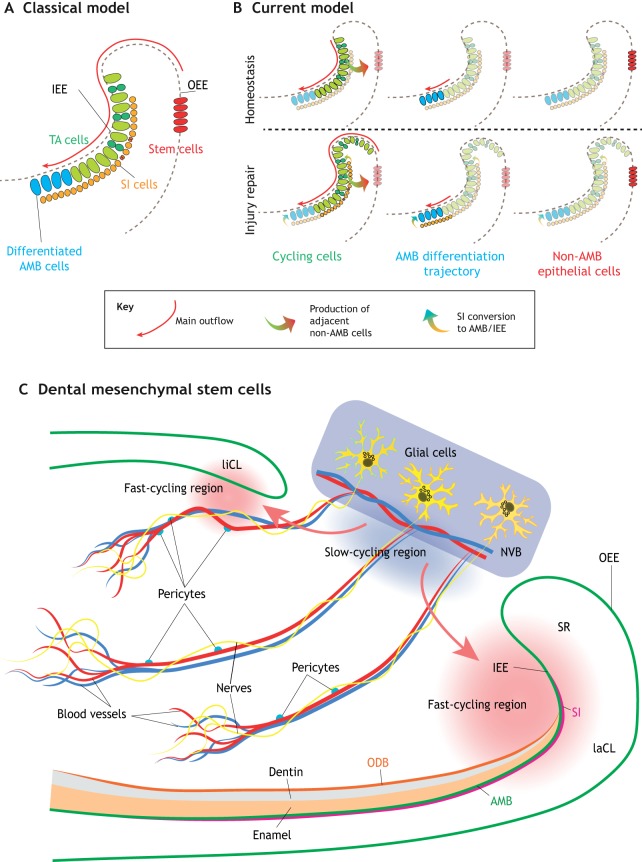
Dental stem cell heterogeneity in adult mouse incisors. (A) The current model posits that stem cells (red) in the outer enamel epithelium (OEE) give rise to transit-amplifying (TA) cells (green) and stratum intermedium (SI) cells (pink) in the inner enamel epithelium (IEE), which then differentiate into ameloblasts (AMB; blue). (B) However, we now know that, during homeostasis, actively cycling IEE cells (green) contribute to the formation of both the enamel-producing ameloblasts (blue) and the adjacent non-ameloblast epithelial cells (red). During injury repair, additional progenitors enter the cell cycle (green), and SI cells (pink) can also convert to differentiate into ameloblasts (blue). (A and B adapted from Sharir et al., 2019.) (C) Different types of cells have also been shown to function as stem cells in the dental mesenchyme. These include glial cells (yellow) and pericytes (blue). They reside in the neurovascular bundle (NVB) niche, giving rise to cells in the fast-cycling regions at both the labial and lingual sides to support the rapid turnover of incisor mesenchymal cells (red arrows). laCL, labial cervical loop; liCL, lingual cervical loop; ODB, odontoblasts; SR, stellate reticulum.
Fig. 6.
Fig. 6.
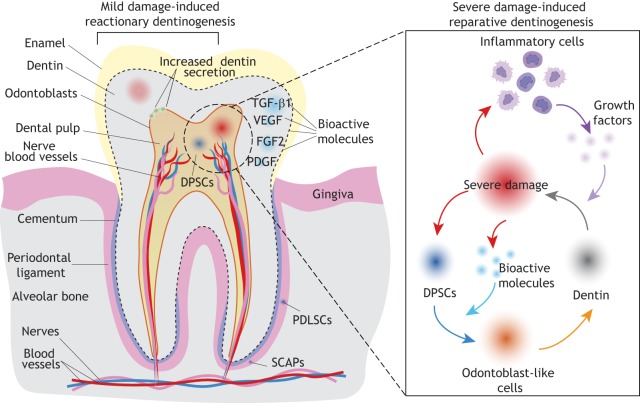
Dentin repair in the human molar. Schematic of a human molar showing dentin mineralization around the dental pulp, enamel deposition on the tooth crown, and cementum coverage around the root surface. The tooth is attached to the alveolar bone via periodontal ligaments. The dental pulp houses blood vessels and nerves. Various types of stem cells, such as dental pulp stem cells (DPSCs), periodontal ligament stem cells (PDLSCs) and stem cells from the root apical papilla (SCAPs) can be found in the dental pulp and periodontal ligament around the tooth root. Mild injury induces reactionary dentinogenesis, which stimulates increased dentin secretion by odontoblasts. By contrast, reparative dentinogenesis takes place in response to severe injury and requires the recruitment of dental progenitors, which differentiate into odontoblast-like cells to fuel dentin production. Bioactive molecules released from mineralized dental tissues, as well as growth factors produced by recruited inflammatory cells, can promote both odontogenesis and tissue repair.

References

    1. Ahn Y. (2015). Signaling in tooth, hair, and mammary placodes. In Current Topics in Developmental Biology, Neural Crest and Placodes (ed. Trainor P. A.), pp. 421-459, Academic Press. - PubMed
    1. Ahn Y., Sanderson B. W., Klein O. D. and Krumlauf R. (2010). Inhibition of Wnt signaling by Wise (Sostdc1) and negative feedback from Shh controls tooth number and patterning. Development 137, 3221-3231. 10.1242/dev.054668 - DOI - PMC - PubMed
    1. Ahn Y., Sims C., Murray M. J., Kuhlmann P. K., Fuentes-Antrás J., Weatherbee S. D. and Krumlauf R. (2017). Multiple modes of Lrp4 function in modulation of Wnt/β-catenin signaling during tooth development. Development 144, 2824-2836. 10.1242/dev.150680 - DOI - PMC - PubMed
    1. Ahtiainen L., Uski I., Thesleff I. and Mikkola M. L. (2016). Early epithelial signaling center governs tooth budding morphogenesis. J. Cell Biol. 214, 753-767. 10.1083/jcb.201512074 - DOI - PMC - PubMed
    1. An Z., Sabalic M., Bloomquist R. F., Fowler T. E., Streelman T. and Sharpe P. T. (2018). A quiescent cell population replenishes mesenchymal stem cells to drive accelerated growth in mouse incisors. Nat. Commun. 9, 378 10.1038/s41467-017-02785-6 - DOI - PMC - PubMed

Publication types