


Guided self-help to reduce psychological distress in South Sudanese female refugees in Uganda: a cluster randomised trial
- PMID: 31981556
- PMCID: PMC9899129
- DOI: 10.1016/S2214-109X(19)30504-2
Guided self-help to reduce psychological distress in South Sudanese female refugees in Uganda: a cluster randomised trial
Abstract
Background: Innovative solutions are required to provide mental health support at scale in low-resource humanitarian contexts. We aimed to assess the effectiveness of a facilitator-guided, group-based, self-help intervention (Self-Help Plus) to reduce psychological distress in female refugees.
Methods: We did a cluster randomised trial in rural refugee settlements in northern Uganda. Participants were female South Sudanese refugees with at least moderate levels of psychological distress (cutoff ≥5 on the Kessler 6). The intervention comprised access to usual care and five 2-h audio-recorded stress-management workshops (20-30 refugees) led by briefly trained lay facilitators, accompanied by an illustrated self-help book. Villages were randomly assigned to either intervention (Self-Help Plus or enhanced usual care) on a 1:1 basis. Within 14 villages, randomly selected households were approached. Screening of women in households continued until 20-30 eligible participants were identified per site. The primary outcome was individual psychological distress, assessed using the Kessler 6 symptom checklist 1 week before, 1 week after, and 3 months after intervention, in the intention-to-treat population. All outcomes were measured at the individual (rather than cluster) level. Secondary outcomes included personally identified problems, post-traumatic stress, depression symptoms, feelings of anger, social interactions with other ethnic groups, functional impairment, and subjective wellbeing. Assessors were masked to allocation. This trial was prospectively registered at ISRCTN, number 50148022.
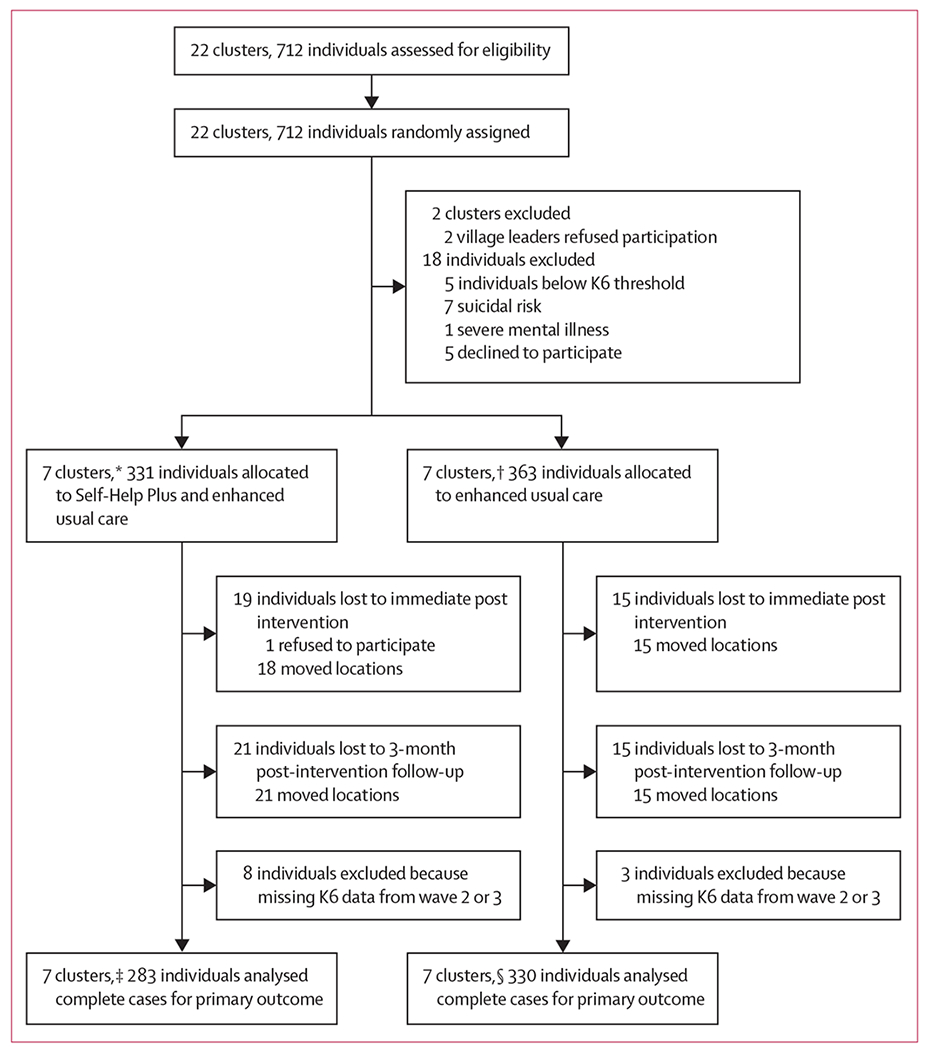
Findings: Of 694 eligible participants (331 Self-Help Plus, 363 enhanced usual care), 613 (88%) completed all assessments. Compared with controls, we found stronger improvements for Self-Help Plus on psychological distress 3 months post intervention (β -1·20, 95% CI -2·33 to -0·08; p=0·04; d -0·26). We also found larger improvements for Self-Help Plus 3 months post-intervention for five of eight secondary outcomes (effect size range -0·30 to -0·36). Refugees with different trauma exposure, length of time in settlements, and initial psychological distress benefited similarly. With regard to safety considerations, the independent data safety management board responded to six adverse events, and none were evaluated to be concerns in response to the intervention.
Interpretation: Self-Help Plus is an innovative, facilitator-guided, group-based self-help intervention that can be rapidly deployed to large numbers of participants, and resulted in meaningful reductions in psychological distress at 3 months among South Sudanese female refugees.
Funding: Research for Health in Humanitarian Crises (R2HC) Programme.
Copyright © 2020 This is an Open Access article published under the CC BY-NC-ND 3.0 IGO license which permits unrestricted use, distribution, and reproduction in any medium, provided the original work is properly cited. In any use of this article, there should be no suggestion that WHO endorses any specific organisation, products or services. The use of the WHO logo is not permitted. This notice should be preserved along with the article's original URL.
Conflict of interest statement
Declaration of interests
We declare no competing interests.
Figures
Comment in
-
Guided self-help to reduce psychological distress: what's the potential for scaling up?Lancet Glob Health. 2020 Feb;8(2):e165-e166. doi: 10.1016/S2214-109X(19)30539-X. Lancet Glob Health. 2020. PMID: 31981546 No abstract available.
-
Self-help or silenced voices? An ethnographically informed warning.Lancet Glob Health. 2020 May;8(5):e646. doi: 10.1016/S2214-109X(20)30106-6. Lancet Glob Health. 2020. PMID: 32353309 No abstract available.
-
Self-help or silenced voices? An ethnographically informed warning - Authors' reply.Lancet Glob Health. 2020 May;8(5):e647. doi: 10.1016/S2214-109X(20)30105-4. Lancet Glob Health. 2020. PMID: 32353310 No abstract available.
References
-
- Bass JK, Annan J, McIvor Murray S, et al. Controlled trial of psychotherapy for Congolese survivors of sexual violence. N Engl J Med 2013; 368: 2182–91. - PubMed
Publication types
MeSH terms
Grants and funding
LinkOut - more resources
Full Text Sources
Medical
