


Unisensory and Multisensory Responses in Fetal Alcohol Spectrum Disorders (FASD): Effects of Spatial Congruence
- PMID: 31982473
- PMCID: PMC7098157
- DOI: 10.1016/j.neuroscience.2020.01.013
Unisensory and Multisensory Responses in Fetal Alcohol Spectrum Disorders (FASD): Effects of Spatial Congruence
Abstract
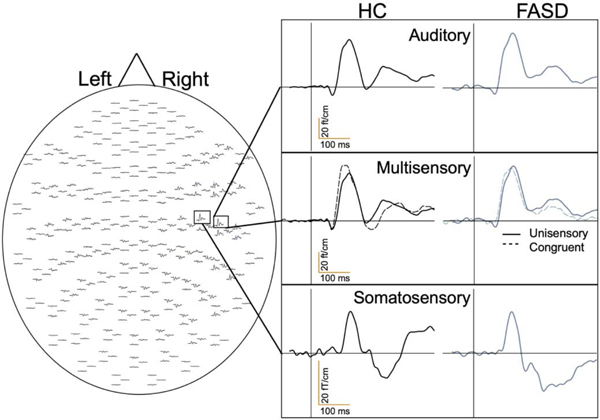
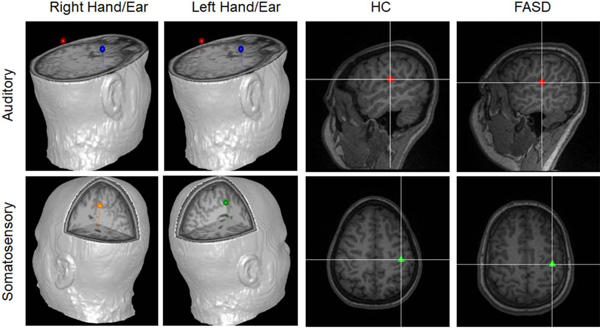
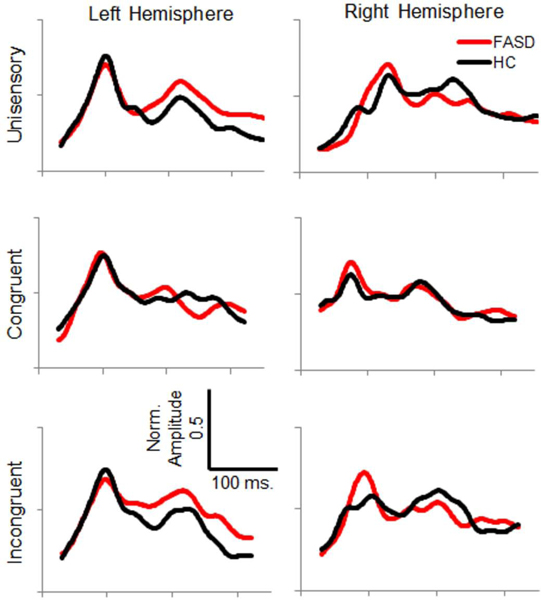
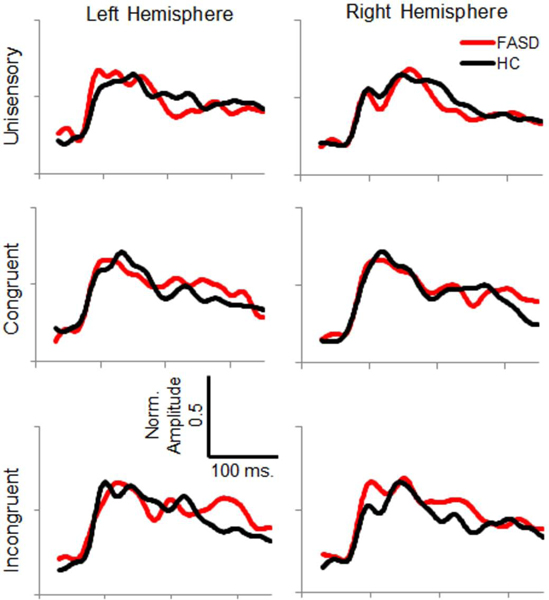
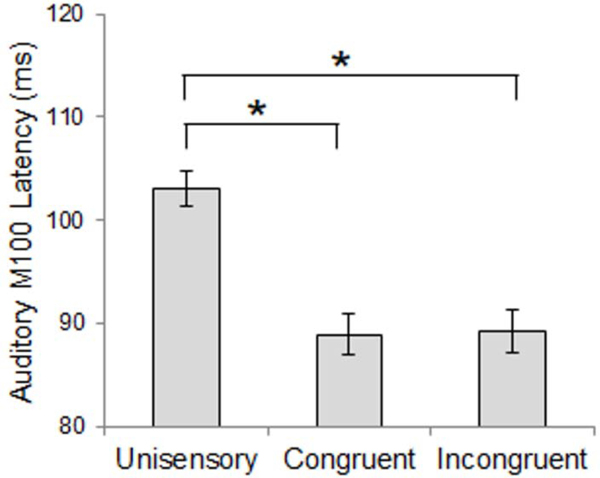
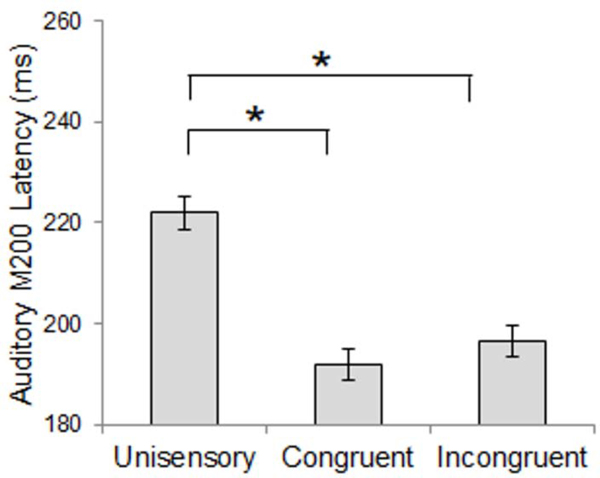
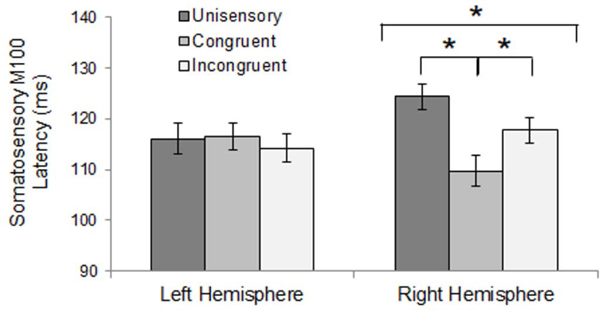
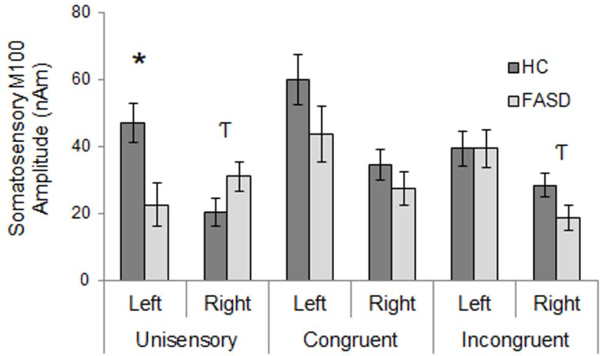
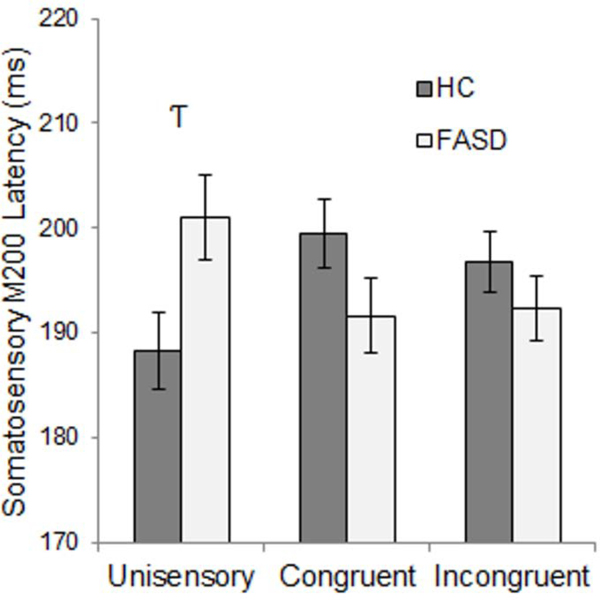
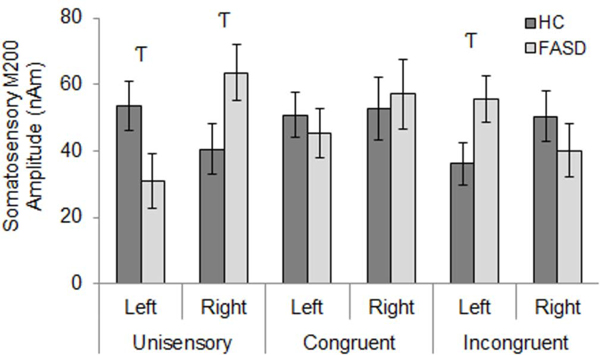
While it is generally accepted that structural and functional brain deficits underlie the behavioral deficits associated with Fetal Alcohol Spectrum Disorders (FASD), the degree to which these problems are expressed in sensory pathology is unknown. Electrophysiological measures indicate that neural processing is delayed in visual and auditory domains. Furthermore, multiple reports of white matter deficits due to prenatal alcohol exposure indicate altered cortical connectivity in individuals with FASD. Multisensory integration requires close coordination between disparate cortical areas leading us to hypothesize that individuals with FASD will have impaired multisensory integration relative to healthy control (HC) participants. Participants' neurophysiological responses were recorded using magnetoencephalography (MEG) during passive unisensory or simultaneous, spatially congruent or incongruent multisensory auditory and somatosensory stimuli. Source timecourses from evoked responses were estimated using multi-dipole spatiotemporal modeling. Auditory M100 response latency was faster for the multisensory relative to the unisensory condition but no group differences were observed. M200 auditory latency to congruent stimuli was earlier and congruent amplitude was larger in participants with FASD relative to controls. Somatosensory M100 response latency was faster in right hemisphere for multisensory relative to unisensory stimulation in both groups. FASD participants' somatosensory M200 responses were delayed by 13 ms, but only for the unisensory presentation of the somatosensory stimulus. M200 results indicate that unisensory and multisensory processing is altered in FASD; it remains to be seen if the multisensory response represents a normalization of the unisensory deficits.
Keywords: Fetal Alcohol Spectrum Disorders; auditory; magnetoencephalography; multisensory integration; somatosensory.
Copyright © 2020 IBRO. Published by Elsevier Ltd. All rights reserved.
Conflict of interest statement
None of the authors have potential conflicts of interest to be disclosed.
Figures
References
-
- Aine C, Huang M, Stephen J, Christner R (2000) Multistart algorithms for MEG empirical data analysis reliably characterize locations and time courses of multiple sources. NeuroImage 12:159–172. - PubMed
-
- Bjuland KJ, Lohaugen GC, Martinussen M, Skranes J (2013) Cortical thickness and cognition in very-low-birth-weight late teenagers. Early Hum Dev 89:371–380. - PubMed
Publication types
MeSH terms
Grants and funding
LinkOut - more resources
Full Text Sources
Medical
