


Sex and substance use behaviors among children of teen mothers: A systematic review
- PMID: 31982832
- PMCID: PMC7050959
- DOI: 10.1016/j.adolescence.2020.01.008
Sex and substance use behaviors among children of teen mothers: A systematic review
Abstract
Introduction: Adolescent birth is a known correlate of many challenging behavioral health consequences for offspring. This systematic review seeks to understanding the sex and substance use behaviors of children born to teen mothers extending the body of literature on the long-term outcomes of being born to a teen mother.
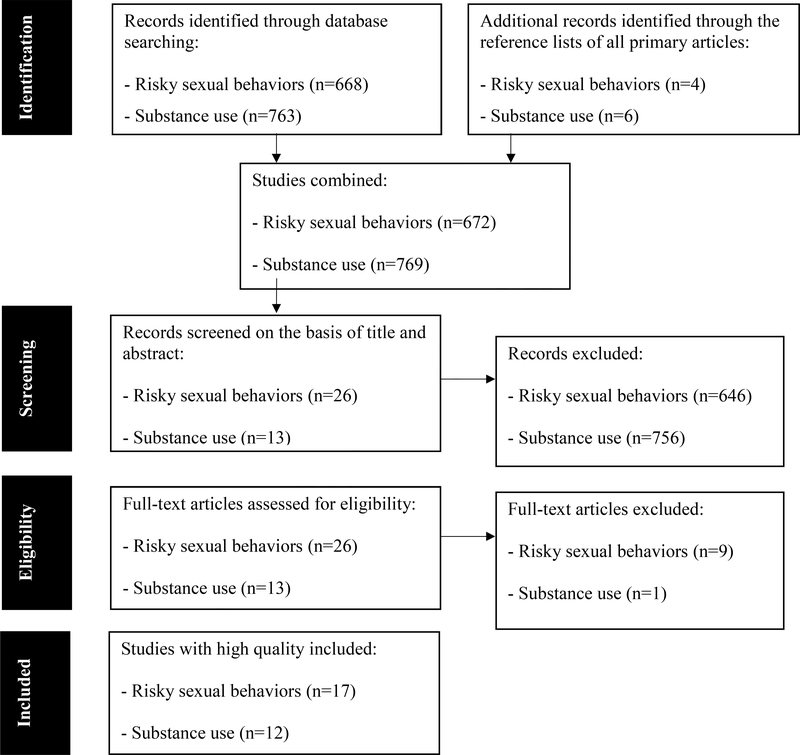
Methods: A systematic approach, in accordance with PRISMA guidelines, was used to review and identify eligible studies in the following electronic databases: Web of Science, ProQuest, PubMed, and Ovid MEDLINE. Study inclusion: (a) maternal age (>20) was the key predictor or group variable and (b) children's risky sexual or substance use behaviors were outcome variables. All articles meeting inclusion criteria were next screened using the quality assessment tool created by the Effective Public Health Practice Project.
Results: Seventeen articles reporting on risky sexual behaviors and 12 articles on substance use behaviors met inclusion criteria. We found a consistent association between being born to a teen mother and risky sexual behaviors, including early sexual debut and transitioning into motherhood during adolescence/young adulthood. The link between being born to a teen mother and substance use behaviors was inconsistent and only found in large population-based studies.
Conclusion: Teen mothers and their children have unique individual, family, and structural needs. Evidence highlights that while there is no clear need to adapt substance use prevention interventions for these children, investing in targeted adaptations of abstinence and safer sex interventions to meet the unique experiences of children of teen mothers and their children is warranted.
Keywords: Children of teen mothers; Review; Sexual health; Substance use; Teen mothers.
Copyright © 2020 The Foundation for Professionals in Services for Adolescents. Published by Elsevier Ltd. All rights reserved.
Conflict of interest statement
Declaration of competing interest No author of this manuscript has conflicts of interest to disclose. All authors participated in the data collection or analysis. The first draft of this manuscript was written by J. Cederbaum. No payment was received for the production of this manuscript. All authors have read and provided feedback; all authors consent to the submission to JOA.
References
-
- Aizer Anna; Devereux Paul J.; Salvanes Kjell G. (2019). Grandparents, mothers, or fathers? Why children of teen mothers do worse in life Working Paper Series, No. 19/08, University College Dublin, UCD Centre for Economic Research, Dublin.
-
- Armijo-Olivo S, Stiles C, Hagen N, Biondo P, & Cummings G (2012). Assessment of study quality for systematic reviews: A comparison of the Cochrane Collaboration Risk of Bias Tool and the Effective Public Health Practice Project Quality Assessment Tool: Methodological research. Journal of Evaluation in Clinical Practice, 18(1), 12–18. - PubMed
-
- Baudry C, Tarabulsy GM, Atkinson L, Pearson J, & St-Pierre A (2017). Intervention with adolescent mother-child dyads and cognitive development in early childhood: A meta-analysis. Prevention Science, 18, 116–130. - PubMed
-
- Card JJ (1981). Long-term consequences for children of teenage parents. Demography, 18(2), 137–156 - PubMed
Publication types
MeSH terms
Grants and funding
LinkOut - more resources
Full Text Sources
Medical
Miscellaneous
