


Boundaries Extend and Contract in Scene Memory Depending on Image Properties
- PMID: 31983637
- PMCID: PMC7187786
- DOI: 10.1016/j.cub.2019.12.004
Boundaries Extend and Contract in Scene Memory Depending on Image Properties
Abstract
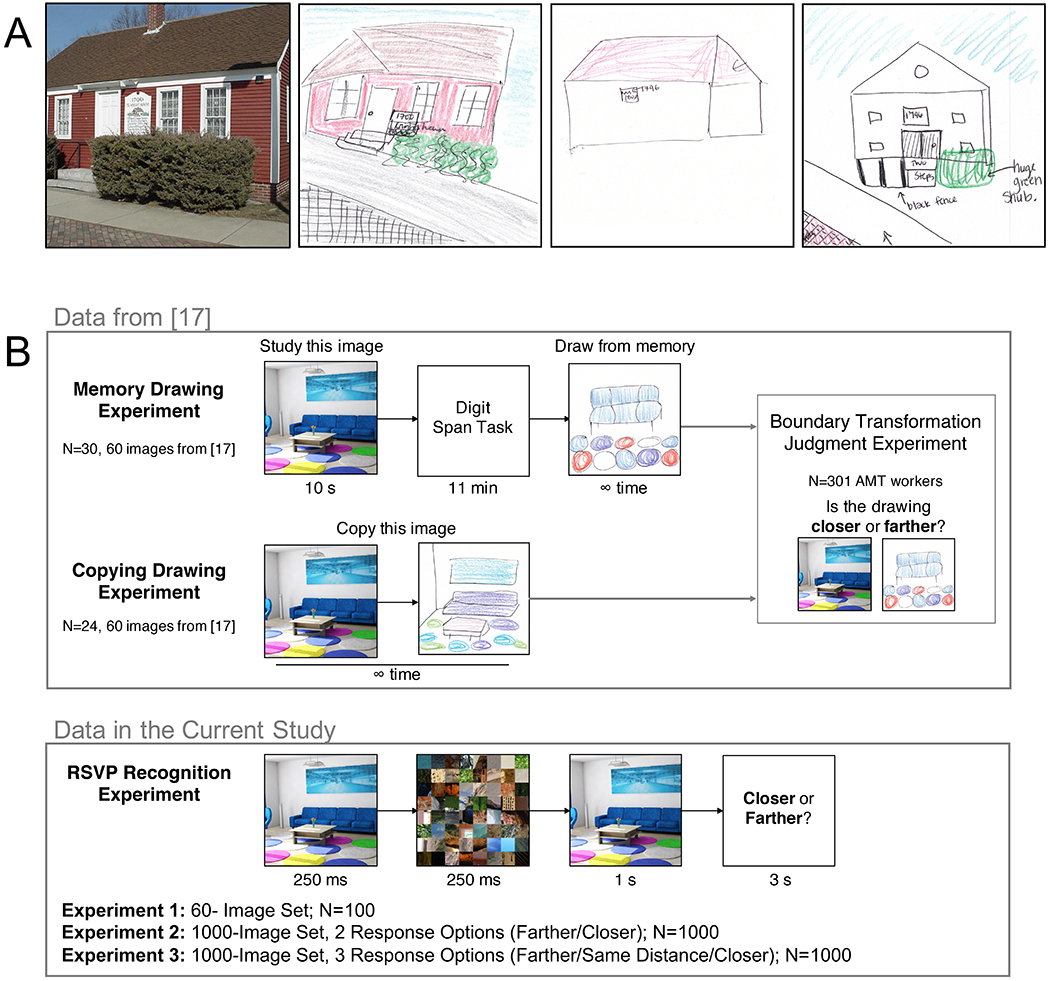
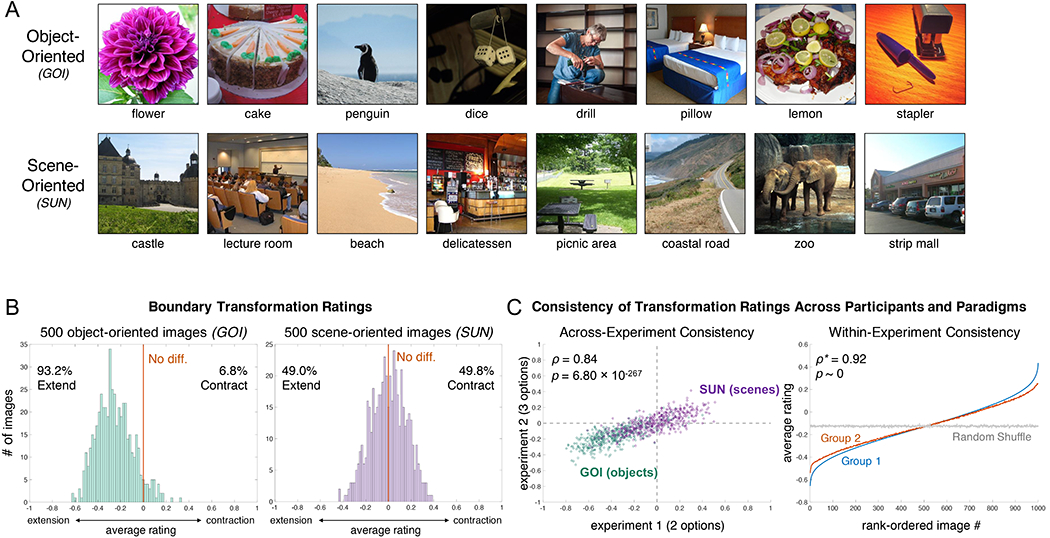
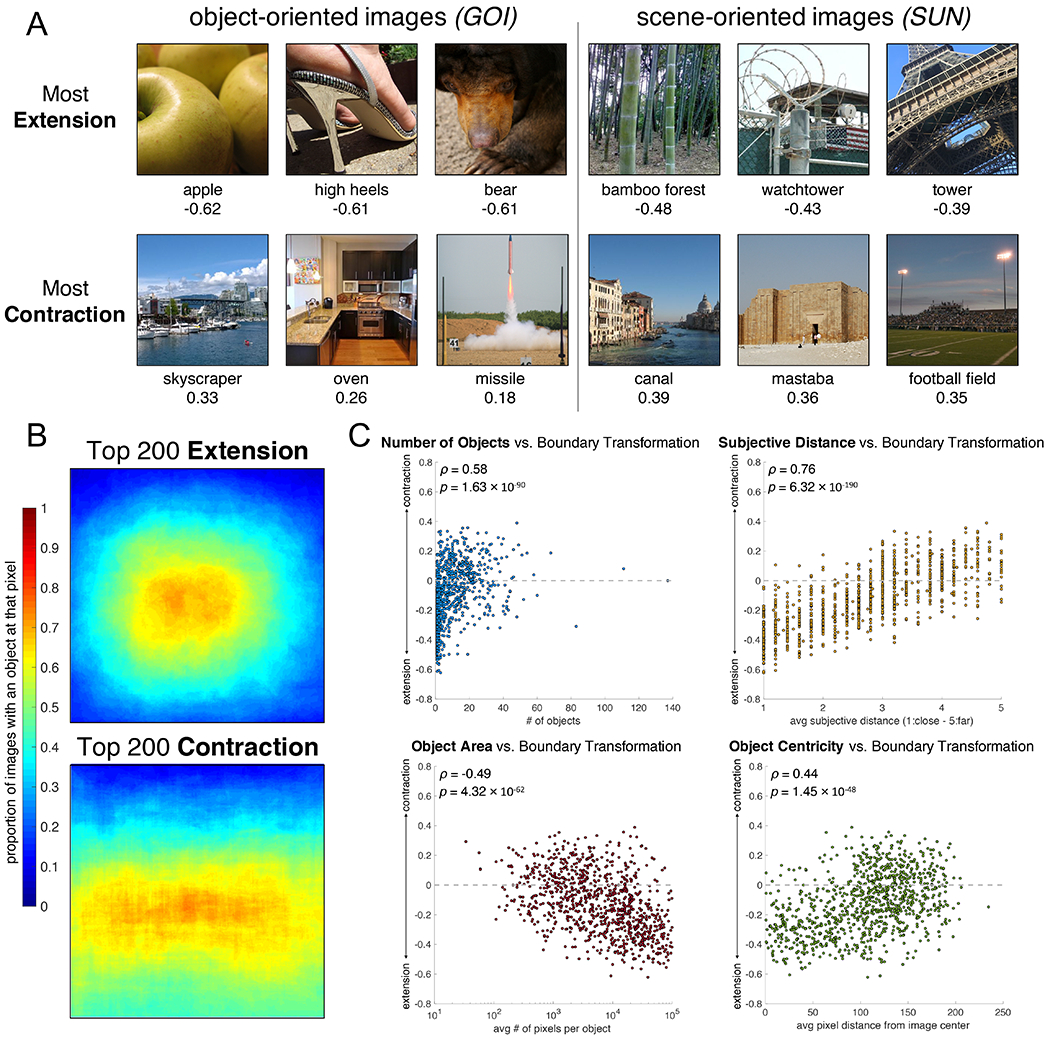
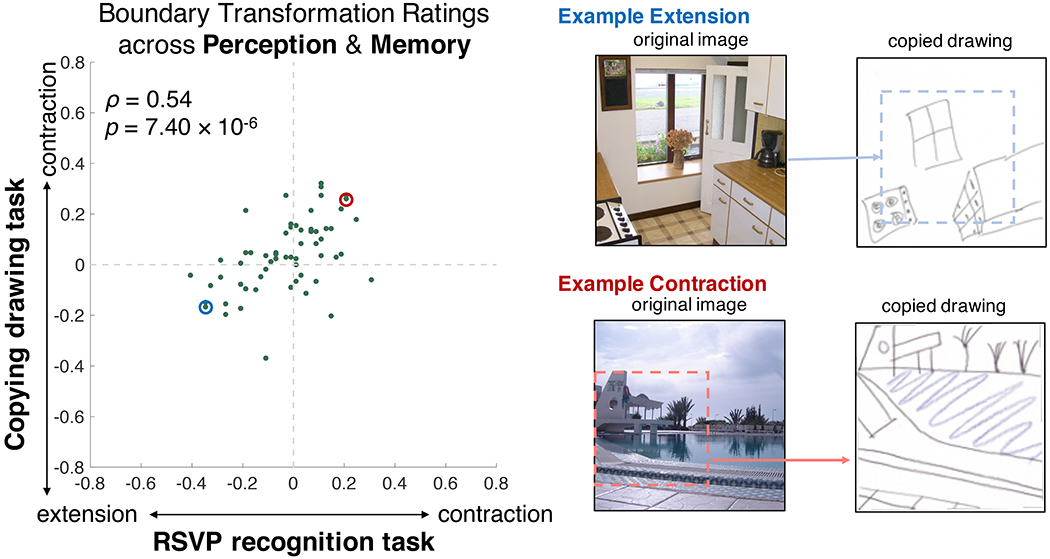
Boundary extension, a memory distortion in which observers consistently recall a scene with visual information beyond its boundaries, is widely accepted across the psychological sciences as a phenomenon revealing fundamental insight into memory representations [1-3], robust across paradigms [1, 4] and age groups [5-7]. This phenomenon has been taken to suggest that the mental representation of a scene consists of an intermingling of sensory information and a schema that extrapolates the views of a presented scene [8], and it has been used to provide evidence for the role of the neocortex [9] and hippocampus [10, 11] in the schematization of scenes during memory. However, the study of boundary extension has typically focused on object-oriented images that are not representative of our visuospatial world. Here, using a broad set of 1,000 images tested on 2,000 participants in a rapid recognition task, we discover "boundary contraction" as an equally robust phenomenon. Further, image composition largely drives whether extension or contraction is observed-although object-oriented images cause more boundary extension, scene-oriented images cause more boundary contraction. Finally, these effects also occur during drawing tasks, including a task with minimal memory load-when participants copy an image during viewing. Collectively, these results show that boundary extension is not a universal phenomenon and put into question the assumption that scene memory automatically combines visual information with additional context derived from internal schema. Instead, our memory for a scene may be largely driven by its visual composition, with a tendency to extend or contract the boundaries equally likely.
Trial registration: ClinicalTrials.gov NCT00001360.
Keywords: boundary extension; boundary transformations; drawings; memory; scenes.
Published by Elsevier Ltd.
Conflict of interest statement
Declaration of Interests The authors declare no competing interests.
Figures
Comment in
-
Searching for boundary extension.Curr Biol. 2020 Dec 21;30(24):R1463-R1464. doi: 10.1016/j.cub.2020.10.031. Curr Biol. 2020. PMID: 33352122
-
Reply to Intraub.Curr Biol. 2020 Dec 21;30(24):R1465-R1466. doi: 10.1016/j.cub.2020.10.032. Curr Biol. 2020. PMID: 33352123
References
-
- Intraub H, and Richardson M (1989). Wide-angle memories of close-up scenes. J. Exp. Psychol. Learn. Mem. Cogn 15, 179–187. - PubMed
-
- Hubbard TL, Hutchison JL, and Courtney JR (2010). Boundary extension: Findings and theories. Q. J. Exp. Psychol 63, 1467–1494. - PubMed
-
- Candel I, Merckelbach H, Houben K, and Vandyck I (2004). How children remember neutral and emotional pictures: Boundary extension in children’s scene memories. Am. J. Psychol 117, 249–257. - PubMed
Publication types
MeSH terms
Associated data
Grants and funding
LinkOut - more resources
Full Text Sources
Medical
