. 2020 Jun 1;125(7):1003-1012.
doi: 10.1093/aob/mcaa012.

Pollen on stigmas as proxies of pollinator competition and facilitation: complexities, caveats and future directions

Affiliations

Pollen on stigmas as proxies of pollinator competition and facilitation: complexities, caveats and future directions

Tia-Lynn Ashman et al. Ann Bot. .

Abstract

Background: Pollen transfer via animals is necessary for reproduction by ~80 % of flowering plants, and most of these plants live in multispecies communities where they can share pollinators. While diffuse plant-pollinator interactions are increasingly recognized as the rule rather than the exception, their fitness consequences cannot be deduced from flower visitation alone, so other proxies, functionally closer to seed production and amenable for use in a broad variety of diverse communities, are necessary.

Scope: We conceptually summarize how the study of pollen on stigmas of spent flowers can reflect key drivers and functional aspects of the plant-pollinator interaction (e.g. competition, facilitation or commensalism). We critically evaluate how variable visitation rates and other factors (pollinator pool and floral avoidance) can give rise to different relationships between heterospecific pollen and (1) conspecific pollen on the stigma and (2) conspecific tubes/grain in the style, revealing the complexity of potential interpretations. We advise on best practices for using these proxies, noting the assumptions and caveats involved in their use, and explicate what additional data are required to verify interpretation of given patterns.

Conclusions: We conclude that characterizing pollen on stigmas of spent flowers provides an attainable indirect measure of pollination interactions, but given the complex processes of pollen transfer that generate patterns of conspecific-heterospecific pollen on stigmas these cannot alone determine whether competition or facilitation are the underlying drivers. Thus, functional tests are also needed to validate these hypotheses.

Keywords: Conspecific pollen; heterospecific pollen; plant–plant interactions; plant–pollinator network; pollen transfer; pollen tube; pollination; pollinator sharing; stigmatic pollen load; visitation network.


Figures

Fig. 1.
Fig. 1.
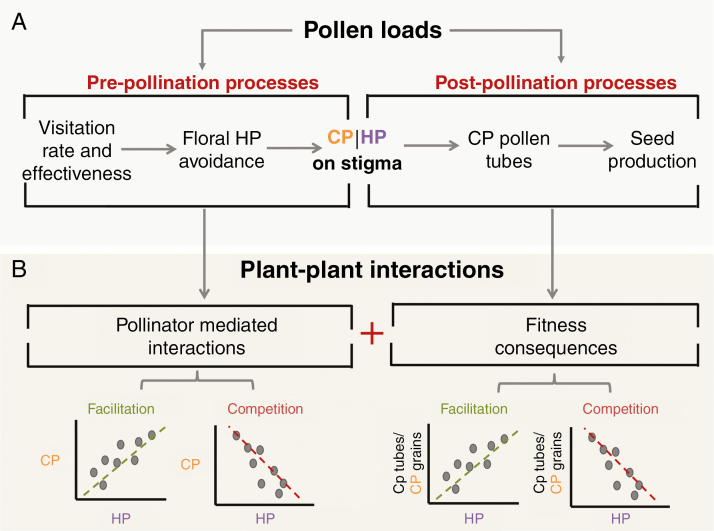
Schematic representation of the pre- and post-pollination processes in the pathway from pollen transport to seed production (A) and how these processes translate into patterns of conspecific pollen (CP) versus heterospecific pollen (HP) on the stigma or patterns of HP and CP/tubes per grain in the style (B). (A) Pre-pollination processes affect CP and HP received by flowers, whereas post-pollination interactions between CP and HP on the stigma affect the number of CP tubes or seeds produced. (B) Patterns between CP and HP grains received, and between CP tubes/grain and HP received per stigma, can reflect pollinator-mediated interactions and their fitness consequences, respectively. Such patterns have been used to infer competitive or facilitative plant–plant interactions. The focus of this paper is to clarify the diversity of drivers that can underlie these patterns (Fig. 2).
Fig. 2.
Fig. 2.
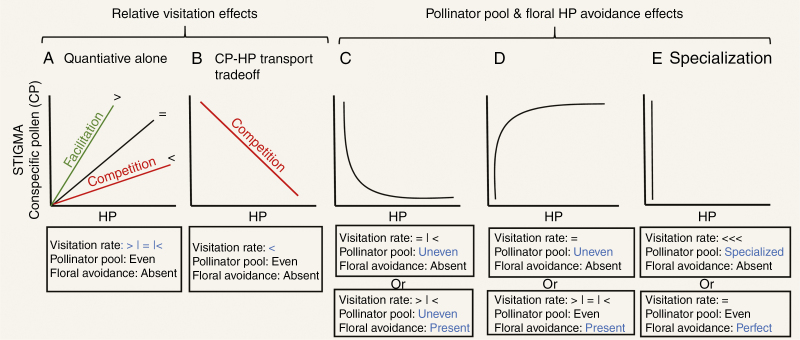
Patterns of conspecific pollen (CP) versus heterospecific pollen (HP) receipt that can be observed on stigmas of spent flowers and potential drivers of variation in these patterns. Potential drivers include variation in pollinator visitation (A, B) or variation in the pollinator pool and floral morphology (C–E). (A, B) Patterns that result from variation in quantity of pollinator visits. In (A), when visitation rate for the focal species is higher (>) or lower (<) in the presence of coflowering species, the pattern can reflect facilitation (green) or competition (red), respectively. However, in (B) lower visitation rate is accompanied by a pollen-transport trade-off leading to a negative CP–HP relationship. (C–E) CP–HP relationships when variation in pollinator pool and floral avoidance mechanisms exist regardless of visitation differences (blue for emphasis of mechanism). (C) Uneven pollinator pools combined with or without floral avoidance can lead to non-linear negative CP–HP relationships. (D) Uneven pollinator pools or presence of floral avoidance can lead to non-linear positive CP–HP relationships. (E) Extremely uneven pollinator pools or perfect floral avoidance of HP represent forms of plant–pollinator specialization and lead to the lack of a CP–HP relationship.
Fig. 3.
Fig. 3.
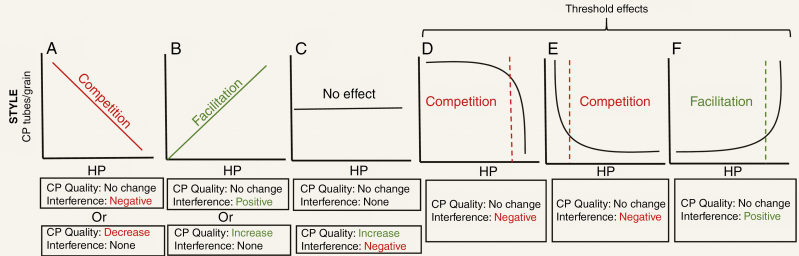
Patterns of conspecific (CP) tubes/grain versus heterospecific pollen (HP) received on stigmas of spent flowers and potential drivers of variation in these patterns. Potential drivers are CP quality and HP interference with CP, with positive interaction noted in green and negative ones in red for emphasis. In (A) increasing interference or decreasing quality of CP can lead to a negative linear CP tubes/grain–HP relationship, which can be interpreted as forms of competitive interaction. In (B) positive linear interaction between CP–HP or increasing quality of CP can lead to a positive CP tubes/grain–HP relationship, which can be interpreted as a facilitative interaction. In (D) and (E) threshold effects of HP load size on the stigma are driving non-linear patterns and no CP quality effects are at play. Dotted lines reflect the threshold number of HP grains required to cause a competitive (D, E, inference only at large or small HP load sizes, respectively) or facilitative (F, mentoring at high HP) effects.

References

    1. Aizen MA, Harder LD. 2007. Expanding the limits of the pollen-limitation concept: effects of pollen quantity and quality. Ecology 88: 271–281. - PubMed
    1. Albor C, García-Franco J, Parra-Tabla V, Díaz-Castelazo C, Arceo-Gómez G. 2019. Taxonomic and functional diversity of the co-flowering community differentially affect Cakile edentula pollination at different spatial scales. Journal of Ecology 107: 2167–2181.
    1. Alonso C, Herrera CM, Ashman T-L. 2012. A piece of the puzzle: a method for comparing pollination quality and quantity across multiple species and reproductive events. New Phytologist 193: 532–542. - PubMed
    1. Alonso C, Navarro-Fernandez CM, Arceo-Gómez G, Meindl GA, Parra-Tabla V, Ashman T-L. 2013. Among-species differences in pollen quality and quantity limitation: implications for endemics in biodiverse hotspots. Annals of Botany 112: 1461–1469. - PMC - PubMed
    1. Arceo-Gómez G, Ashman T-L. 2011. Heterospecific pollen deposition: does diversity alter the consequences? New Phytologist 192: 738–746. - PubMed

Publication types