


Pollen on stigmas as proxies of pollinator competition and facilitation: complexities, caveats and future directions
- PMID: 31985008
- PMCID: PMC7262468
- DOI: 10.1093/aob/mcaa012
Pollen on stigmas as proxies of pollinator competition and facilitation: complexities, caveats and future directions
Abstract
Background: Pollen transfer via animals is necessary for reproduction by ~80 % of flowering plants, and most of these plants live in multispecies communities where they can share pollinators. While diffuse plant-pollinator interactions are increasingly recognized as the rule rather than the exception, their fitness consequences cannot be deduced from flower visitation alone, so other proxies, functionally closer to seed production and amenable for use in a broad variety of diverse communities, are necessary.
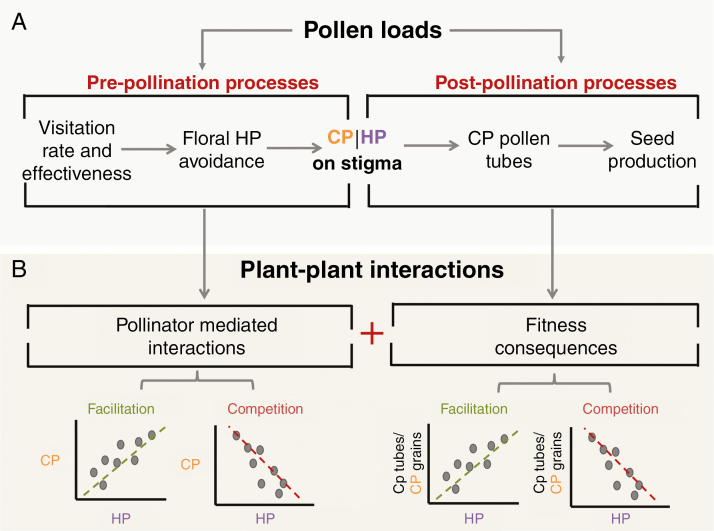
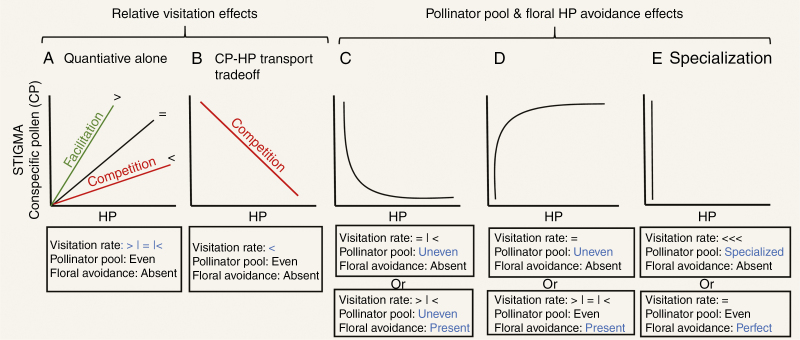
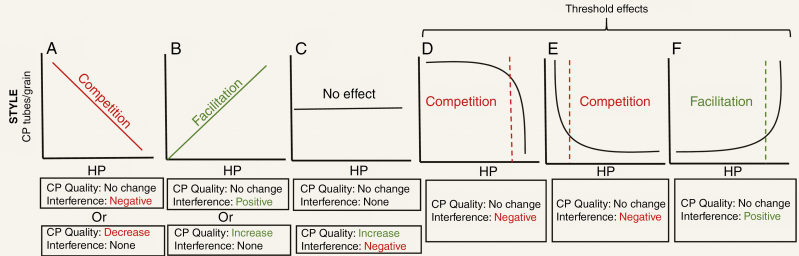
Scope: We conceptually summarize how the study of pollen on stigmas of spent flowers can reflect key drivers and functional aspects of the plant-pollinator interaction (e.g. competition, facilitation or commensalism). We critically evaluate how variable visitation rates and other factors (pollinator pool and floral avoidance) can give rise to different relationships between heterospecific pollen and (1) conspecific pollen on the stigma and (2) conspecific tubes/grain in the style, revealing the complexity of potential interpretations. We advise on best practices for using these proxies, noting the assumptions and caveats involved in their use, and explicate what additional data are required to verify interpretation of given patterns.
Conclusions: We conclude that characterizing pollen on stigmas of spent flowers provides an attainable indirect measure of pollination interactions, but given the complex processes of pollen transfer that generate patterns of conspecific-heterospecific pollen on stigmas these cannot alone determine whether competition or facilitation are the underlying drivers. Thus, functional tests are also needed to validate these hypotheses.
Keywords: Conspecific pollen; heterospecific pollen; plant–plant interactions; plant–pollinator network; pollen transfer; pollen tube; pollination; pollinator sharing; stigmatic pollen load; visitation network.
© The Author(s) 2020. Published by Oxford University Press on behalf of the Annals of Botany Company. All rights reserved. For permissions, please e-mail: journals.permissions@oup.com.
Figures
References
-
- Aizen MA, Harder LD. 2007. Expanding the limits of the pollen-limitation concept: effects of pollen quantity and quality. Ecology 88: 271–281. - PubMed
-
- Albor C, García-Franco J, Parra-Tabla V, Díaz-Castelazo C, Arceo-Gómez G. 2019. Taxonomic and functional diversity of the co-flowering community differentially affect Cakile edentula pollination at different spatial scales. Journal of Ecology 107: 2167–2181.
-
- Alonso C, Herrera CM, Ashman T-L. 2012. A piece of the puzzle: a method for comparing pollination quality and quantity across multiple species and reproductive events. New Phytologist 193: 532–542. - PubMed
-
- Arceo-Gómez G, Ashman T-L. 2011. Heterospecific pollen deposition: does diversity alter the consequences? New Phytologist 192: 738–746. - PubMed
Publication types
MeSH terms
LinkOut - more resources
Full Text Sources
