. 2020 Jan 27;16(1):e1008347.
doi: 10.1371/journal.pgen.1008347. eCollection 2020 Jan.

Comprehensive Analysis of Human Subtelomeres by Whole Genome Mapping

Affiliations

Comprehensive Analysis of Human Subtelomeres by Whole Genome Mapping

Eleanor Young et al. PLoS Genet. .

Abstract

Detailed comprehensive knowledge of the structures of individual long-range telomere-terminal haplotypes are needed to understand their impact on telomere function, and to delineate the population structure and evolution of subtelomere regions. However, the abundance of large evolutionarily recent segmental duplications and high levels of large structural variations have complicated both the mapping and sequence characterization of human subtelomere regions. Here, we use high throughput optical mapping of large single DNA molecules in nanochannel arrays for 154 human genomes from 26 populations to present a comprehensive look at human subtelomere structure and variation. The results catalog many novel long-range subtelomere haplotypes and determine the frequencies and contexts of specific subtelomeric duplicons on each chromosome arm, helping to clarify the currently ambiguous nature of many specific subtelomere structures as represented in the current reference sequence (HG38). The organization and content of some duplicons in subtelomeres appear to show both chromosome arm and population-specific trends. Based upon these trends we estimate a timeline for the spread of these duplication blocks.


Conflict of interest statement

The authors have declared that no competing interests exist.

Figures
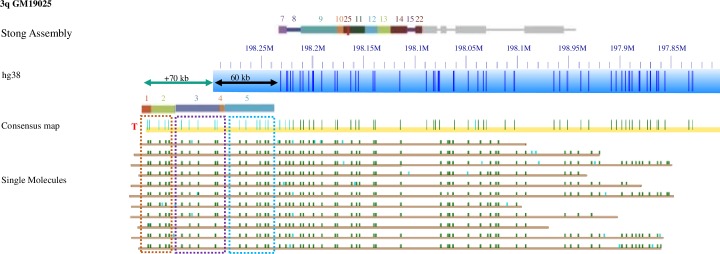
Fig 1
Fig 1. Extended haplotypes in subtelomeric regions of 3q in GM191025 supported by single molecule evidence.
Colored rectangles represent paralogy blocks defined in the subtelomere assemblies of Stong et al. [24]. The blue bar shows the hg38 reference with Nt.BsPQ1 nick sites as dark blue dashes along it. The yellow bar shows the consensus contig for this sample, with dark green marks indicating a match to the reference and lighter green/blue showing nick sites without a reference match. The colored rectangles about the yellow bar show the paralogy blocks that match the pattern seen in the extended region. The brown rows indicate single molecules, which extend well past the block regions and into the single copy region. A teal arrow shows the distance, 70kb, from the telomere as defined by the Bionano single-molecule maps to the end of the HG38 reference assembly. A black arrow represents 60 kb of unknown sequence currently in the HG38 reference as ‘N’, an estimate of gap size to the end of the chromosome. Dashed boxes on top of the molecules indicate portions of the extended region that match to paralogy blocks 1–5 but are not in the current references for 3q. A red T indicates the telomeric end of the 3q map.
Fig 2
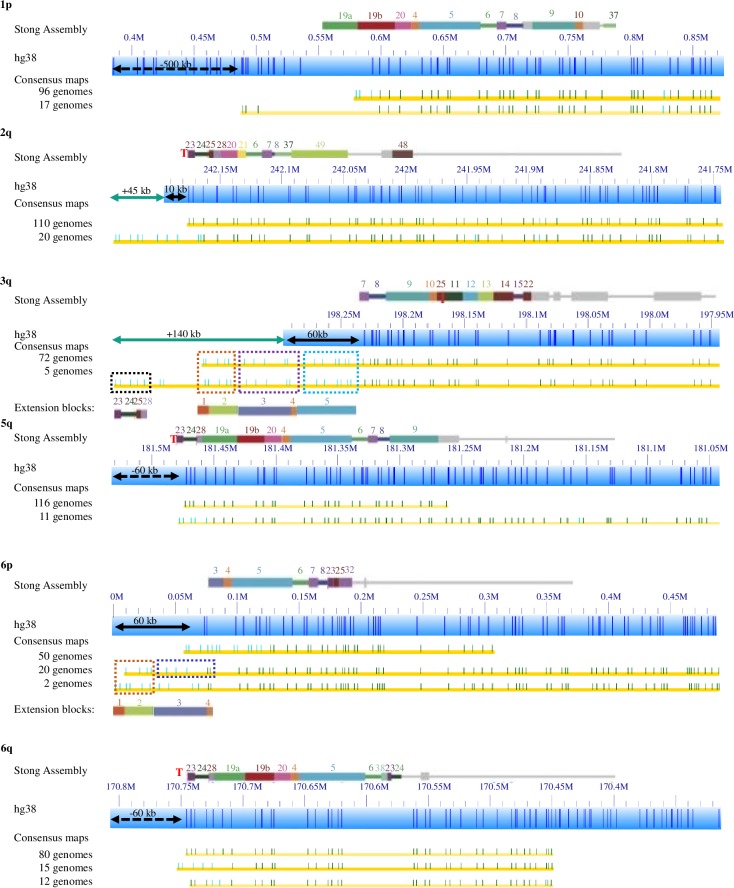
Fig 2. Major haplotypes of highly variable subtelomere regions.
The Stong et al. assembly blocks are shown as colored rectangles above blue Bionano genome mapping bars. Yellow rows with green ticks show haplotypes below these. A teal arrow indicates the size of additional extended regions not covered by the reference. A black arrow represents unknown sequence currently in the HG38 reference as ‘N’, an estimate of gap size to the end of the chromosome. If the black arrow is dashed it signifies a region of unknown telomere-adjacent gap sequence that should be deleted. A red T indicates the Stong 2014 assembly reached the telomere, and the lack of one means that assembly was unable to reach the telomere repeats. Highly variable arms 1p, 2q, 3q, 5q, 6p, and 6q are included here. Additional highly variable arms (7p, 7q, 8p, 9p, 9q, 11p, 14q, 15q, 16q, 17q, 19p, 20p) can be found in S1 Fig through S4 Fig.
Fig 3
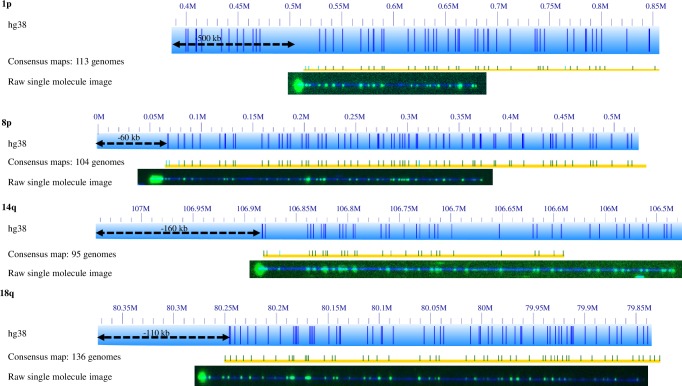
Fig 3. Telomere labeling shows inaccurate sizing of telomere-adjacent gap segments in HG38 subtelomere regions.
Blue bars represent the nick sites in hg38 reference. Yellow bars with green Nt.BsPQ1 nick sites represent the main haplotype seen in the genomes. A black dashed arrow indicated the width of the telomere-adjacent gap sequence that should be deleted from the hg38 reference. An image below the haplotype shows a single telomere labeled molecule confirming the end of the chromosome arm. These telomeres were labeled using CRISPR-Cas9 to tag the telomere repeat and incorporate a fluorophore[32]. None of the subtelomeric haplotypes for each of these arms extends past the telomere label shown here.
Fig 4
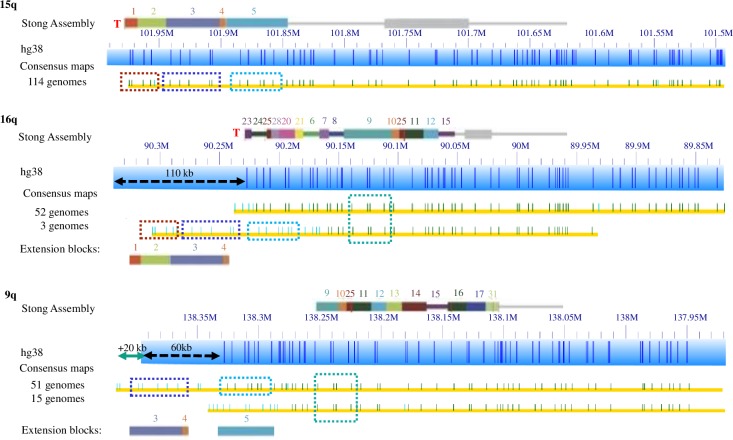
Fig 4. Distribution of paralogy block 5 in 15q, 16q and 9q.
The solid color rectangle bars show the paralogy blocks defined in the subtelomeric assemblies of Stong et al. (2014). The narrow grey line segments to the right of the colored blocks show the single-copy DNA region. Blue rectangles with dark blue lines show the HG38 reference with Nt.BsPQ1 nick sites. Paralogy block five is shown as a dashed blue rectangle on top of yellow rows representing consensus maps for particular genomes. Additional paralogy blocks are also shown as dashed colored rectangles. A teal arrow indicates the size of additional extended regions not covered by the reference. A black arrow represents unknown sequence currently in the HG38 reference as ‘N’, an estimate of gap size to the end of the chromosome. If the black arrow is dashed it signifies a region of unknown telomere-adjacent gap sequence that should be deleted.

References

    1. Azzalin CM, Reichenbach P, Khoriauli L, Giulotto E, Lingner J. Telomeric repeat containing RNA and RNA surveillance factors at mammalian chromosome ends. Science. 2007;318(5851):798–801. Epub 2007/10/06. 10.1126/science.1147182 . - DOI - PubMed
    1. Porro A, Feuerhahn S, Delafontaine J, Riethman H, Rougemont J, Lingner J. Functional characterization of the TERRA transcriptome at damaged telomeres. Nature Communications. 2014;5 10.1038/ncomms6379 WOS:000344063500001. - DOI - PMC - PubMed
    1. Porro A, Feuerhahn S, Reichenbach P, Lingner J. Molecular Dissection of Telomeric Repeat-Containing RNA Biogenesis Unveils the Presence of Distinct and Multiple Regulatory Pathways. Molecular and Cellular Biology. 2010;30(20):4808–17. 10.1128/MCB.00460-10 WOS:000282099300005. - DOI - PMC - PubMed
    1. Deng Z, Norseen J, Wiedmer A, Riethman H, Lieberman PM. TERRA RNA Binding to TRF2 Facilitates Heterochromatin Formation and ORC Recruitment at Telomeres. Molecular Cell. 2009;35(4):403–13. 10.1016/j.molcel.2009.06.025 WOS:000269432600005. - DOI - PMC - PubMed
    1. Chu H-P, Cifuentes-Rojas C, Kesner B, Aeby E, Lee H-G, Wei C, et al. TERRA RNA Antagonizes ATRX and Protects Telomeres. Cell. 2017;170(1):86–101.e16. 10.1016/j.cell.2017.06.017 . - DOI - PMC - PubMed

Publication types