


Left Atrial Volume, Cardiorespiratory Fitness, and Diastolic Function in Healthy Individuals: The HUNT Study, Norway
- PMID: 31986991
- PMCID: PMC7033857
- DOI: 10.1161/JAHA.119.014682
Left Atrial Volume, Cardiorespiratory Fitness, and Diastolic Function in Healthy Individuals: The HUNT Study, Norway
Erratum in
-
Correction to: Left Atrial Volume, Cardiorespiratory Fitness, and Diastolic Function in Healthy Individuals: The HUNT Study, Norway.J Am Heart Assoc. 2020 Nov 3;9(21):e014627. doi: 10.1161/JAHA.119.014627. Epub 2020 Oct 17. J Am Heart Assoc. 2020. PMID: 33070672 Free PMC article. No abstract available.
Abstract
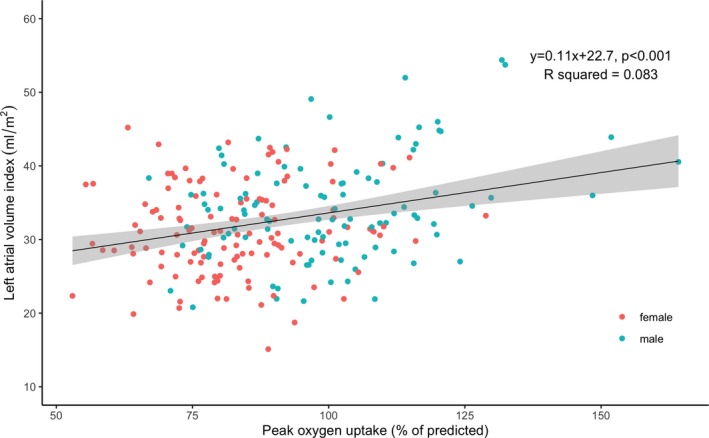
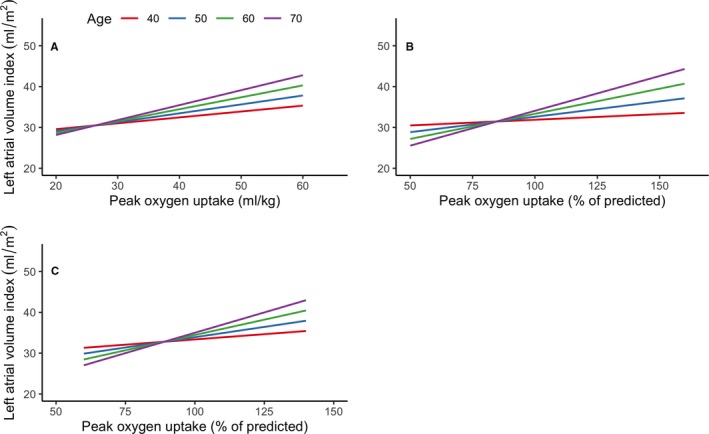
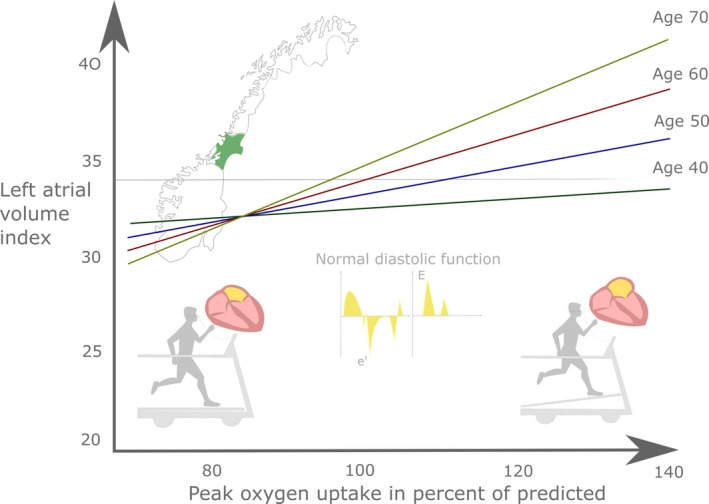
Background Left atrial (LA) size and cardiorespiratory fitness (CRF) are predictors of future cardiovascular events in high-risk populations. LA dilatation is a diagnostic criterion for left ventricular diastolic dysfunction. However, LA is dilated in endurance athletes with high CRF, but little is known about the association between CRF and LA size in healthy, free-living individuals. We hypothesized that in a healthy population, LA size was associated with CRF and leisure-time physical activity, but not with echocardiographic indexes of left ventricular diastolic dysfunction. Methods and Results In this cross-sectional study from HUNT (Nord-Trøndelag Health Study), 107 men and 138 women, aged 20 to 82 years, without hypertension, cardiovascular, pulmonary, or malignant disease participated. LA volume was assessed by echocardiography and indexed to body surface area LAVI (left atrial volume index). CRF was measured as peak oxygen uptake (VO2peak) using ergospirometry, and percent of age- and-sex-predicted VO2peak was calculated. Indexes of left ventricular diastolic dysfunction were assessed in accordance with latest recommendations. LAVI was >34 mL/m2 in 39% of participants, and LAVI was positively associated with VO2peak and percentage of age- and-sex-predicted VO2peak (β [95% CI], 0.11 [0.06-0.16] and 0.18 [0.09-0.28], respectively) and weighted minutes of physical activity per week (β [95% CI], 0.01 [0.003-0.015]). LAVI was not associated with other indexes of left ventricular diastolic dysfunction. There was an effect modification between age and VO2peak/percentage of age- and-sex-predicted VO2peak showing higher LAVI with advanced age and higher VO2peak/percentage of age- and-sex-predicted VO2peak as presented in prediction diagrams. Conclusions Interpretation of LAVI as a marker of diastolic dysfunction should be done in relation to age-relative CRF. Studies on the prognostic value of LAVI in fit subpopulations are needed.
Keywords: echocardiography; endurance training; exercise; heart; physical activity.
Figures
References
-
- Møller JE, Hillis GS, Oh JK, Seward JB, Reeder GS, Wright RS, Park SW, Bailey KR, Pellikka PA. Left atrial volume: a powerful predictor of survival after acute myocardial infarction. Circulation. 2003;107:2207–2212. - PubMed
-
- Poulsen MK, Dahl JS, Henriksen JE, Hey TM, Høilund‐Carlsen PF, Beck‐Nielsen H, Møller JE. Left atrial volume index: relation to long‐term clinical outcome in type 2 diabetes. J Am Coll Cardiol. 2013;62:2416–2421. - PubMed
-
- Tsang TSM, Abhayaratna WP, Barnes ME, Miyasaka Y, Gersh BJ, Bailey KR, Cha SS, Seward JB. Prediction of cardiovascular outcomes with left atrial size. J Am Coll Cardiol. 2006;47:1018–1023. - PubMed
-
- Tsang TSM, Barnes ME, Gersh BJ, Bailey KR, Seward JB. Left atrial volume as a morphophysiologic expression of left ventricular diastolic dysfunction and relation to cardiovascular risk burden. Am J Cardiol. 2002;90:1284–1289. - PubMed
-
- Abhayaratna WP, Seward JB, Appleton CP, Douglas PS, Oh JK, Tajik AJ, Tsang TSM. Left atrial size. J Am Coll Cardiol. 2006;47:2357–2363. - PubMed
Publication types
MeSH terms
LinkOut - more resources
Full Text Sources
