


Global longitudinal strain correlates to systemic right ventricular function
- PMID: 31987049
- PMCID: PMC6986040
- DOI: 10.1186/s12947-020-0186-7
Global longitudinal strain correlates to systemic right ventricular function
Abstract
Background: The aim of this retrospective study was to evaluate the relationship between right ventricular function derived from cardiac magnetic resonance imaging (CMR), echocardiography and exercise stress test performance, NT-proBNP (N-terminal proB-type natriuretic peptide) level and NYHA class in patients with a systemic right ventricle.
Methods: All patients with congenitally corrected transposition of the great arteries (ccTGA), or transposition of the great arteries after Mustard or Senning procedures, (TGA) followed at our centre who had undergone CMR, echocardiography, an exercise stress test and blood sampling, were included in the study.
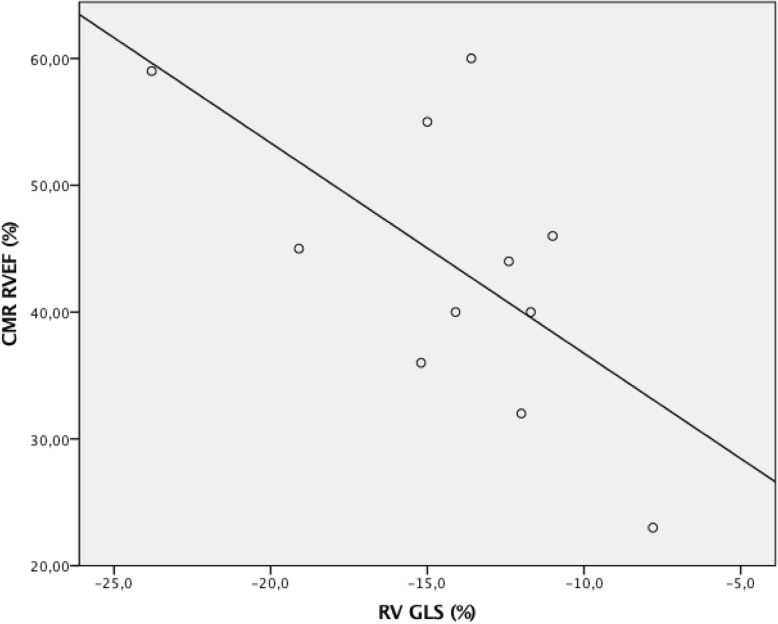
Results: We examined 11 patients (six after the Senning procedure, one after the Mustard procedure, and four ccTGA) who have a median age of 32 years (22-67 years). A significant correlation was observed between the systemic ventricular function, expressed as the CMR-derived right ventricular ejection fraction and the right ventricular global longitudinal strain (r= -0.627; p=0.039).
Conclusion: We have demonstrated that in patients with ccTGA or TGA right ventricular global longitudinal strain may be useful in the evaluation of the systemic right ventricular function.
Keywords: Atrial switch; Echocardiography; Global longitudinal strain; Systemic right ventricle.
Conflict of interest statement
None to declare.
Figures
References
-
- Diller GP, Radojevic J, Kempny A, Alonso-Gonzalez R, Emmanouil L, Orwat S, et al. Systemic right ventricular longitudinal strain is reduced in adults with transposition of the great arteries, relates to subpulmonary ventricular function, and predicts adverse clinical outcome. Am Heart J. 2012;163(5):859–866. doi: 10.1016/j.ahj.2012.01.038. - DOI - PubMed
MeSH terms
LinkOut - more resources
Full Text Sources
Research Materials
