


Diversity buffers winegrowing regions from climate change losses
- PMID: 31988113
- PMCID: PMC7022210
- DOI: 10.1073/pnas.1906731117
Diversity buffers winegrowing regions from climate change losses
Erratum in
-
Correction to Supporting Information for Morales-Castilla et al., Diversity buffers winegrowing regions from climate change losses.Proc Natl Acad Sci U S A. 2020 Dec 1;117(48):30860. doi: 10.1073/pnas.2019721117. Epub 2020 Nov 9. Proc Natl Acad Sci U S A. 2020. PMID: 33168736 Free PMC article. No abstract available.
Abstract
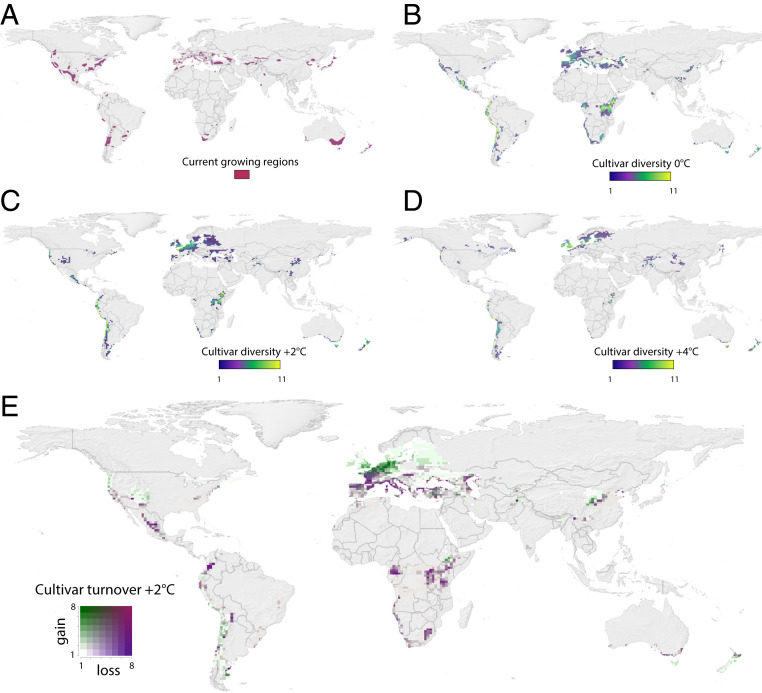
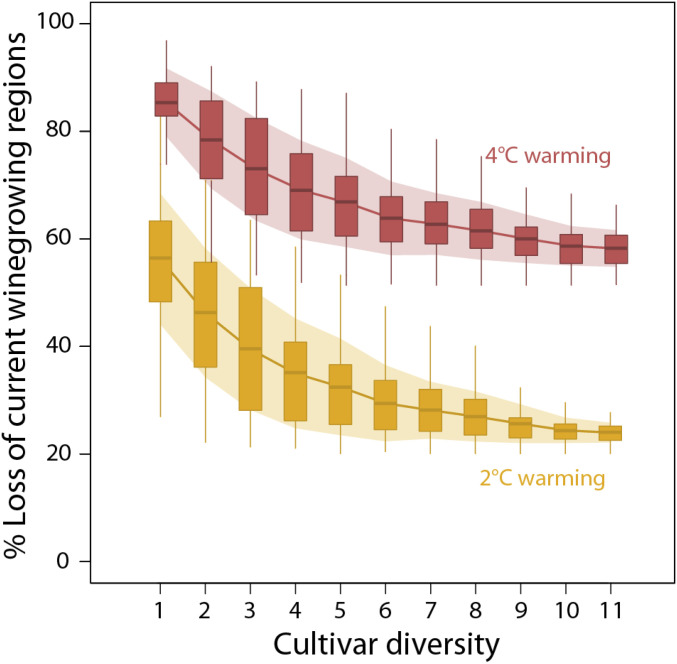
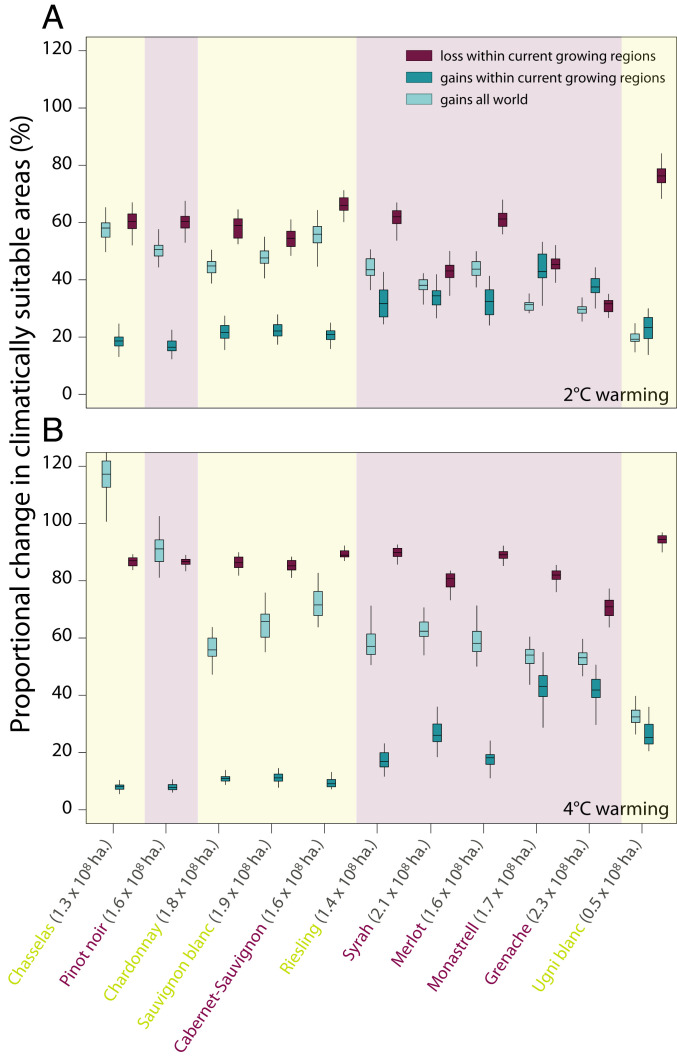
Agrobiodiversity-the variation within agricultural plants, animals, and practices-is often suggested as a way to mitigate the negative impacts of climate change on crops [S. A. Wood et al., Trends Ecol. Evol. 30, 531-539 (2015)]. Recently, increasing research and attention has focused on exploiting the intraspecific genetic variation within a crop [Hajjar et al., Agric. Ecosyst. Environ. 123, 261-270 (2008)], despite few relevant tests of how this diversity modifies agricultural forecasts. Here, we quantify how intraspecific diversity, via cultivars, changes global projections of growing areas. We focus on a crop that spans diverse climates, has the necessary records, and is clearly impacted by climate change: winegrapes (predominantly Vitis vinifera subspecies vinifera). We draw on long-term French records to extrapolate globally for 11 cultivars (varieties) with high diversity in a key trait for climate change adaptation-phenology. We compared scenarios where growers shift to more climatically suitable cultivars as the climate warms or do not change cultivars. We find that cultivar diversity more than halved projected losses of current winegrowing areas under a 2 °C warming scenario, decreasing areas lost from 56 to 24%. These benefits are more muted at higher warming scenarios, reducing areas lost by a third at 4 °C (85% versus 58%). Our results support the potential of in situ shifting of cultivars to adapt agriculture to climate change-including in major winegrowing regions-as long as efforts to avoid higher warming scenarios are successful.
Keywords: agriculture; agrobiodiversity; climate change adaptation; phenology; resilience.
Conflict of interest statement
The authors declare no competing interest.
Figures
References
-
- Food and Agriculture Organization of the United Nations , “The contribution of plant genetic resources for food and agriculture to food security and sustainable agricultural development” in The Second Report on the State of the World’s Plant Genetic Resources for Food and Agriculture (Food and Agriculture Organization of the United Nations, Rome, Italy: 2010), pp. 182–201; http://www.fao.org/docrep/013/i1500e/i1500e08.pdf.
-
- Wood S. A., et al. , Functional traits in agriculture: Agrobiodiversity and ecosystem services. Trends Ecol. Evol. 30, 531–539 (2015). - PubMed
-
- Hajjar R., Jarvis D. I., Gemmill-Herren B., The utility of crop genetic diversity in maintaining ecosystem services. Agric. Ecosyst. Environ. 123, 261–270 (2008).
-
- Godfray H. C. J., et al. , Food security: The challenge of feeding 9 billion people. Science 327, 812–818 (2010). - PubMed
-
- Lobell D. B., et al. , Prioritizing climate change adaptation needs for food security in 2030. Science 319, 607–610 (2008). - PubMed
Publication types
MeSH terms
LinkOut - more resources
Full Text Sources
Medical
