. 2020 Feb 11;117(6):2906-2913.
doi: 10.1073/pnas.1914282117. Epub 2020 Jan 27.

An RNA polymerase ribozyme that synthesizes its own ancestor

Affiliations

An RNA polymerase ribozyme that synthesizes its own ancestor

Katrina F Tjhung et al. Proc Natl Acad Sci U S A. .

Abstract

The RNA-based organisms from which modern life is thought to have descended would have depended on an RNA polymerase ribozyme to copy functional RNA molecules, including copying the polymerase itself. Such a polymerase must have been capable of copying structured RNAs with high efficiency and high fidelity to maintain genetic information across successive generations. Here the class I RNA polymerase ribozyme was evolved in vitro for the ability to synthesize functional ribozymes, resulting in the markedly improved ability to synthesize complex RNAs using nucleoside 5'-triphosphate (NTP) substrates. The polymerase is descended from the class I ligase, which contains the same catalytic core as the polymerase. The class I ligase can be synthesized by the improved polymerase as three separate RNA strands that assemble to form a functional ligase. The polymerase also can synthesize the complement of each of these three strands. Despite this remarkable level of activity, only a very small fraction of the assembled ligases retain catalytic activity due to the presence of disabling mutations. Thus, the fidelity of RNA polymerization should be considered a major impediment to the construction of a self-sustained, RNA-based evolving system. The propagation of heritable information requires both efficient and accurate synthesis of genetic molecules, a requirement relevant to both laboratory systems and the early history of life on Earth.

Keywords: RNA enzyme; RNA replication; directed evolution.


Conflict of interest statement

The authors declare no competing interest.

Figures
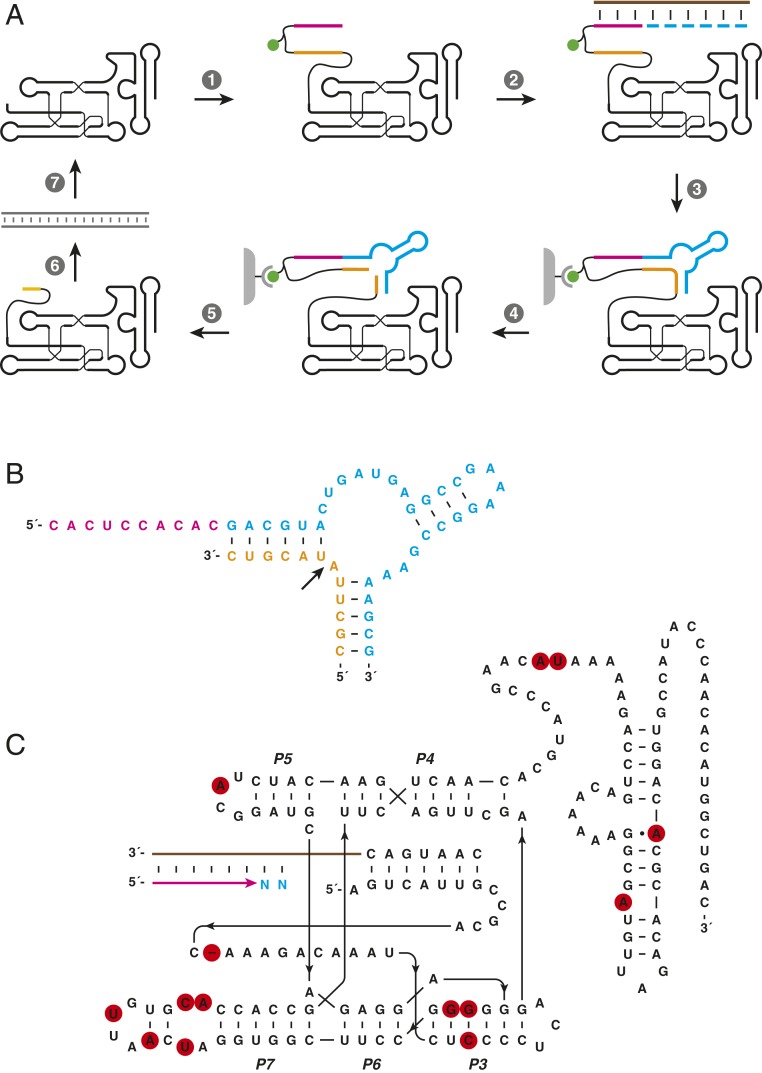
Fig. 1.
Fig. 1.
In vitro evolution of the 38-6 RNA polymerase ribozyme. (A) Scheme for selective amplification of polymerase ribozymes that synthesize a functional hammerhead ribozyme. (1) Attachment to the polymerase of an RNA primer (magenta), biotin (green), and the RNA substrate (orange) to be cleaved by the hammerhead. (2) Hybridization of the primer to an RNA template (brown) that encodes the hammerhead. (3) Extension of the primer by polymerization of NTPs (cyan), followed by biotin capture on streptavidin magnetic beads (gray). (4) Cleavage of the attached RNA substrate by the hammerhead, releasing the polymerase from the beads. (5) Recovery of functional polymerases. (6) Reverse transcription and PCR amplification. (7) Transcription to generate progeny polymerases. (B) Sequence and secondary structure of the hammerhead ribozyme (cyan), together with the primer used to initiate its synthesis and the RNA substrate. The arrow indicates the site of cleavage. (C) Sequence and secondary structure of the 38-6 RNA polymerase. Red circles indicate mutations relative to the 24-3 polymerase (14). Stem elements P3–P7 within the core domain are labeled.
Fig. 2.
Fig. 2.
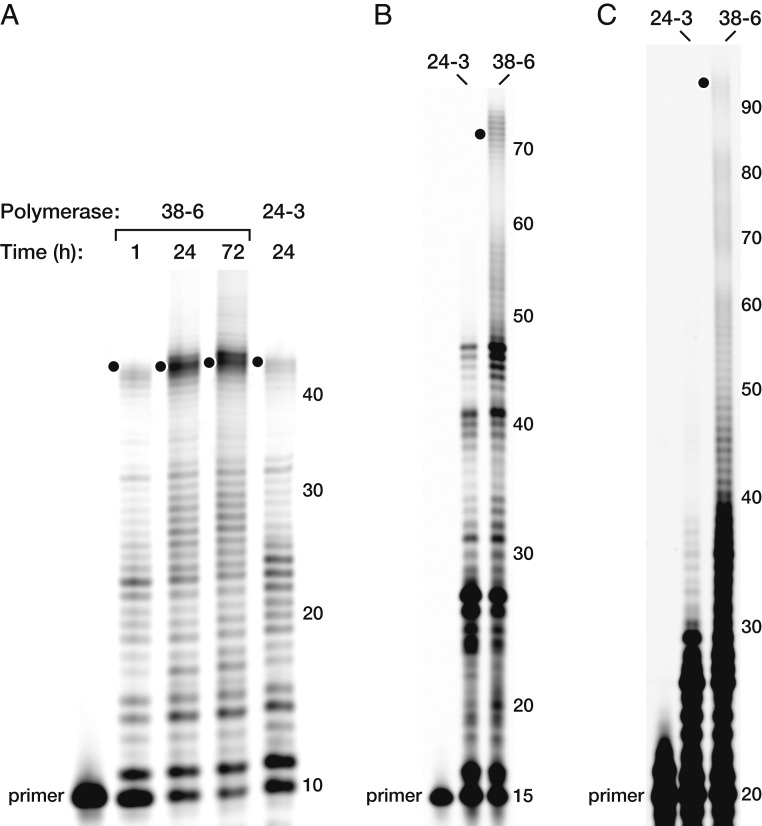
Synthesis of functional RNAs molecules by the 24-3 and 38-6 polymerases. (A) Synthesis of the hammerhead ribozyme, as shown in Fig. 1B. (B) Synthesis of yeast phenylalanyl-tRNA after 5 d. (C) Synthesis of the class I ligase after 5 d. Reaction conditions: 100 nM polymerase, 80 nM primer, 100 nM template, 4 mM each NTP, and 200 mM MgCl2 at pH 8.3 and 17 °C. Numbers at the right indicate product lengths, including the primer. Black dots indicate full-length products.
Fig. 3.
Fig. 3.
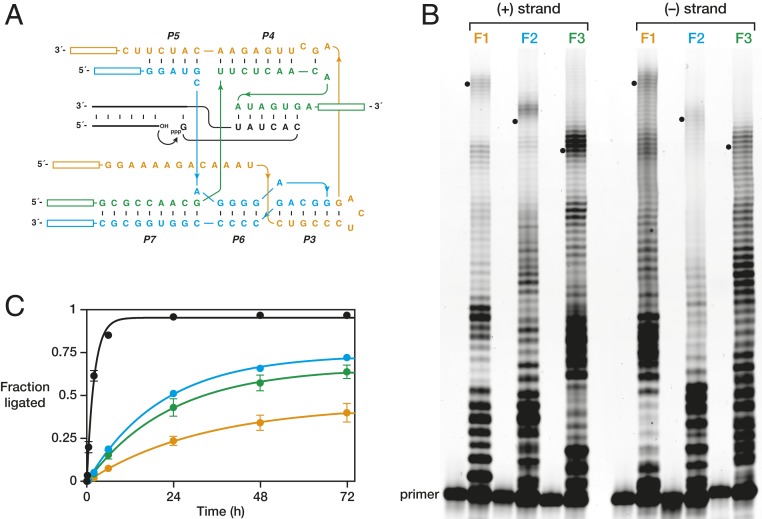
Synthesis of the three-fragment form of the class I ligase ribozyme by the 38-6 polymerase. (A) Sequence and secondary structure of the class I ligase, divided into fragments 1 (orange), 2 (cyan), and 3 (green), each with flanking primer regions of 12 nucleotides each (boxes). The substrates for ligation are shown in black, with a curved arrow indicating the site of ligation. (B) Synthesis of each of the three fragments (+strand) and their complements (−strand) by the 38-6 polymerase. Reaction conditions: 100 nM polymerase, 80 nM primer, 100 nM template, 4 mM each NTP, and 200 mM MgCl2 at pH 8.3 and 17 °C for 3 d. Black dots indicate full-length products. (C) Activity of the three-fragment ligase ribozyme, either with all fragments synthesized by T7 RNA polymerase protein (black, kobs = 0.49 ± 0.02 h−1) or with two fragments synthesized by the protein and the third synthesized by the 38-6 polymerase (fragment 1, orange, kobs = 0.031 ± 0.004 h−1; fragment 2, cyan, kobs = 0.049 ± 0.001 h−1; fragment 3, green, kobs = 0.043 ± 0.004 h−1). Values are based on three replicates, with SE. Reaction conditions: 1 µM each fragment, 20 µM 5′-substrate (S2), 80 µM 3′-substrate with attached template (S3), 60 mM MgCl2, 200 mM KCl, and 0.6 mM EDTA at pH 8.3 and 23 °C.
Fig. 4.
Fig. 4.
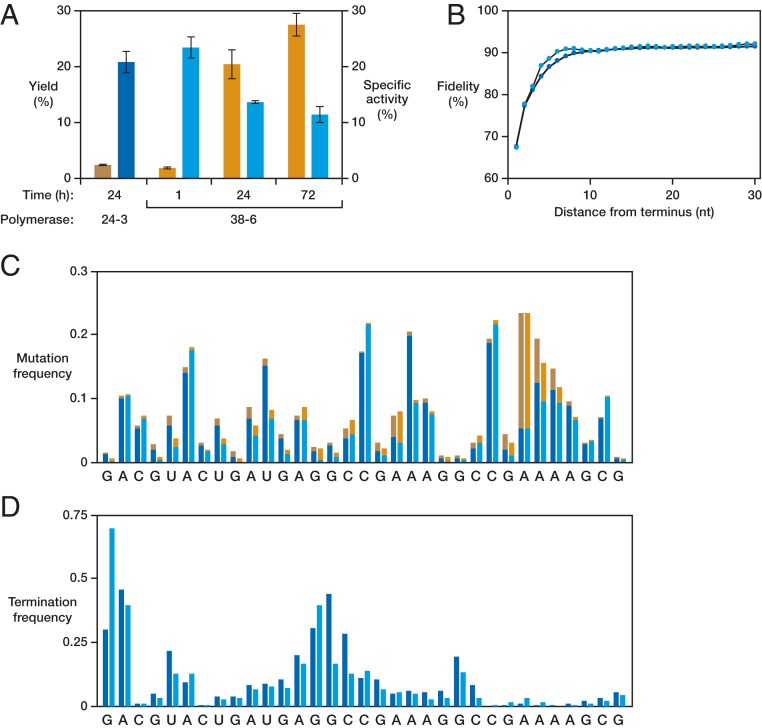
Synthesis of the hammerhead ribozyme by the 24-3 and 38-6 polymerases. (A) Yield and specific activity of synthesized products. Yield (orange) is the percent primer extended to give the full-length hammerhead, as shown in Fig. 1B. Specific activity (blue) is the initial rate of reaction, under multiple-turnover conditions, of the ribozyme-synthesized hammerhead relative to that of the protein-synthesized hammerhead (for which kobs = 0.38 min−1). Values are the average of three replicates, with SD. Reaction conditions: 10 to 100 nM hammerhead ribozyme, 4 µM RNA substrate, and 20 mM MgCl2 at pH 8.0 and 23 °C. (B) Fidelity as a function of distance from the 3′-terminal nucleotide for all partial- and full-length products synthesized by either 24-3 in 24 h (dark blue) or 38-6 in 1 h (light blue). Values are the average fidelity per nucleotide within the specified distance upstream from the terminus. (C) Positional mutation frequencies across the entire hammerhead sequence, with substitutions shown in blue and insertions/deletions shown in orange, for 24-3 (darker colors) and 38-6 (lighter colors). (D) Positional termination frequencies across the hammerhead sequence for 24-3 (dark blue) and 38-6 (light blue). Termination frequency is the probability that extension ended immediately before the indicated nucleotide, as determined by analysis of the extension products by high-resolution PAGE (Fig. 2A).

References

    1. Gilbert W., Origin of life: The RNA world. Nature 319, 618 (1986).
    1. Joyce G. F., The antiquity of RNA-based evolution. Nature 418, 214–221 (2002). - PubMed
    1. Joyce G. F., Szostak J. W., Protocells and RNA self-replication. Cold Spring Harb. Perspect. Biol. 10, a034801 (2018). - PMC - PubMed
    1. Eigen M., Self-organization of matter and the evolution of biological macromolecules. Naturwissenschaften 58, 465–523 (1971). - PubMed
    1. Joyce G. F., Bit by bit: The Darwinian basis of life. PLoS Biol. 10, e1001323 (2012). - PMC - PubMed

Publication types

LinkOut - more resources