Review
. 2020 Jan 20:17:2.
doi: 10.1186/s12979-020-0173-8. eCollection 2020.

Contributions of Age-Related Thymic Involution to Immunosenescence and Inflammaging

Affiliations
Review

Contributions of Age-Related Thymic Involution to Immunosenescence and Inflammaging

Rachel Thomas et al. Immun Ageing. .

Abstract

Immune system aging is characterized by the paradox of immunosenescence (insufficiency) and inflammaging (over-reaction), which incorporate two sides of the same coin, resulting in immune disorder. Immunosenescence refers to disruption in the structural architecture of immune organs and dysfunction in immune responses, resulting from both aged innate and adaptive immunity. Inflammaging, described as a chronic, sterile, systemic inflammatory condition associated with advanced age, is mainly attributed to somatic cellular senescence-associated secretory phenotype (SASP) and age-related autoimmune predisposition. However, the inability to reduce senescent somatic cells (SSCs), because of immunosenescence, exacerbates inflammaging. Age-related adaptive immune system deviations, particularly altered T cell function, are derived from age-related thymic atrophy or involution, a hallmark of thymic aging. Recently, there have been major developments in understanding how age-related thymic involution contributes to inflammaging and immunosenescence at the cellular and molecular levels, including genetic and epigenetic regulation, as well as developments of many potential rejuvenation strategies. Herein, we discuss the research progress uncovering how age-related thymic involution contributes to immunosenescence and inflammaging, as well as their intersection. We also describe how T cell adaptive immunity mediates inflammaging and plays a crucial role in the progression of age-related neurological and cardiovascular diseases, as well as cancer. We then briefly outline the underlying cellular and molecular mechanisms of age-related thymic involution, and finally summarize potential rejuvenation strategies to restore aged thymic function.

Keywords: Age-related thymic involution; Central tolerance; Immunosenescence and inflammaging; Negative selection and regulatory T (Treg) cell generation; Rejuvenation; Thymic aging.


Figures

Fig. 1
Fig. 1
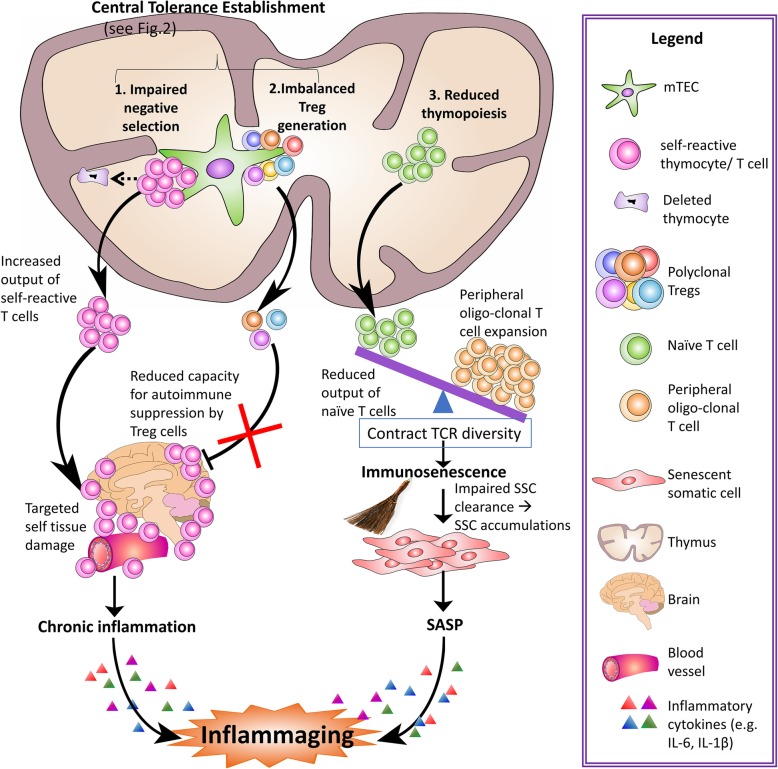
Intersection of immunosenescence and inflammaging is associated with age-related thymic involution. The aged, involuted thymus exhibits ineffective central tolerance and declined thymopoiesis. The ineffective central tolerance includes (1) impaired negative selection, which leads to the increased output of self-reactive T cells that attack self-tissues/organs, and (2) imbalanced generation of tTreg TCR repertoire, which fails to sufficiently suppress self-reactive T cell–mediated autoimmune responses. Autoimmune responses lead to tissue damage and thus cause chronic inflammation, which is one of the contributors to inflammaging. Reduced thymopoiesis leads to decreased output of naïve T cells for the clearance of senescent somatic cells (SSCs) and the expansion of oligo-clonal T cells in the aged periphery lack sufficient clearance capacity, which allows for SSC accumulation. SSCs are an important source of SASP, another contributor to inflammaging
Fig. 2
Fig. 2
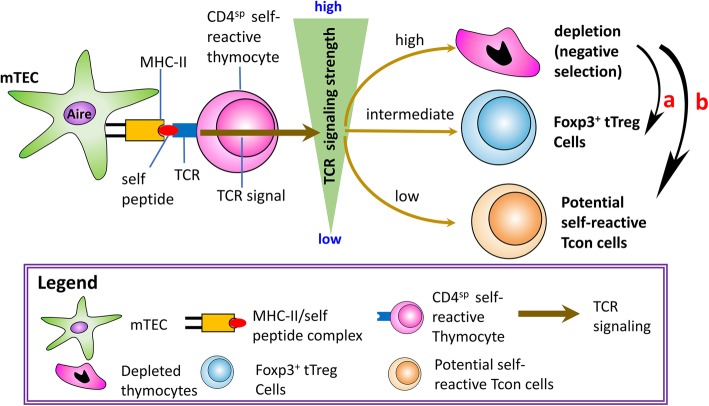
TCR signaling strength decides self-reactive CD4sp T clone fates. Interaction between MHC-II/self peptide complex on mTEC and self-reactive TCR on CD4sp thymocyte produces three types of signaling strength: (1) a strong signal leads to negative selection, resulting in thymocyte depletion; (2) an intermediate signal leads to tTreg generation; (3) a weak signal results in thymocyte differentiation into T conventional (Tcon) cells. We hypothesize that age-related thymic involution shifts signaling strength from strong to intermediate and relatively enhances polyclonal tTreg generation (black arrow—a) ; while in some cases, antigen-specific interactions exhibit an even weaker signal, resulting in diminished antigen-specific tTreg cells and increased antigen-specific Tcon cells (black arrow—b)

References

    1. Pawelec G. Age and immunity: What is “immunosenescence”? Exp Gerontol. 2018;105:4–9. doi: 10.1016/j.exger.2017.10.024. - DOI - PubMed
    1. McElhaney JE, Effros RB. Immunosenescence: what does it mean to health outcomes in older adults? Curr Opin Immunol. 2009;21(4):418–424. doi: 10.1016/j.coi.2009.05.023. - DOI - PMC - PubMed
    1. Pawelec G. Immunosenescence comes of age. Symposium on Aging Research in Immunology: The Impact of Genomics. EMBO Rep. 2007;8(3):220–223. doi: 10.1038/sj.embor.7400922. - DOI - PMC - PubMed
    1. Pawelec G, Wagner W, Adibzadeh M, Engel A. T cell immunosenescence in vitro and in vivo. Exp Gerontol. 1999;34(3):419–429. doi: 10.1016/S0531-5565(99)00002-9. - DOI - PubMed
    1. Nikolich-Zugich J. The twilight of immunity: emerging concepts in aging of the immune system. Nat Immun. 2018;19(1):10–19. doi: 10.1038/s41590-017-0006-x. - DOI - PubMed

LinkOut - more resources