. 2019 Nov 1;14(11):1243-1253.
doi: 10.1093/scan/nsz099.

A Guide to Representational Similarity Analysis for Social Neuroscience

Affiliations

A Guide to Representational Similarity Analysis for Social Neuroscience

Haroon Popal et al. Soc Cogn Affect Neurosci. .

Abstract

Representational similarity analysis (RSA) is a computational technique that uses pairwise comparisons of stimuli to reveal their representation in higher-order space. In the context of neuroimaging, mass-univariate analyses and other multivariate analyses can provide information on what and where information is represented but have limitations in their ability to address how information is represented. Social neuroscience is a field that can particularly benefit from incorporating RSA techniques to explore hypotheses regarding the representation of multidimensional data, how representations can predict behavior, how representations differ between groups and how multimodal data can be compared to inform theories. The goal of this paper is to provide a practical as well as theoretical guide to implementing RSA in social neuroscience studies.

Keywords: fMRI; multivariate pattern analysis; representational similarity analysis; social neuroscience.


Figures

Figure 1
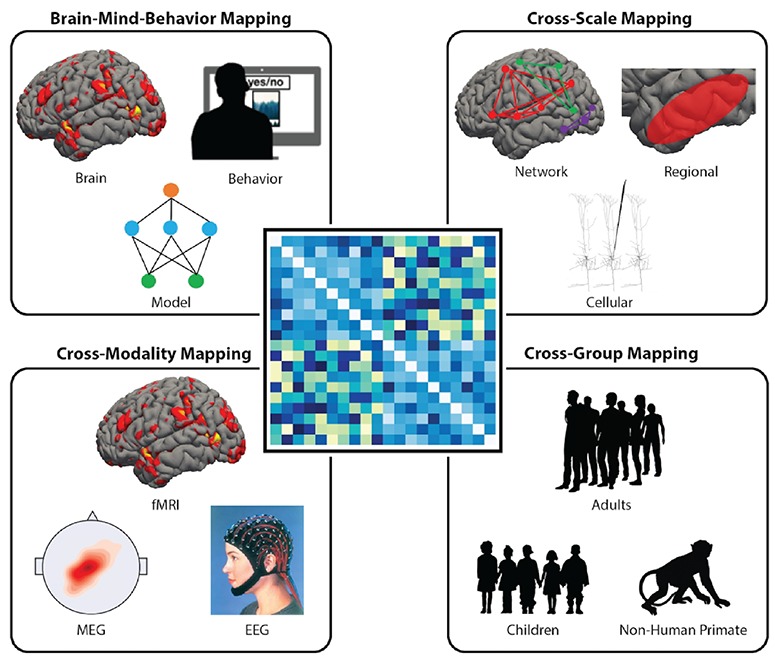
Figure 1. RSA combines data from different sources by using a common representational space. RSA is unique in its ability to incorporate data from a variety of sources. By using a common stimulus set, RDMs can be created from different sources, such as brain data, cognitive models and behavioral data, to analyze the common representational mapping. Other examples of social neuroscience uses for RSA include combining fMRI, MEG and EEG data to do cross-modality mapping, network, regional and cellular data to explore cross-scale mapping and data from different populations or species to explore cross-individual and species mapping of representations.
Figure 2
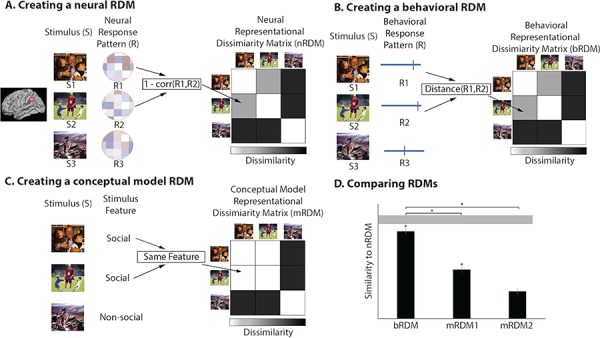
Figure 2. Construction of RDMs. (A) An RDM is constructed from neural data by extracting the multi-voxel pattern response from a ROI, from a single participant, for each individual stimulus. The dissimilarity, or 1 minus the correlation coefficient, is found between all possible stimuli comparison pairs, to create a dissimilarity matrix. (B) An RDM is constructed from behavioral data by collecting the response from a participant for each individual stimulus. The dissimilarity between all individual stimuli pairs is found using a distance measure calculation, such as the Euclidean distance. (C) A conceptual model RDM is constructed by pinpointing a feature of interest from the stimulus set. The dissimilarity matrix represents which stimuli share the common feature and which do not. (D) In the final step of the analysis, the bRDM and two mRDMs are compared to the nRDM. A noise ceiling (the gray horizontal bar) is calculated to see how well a perfect model would perform. Significance tests show that the bRDM and the mRDM1 are significantly similar to the nRDM. A pairwise comparison shows that the bRDM performs significantly better than the mRDM1 and mRDM2, in terms of relating to the nRDM.

References

    1. Anzellotti S., Coutanche M.N. (2018). Beyond functional connectivity: investigating networks of multivariate representations. Trends in Cognitive Sciences, 22(3), 258–69. 10.1016/j.tics.2017.12.002. - DOI - PubMed
    1. van Baar J.M., Chang L.J., Sanfey A.G. (2019). The computational and neural substrates of moral strategies in social decision-making. Nature Communications, 10(1), 1483 10.1038/s41467-019-09161-6. - DOI - PMC - PubMed
    1. Bracci S., Caramazza A., Peelen M.V. (2015). Representational similarity of body parts in human occipitotemporal cortex. Journal of Neuroscience, 35(38), 12977–85. 10.1523/JNEUROSCI.4698-14.2015. - DOI - PMC - PubMed
    1. Brooks J.A., Freeman J.B. (2018). Conceptual knowledge predicts the representational structure of facial emotion perception. Nature Human Behaviour, 2(8), 581–91. 10.1038/s41562-018-0376-6. - DOI - PMC - PubMed
    1. Carlin J.D., Calder A.J., Kriegeskorte N., Nili H., Rowe J.B. (2011). A head view-invariant representation of gaze direction in anterior superior temporal sulcus. Current Biology, 21(21), 1817–21. 10.1016/j.cub.2011.09.025. - DOI - PMC - PubMed

Publication types