


Changing epidemiology of methicillin-resistant Staphylococcus aureus in a low endemicity area-new challenges for MRSA control
- PMID: 31989375
- PMCID: PMC7669800
- DOI: 10.1007/s10096-020-03824-9
Changing epidemiology of methicillin-resistant Staphylococcus aureus in a low endemicity area-new challenges for MRSA control
Abstract
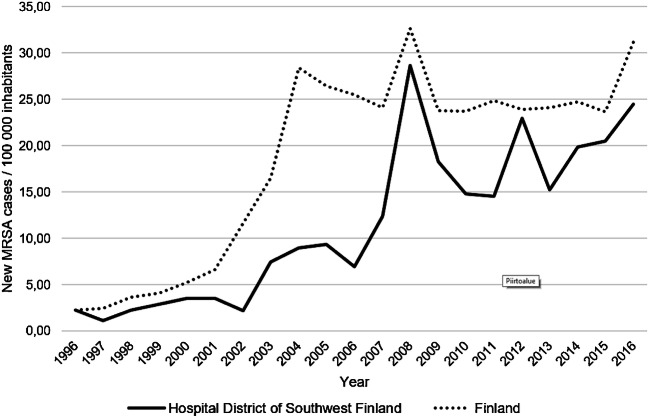
The incidence of methicillin-resistant Staphylococcus aureus (MRSA) has increased sharply in Hospital District of Southwest Finland (HD). To understand reasons behind this, a retrospective, population-based study covering 10 years was conducted. All new 983 MRSA cases in HD from January 2007 to December 2016 were analysed. Several data sources were used to gather background information on the cases. MRSA cases were classified as healthcare-associated (HA-MRSA), community-associated (CA-MRSA), and livestock contact was determined (livestock-associated MRSA, LA-MRSA). Spa typing was performed to all available strains. The incidence of MRSA doubled from 12.4 to 24.9 cases/100000 persons/year. The proportion of clinical infections increased from 25 to 32% in the 5-year periods, respectively, (p < 0.05). The median age decreased from 61 years in 2007 to 30 years in 2016. HA-MRSA accounted for 68% of all cases, of which 32% associated with 26 healthcare outbreaks. The proportion of CA-MRSA cases increased from 13% in 2007 to 43% in 2016. Of CA-MRSA cases, 43% were among family clusters, 32% in immigrants and 4% were LA-MRSA. The Gini-Simpson diversity index for spa types increased from 0.86 to 0.95 from the first to the second 5-year period. The proportion of a predominant strain t172 decreased from 43% in 2009 to 7% in 2016. The rise in the proportion of CA-MRSA, the switch to younger age groups, the complexity of possible transmission routes and the growing spa-type diversity characterize our current MRSA landscape. This creates challenges for targeted infection control measures, demanding further studies.
Keywords: Community-associated; Epidemiology; Family cluster; Infection control; MRSA; spa type.
Conflict of interest statement
The authors declare that they have no conflict of interest.
Figures


References
-
- World Health Organization. Global priority list of antibiotic-resistant bacteria to guide research, discovery, and development of new antibiotics. Geneva: 2017. Available from: https://www.who.int/medicines/publications/WHO-PPL-Short_Summary_25Feb-E...
-
- ECDC. Summary of the latest data on antibiotic resistance in the European Union, 15.11.2017. Available from: https://www.ecdc.europa.eu/en/publications-data/summary-latest-data-anti...
-
- Finnish institute for health and welfare (THL). National Infectious Diseases Register (in Finnish). Available at: www.thl.fi. Last viewed 2/2018
-
- Harmsen D, Claus H, Witte W, Rothgänger J, Claus H, Turnwald D, Vogel U. Typing of methicillin-resistant Staphylococcus aureus in a university hospital setting by using novel software for spa repeat determination and database management. J Clin Microbiol. 2003;41(12):5442–5448. doi: 10.1128/JCM.41.12.5442-5448.2003. - DOI - PMC - PubMed
MeSH terms
LinkOut - more resources
Full Text Sources
Medical
