


Patient-reported outcome after oncoplastic breast surgery compared with conventional breast-conserving surgery in breast cancer
- PMID: 31989380
- PMCID: PMC7031405
- DOI: 10.1007/s10549-020-05544-2
Patient-reported outcome after oncoplastic breast surgery compared with conventional breast-conserving surgery in breast cancer
Abstract
Introduction: Oncoplastic breast surgery (OBS) has developed as an extension of breast-conserving surgery (BCS) in an effort to improve esthetic and functional outcome following surgery for breast cancer. The aim of the present study was to evaluate the possible benefits of OBS, as compared with BCS, with regard to health-related quality of life (HRQoL), using patient-reported outcome measures (PROMs).
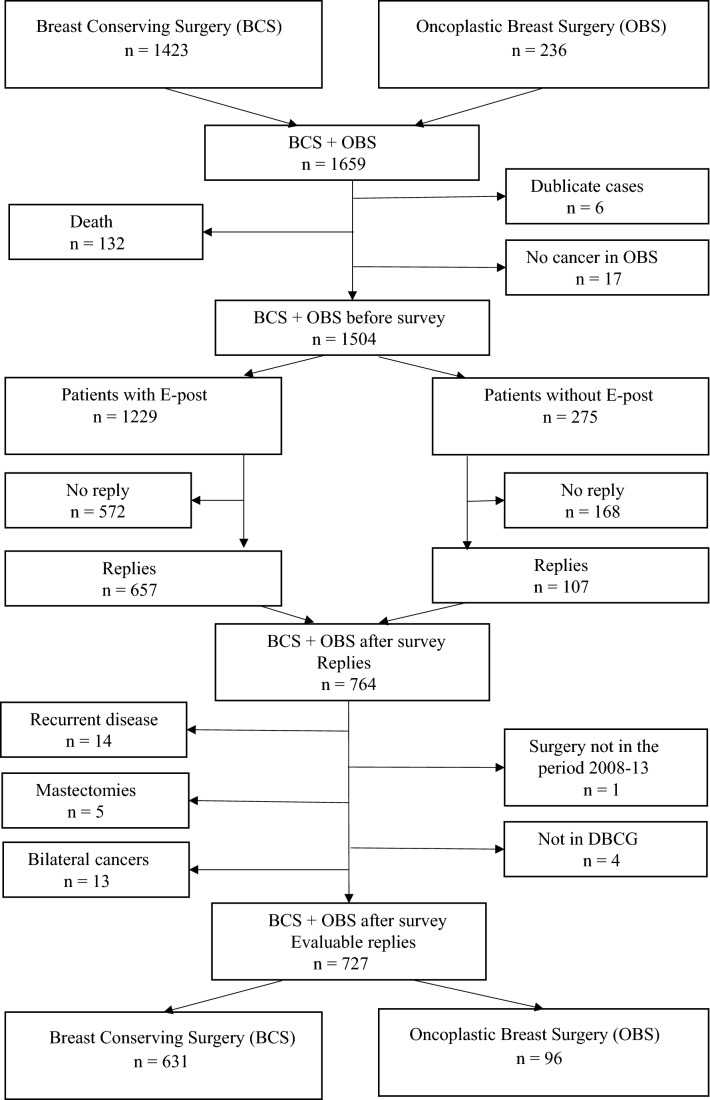
Patients and methods: Patients treated with OBS (n = 200) and BCS (n = 1304) in the period 1 January 2008 to 31 December 2013 were identified in a research database and in the Danish Breast Cancer Cooperative Group (DBCG) registry. Data on patient, tumor, and treatment characteristics were retrieved from the DBCG registry. Patients were sent a survey including the Breast-Q™ BCT postoperative module and a study-specific questionnaire (SSQ) in 2016. A good outcome in the Breast-Q module was defined as above the median. OBS was compared to BCS using a logistic regression analysis, and then adjusted for potential confounders, yielding odds ratios (OR) with 95% confidence intervals.
Results: There was a statistically significant better outcome considering the HRQoL domain "Psychosocial Well-being " for patients treated with OBS as compared with BCS (OR 2.15: 1.25-3.69). No statistically significant differences were found for the domains "Physical Well-being" (0.83: 0.50-1.39), "Satisfaction with Breast" (0.95: 0.57-1.59), or "Sexual Well-being" (1.42: 0.78-2.58).
Conclusion: The present study indicates better outcomes of HRQoL for breast cancer patients treated with OBS as compared to patients treated with BCS. There was no increase in physical discomfort among OBS patients despite more extensive surgery.
Keywords: Breast cancer; Breast conserving surgery; Breast-Q; Oncoplastic breast surgery; Patient-reported outcome.
Conflict of interest statement
The authors declare that they have no conflicts of interest.
Figures
Comment in
-
Comments on patient-reported outcome after oncoplastic breast surgery compared with conventional breast-conserving surgery in breast cancer.Breast Cancer Res Treat. 2021 Jan;185(2):529-530. doi: 10.1007/s10549-020-05945-3. Epub 2020 Sep 24. Breast Cancer Res Treat. 2021. PMID: 32974791 No abstract available.
References
-
- Christiansen P, et al. Breast conserving surgery versus mastectomy: overall and relative survival—a population based study by the Danish Breast Cancer Cooperative Group (DBCG ) Supplementary material. Acta Oncol. 2017;57:1–3. - PubMed
MeSH terms
Grants and funding
LinkOut - more resources
Full Text Sources
Medical
