von Willebrand factor/ADAMTS13 ratio at presentation of acute ischemic brain injury is predictive of outcome
- PMID: 31990334
- PMCID: PMC6988400
- DOI: 10.1182/bloodadvances.2019000979
von Willebrand factor/ADAMTS13 ratio at presentation of acute ischemic brain injury is predictive of outcome
Abstract
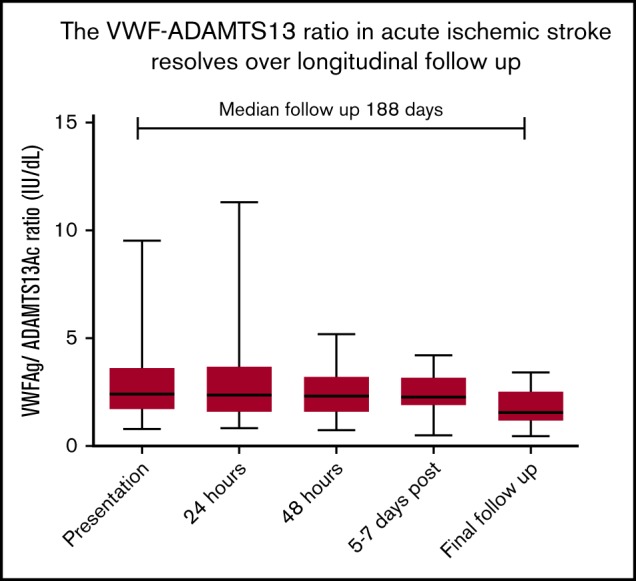
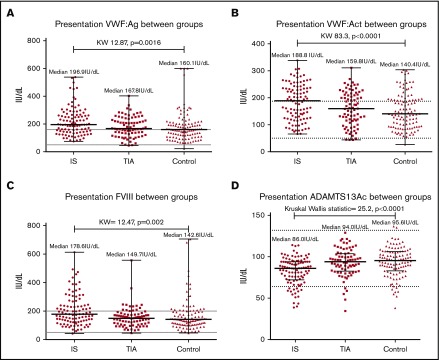
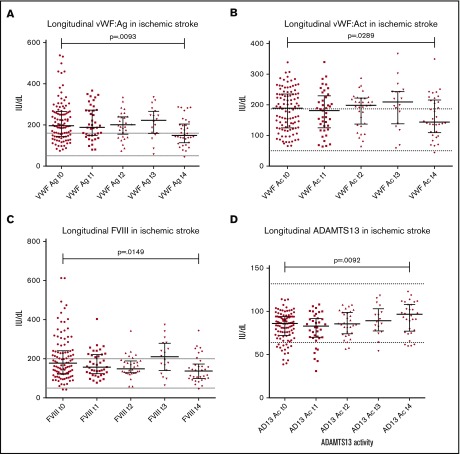
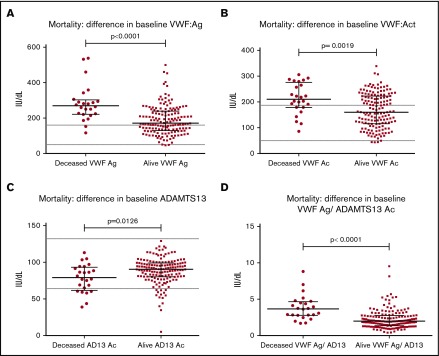
Acute ischemic stroke (IS) and transient ischemic attack (TIA) are associated with raised von Willebrand factor (VWF) and decreased ADAMTS13 activity (ADAMTS13Ac). Their impact on mortality and morbidity is unclear. We conducted a prospective investigation of the VWF-ADAMTS13 axis in 292 adults (acute IS, n = 103; TIA, n = 80; controls, n = 109) serially from presentation until >6 weeks. The National Institutes of Health Stroke Score (NIHSS) and modified Rankin scale (mRS) were used to assess stroke severity. Presenting median VWF antigen (VWF:Ag)/ADAMTS13Ac ratios were: IS, 2.42 (range, 0.78-9.53); TIA, 1.89 (range, 0.41-8.14); and controls, 1.69 (range, 0.25-15.63). Longitudinally, the median VWF:Ag/ADAMTS13Ac ratio decreased (IS, 2.42 to 1.66; P = .0008; TIA, 1.89 to 0.65; P < .0001). The VWF:Ag/ADAMTS13Ac ratio was higher at presentation in IS patients who died (3.683 vs 2.014; P < .0001). A presenting VWF:Ag/ADAMTS13Ac ratio >2.6 predicted mortality (odds ratio, 6.33; range, 2.22-18.1). Those with a VWF:Ag/ADAMTS13Ac ratio in the highest quartile (>3.091) had 31% increased risk mortality. VWF:Ag/ADAMTS13Ac ratio at presentation of ischemic brain injury was associated with higher mRS (P = .021) and NIHSS scores (P = .029) at follow-up. Thrombolysis resulted in prompt reduction of the VWF:Ag/ADAMTS13Ac ratio and significant improvement in mRS on follow-up. A raised VWF:Ag/ADAMTS13Ac ratio at presentation of acute IS or TIA is associated with increased mortality and poorer functional outcome. A ratio of 2.6 seems to differentiate outcome. Prompt reduction in the ratio in thrombolysed patients was associated with decreased mortality and morbidity. The VWF:Ag/ADAMTS13Ac ratio is a biomarker for the acute impact of an ischemic event and longer-term outcome.
© 2020 by The American Society of Hematology.
Conflict of interest statement
Conflict-of-interest disclosure: M.S. has received funding from Baxalta/Takeda, including speakers’ fees and attendance of advisory boards. The remaining authors declare no competing financial interests.
Figures
References
-
- Ruggeri ZM. Platelets in atherothrombosis. Nat Med. 2002;8(11):1227-1234. - PubMed
-
- Penz SM, Reininger AJ, Toth O, Deckmyn H, Brandl R, Siess W. Glycoprotein Ibalpha inhibition and ADP receptor antagonists, but not aspirin, reduce platelet thrombus formation in flowing blood exposed to atherosclerotic plaques. Thromb Haemost. 2007;97(3):435-443. - PubMed
-
- Montaner J. The post-stroke clotting battle: ADAMTS13 falls and puts out of control vWF into brain arteries. J Neurol Sci. 2015;348(1-2):1-2. - PubMed
-
- Wannamethee SG, Whincup PH, Lennon L, Rumley A, Lowe GD. Fibrin D-dimer, tissue-type plasminogen activator, von Willebrand factor, and risk of incident stroke in older men. Stroke. 2012;43(5):1206-1211. - PubMed
-
- Wieberdink RG, van Schie MC, Koudstaal PJ, et al. . High von Willebrand factor levels increase the risk of stroke: the Rotterdam study. Stroke. 2010;41(10):2151-2156. - PubMed
MeSH terms
Substances
LinkOut - more resources
Full Text Sources
Other Literature Sources
Miscellaneous