


Population variation in early development can determine ecological resilience in response to environmental change
- PMID: 31990993
- PMCID: PMC7317736
- DOI: 10.1111/nph.16453
Population variation in early development can determine ecological resilience in response to environmental change
Abstract
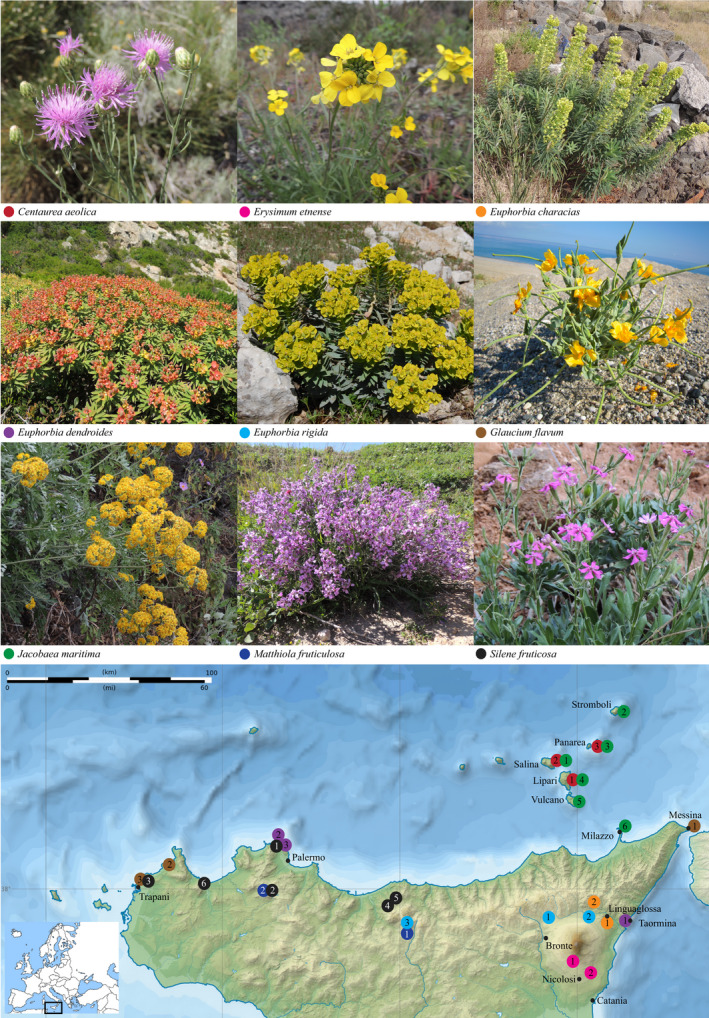
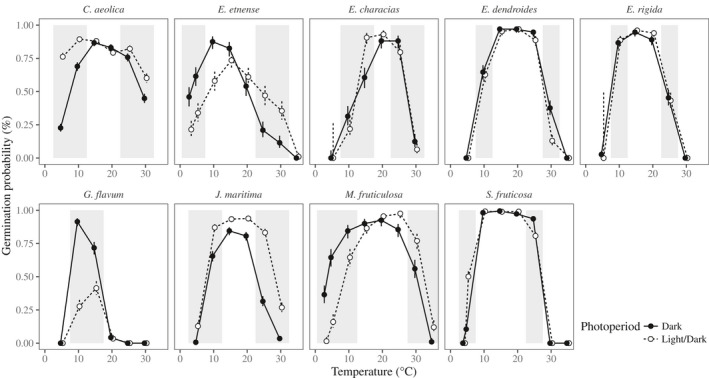
As climate change transforms seasonal patterns of temperature and precipitation, germination success at marginal temperatures will become critical for the long-term persistence of many plant species and communities. If populations vary in their environmental sensitivity to marginal temperatures across a species' geographical range, populations that respond better to future environmental extremes are likely to be critical for maintaining ecological resilience of the species. Using seeds from two to six populations for each of nine species of Mediterranean plants, we characterized patterns of among-population variation in environmental sensitivity by quantifying genotype-by-environment interactions (G × E) for germination success at temperature extremes, and under two light regimes representing conditions below and above the soil surface. For eight of nine species tested at hot and cold marginal temperatures, we observed substantial among-population variation in environmental sensitivity for germination success, and this often depended on the light treatment. Importantly, different populations often performed best at different environmental extremes. Our results demonstrate that ongoing changes in temperature regime will affect the phenology, fitness, and demography of different populations within the same species differently. We show that quantifying patterns of G × E for multiple populations, and understanding how such patterns arise, can test mechanisms that promote ecological resilience.
Keywords: Mediterranean ecosystems; climate change; ecological resilience; environmental sensitivity; genotype-by-environment interactions; germination success; intraspecific variation; seed ecology.
© 2020 The Authors. New Phytologist © 2020 New Phytologist Trust.
Figures


References
-
- Agrawal AA, Conner JK, Rasmann S. 2010. Tradeoffs and adaptive negative correlations in evolutionary ecology In: Bell M, Eanes W, Futuyma D, Levinton J, eds. Evolution after Darwin: the first 150 years. Sunderland, MA, USA: Sinauer Associates, 243–268.
-
- Angert AL, Sheth SN, Paul JR. 2011. Incorporating population‐level variation in thermal performance into predictions of geographic range shifts. Integrative and Comparative Biology 51: 733–750. - PubMed
Publication types
MeSH terms
LinkOut - more resources
Full Text Sources
Research Materials
