


Red Cell Distribution Width Is a Risk Factor for Hip Fracture in Elderly Men Without Anemia
- PMID: 31991005
- PMCID: PMC7744556
- DOI: 10.1002/jbmr.3963
Red Cell Distribution Width Is a Risk Factor for Hip Fracture in Elderly Men Without Anemia
Abstract
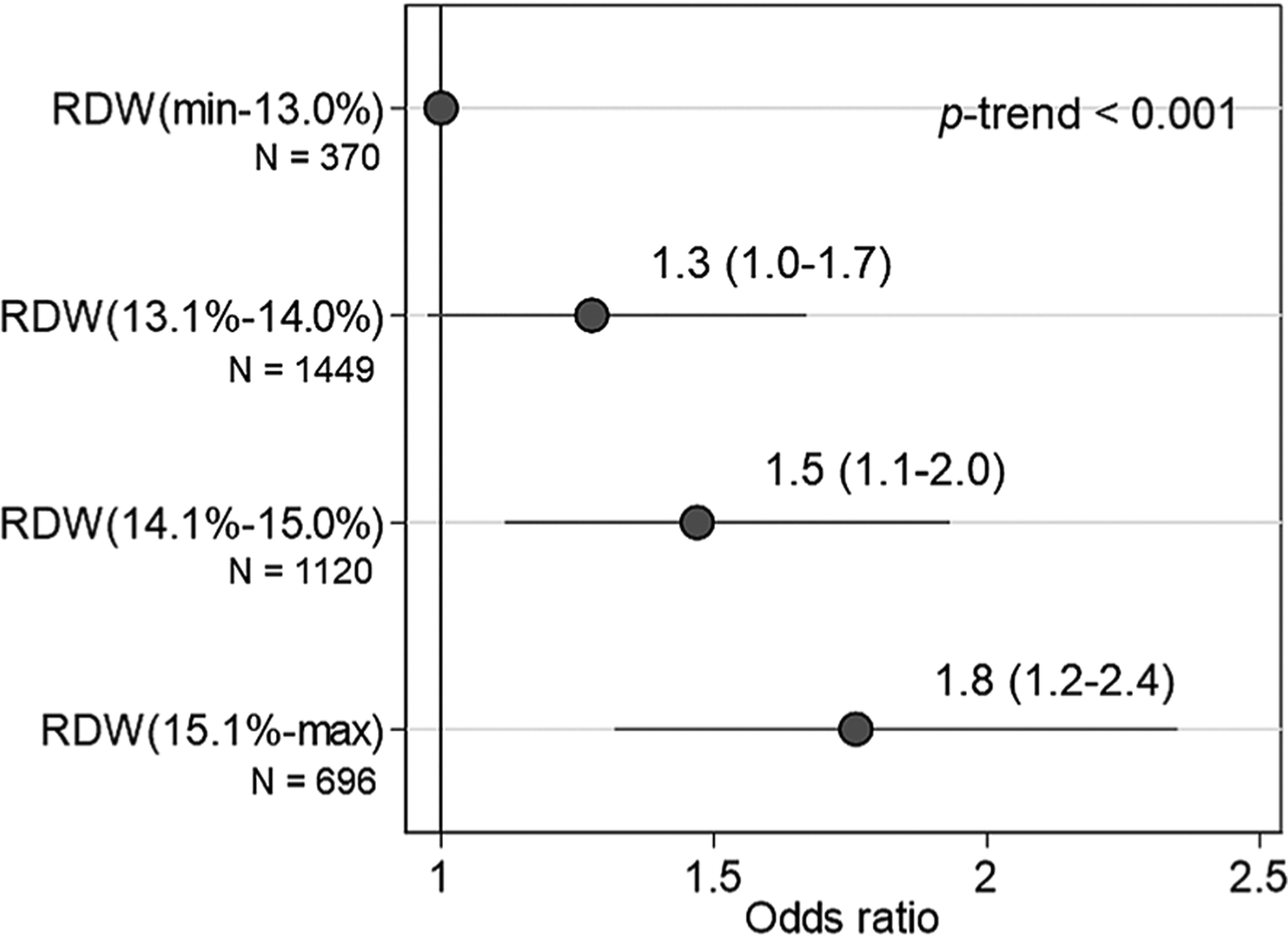
Red cell distribution width (RDW), routinely assessed as a component of a complete blood count (CBC), quantifies the variation in the size of red blood cells. It increases with age, and increased RDW predicts many aging-related diseases and mortality. However, whether it also predicts hip fracture is unknown. We prospectively evaluated the association between RDW and hip fracture using data from the Osteoporotic Fracture in Men (MrOS) study. RDW was measured in 3635 men (aged 71 to 99 years) along with bone mineral density (BMD) in MrOS. RDW ranged from 11.3% to 32.9% (median 14.0%; interquartile range 13.5% to 14.8%) and was categorized into four groups (≤13.0%, 13.1% to 14.0%, 14.1% to 15.0%, ≥15.1%). Study participants with a hemoglobin level <13.0 g/dL were classified as having anemia. During an average 8.1 years, 164 men suffered hip fractures. The risks of hip fractures increased with increase of RDW category. Furthermore, there was a significant interaction between anemia and RDW: An association between RDW and hip fractures was only observed in participants without anemia. In those without anemia, the relative hazard of hip fractures increased with increases in RDW category: Men in the highest RDW category had a 2.8 times higher risk of hip fractures than men in the lowest group (95% confidence interval 1.1 to 7.1). The risks of all-clinical fractures were also increased along with higher RDW values. Additionally, RDW was significantly associated with the risk of having a fall but not with femoral neck or total hip BMD. In conclusion, RDW and anemia defined by hemoglobin are widely available routine laboratory measurements that together could indicate increased risk of hip fracture, reflecting the neuromuscular effects of aging rather than lower hip BMD. © 2020 American Society for Bone and Mineral Research.
Keywords: AGING; ANEMIA; HIP FRACTURE; OSTEOPOROSIS; RED CELL DISTRIBUTION WIDTH.
© 2020 American Society for Bone and Mineral Research.
Conflict of interest statement
Disclosures
All authors state that they have no conflicts of interest.
Figures

Comment in
-
Red Cell Distribution Width and Hip Fracture.J Bone Miner Res. 2021 Jun;36(6):1202. doi: 10.1002/jbmr.4201. Epub 2020 Nov 10. J Bone Miner Res. 2021. PMID: 33170965 No abstract available.
-
Response to "Red Cell Distribution Width Is a Risk Factor for Hip Fracture in Elderly Men Without Anemia".J Bone Miner Res. 2021 Jun;36(6):1203. doi: 10.1002/jbmr.4242. Epub 2021 Jan 28. J Bone Miner Res. 2021. PMID: 33507579 No abstract available.
References
-
- Salvagno GL, Sanchis-Gomar F, Picanza A, Lippi G. Red blood cell distribution width: a simple parameter with multiple clinical applications. Crit Rev Clin Lab Sci. 2015;52(2):86–105. - PubMed
-
- Hunziker S, Stevens J, Howell MD. Red cell distribution width and mortality in newly hospitalized patients. Am J Med. 2012;125(3):283–91. - PubMed
Publication types
MeSH terms
Grants and funding
- U01 AG042143/NH/NIH HHS/United States
- UL1 TR000128/TR/NCATS NIH HHS/United States
- UL1 TR002369/TR/NCATS NIH HHS/United States
- U01 AG042124/AG/NIA NIH HHS/United States
- U01 AG042124/NH/NIH HHS/United States
- U01 AG042145/NH/NIH HHS/United States
- U01 AG042140/AG/NIA NIH HHS/United States
- U01 AG027810/NH/NIH HHS/United States
- U01 AG027810/AG/NIA NIH HHS/United States
- U01 AG042139/AG/NIA NIH HHS/United States
- UL1 TR000128/NH/NIH HHS/United States
- U01 AG042139/NH/NIH HHS/United States
- U01 AR066160/NH/NIH HHS/United States
- U01 AG042145/AG/NIA NIH HHS/United States
- U01 AG042168/AG/NIA NIH HHS/United States
- U01 AG042140/NH/NIH HHS/United States
- R56 AG061085/AG/NIA NIH HHS/United States
- U01 AG042143/AG/NIA NIH HHS/United States
- U01 AR066160/AR/NIAMS NIH HHS/United States
- U01 AG042168/NH/NIH HHS/United States
LinkOut - more resources
Full Text Sources
Medical
