


Healthcare Associated Infections-A New Pathology in Medical Practice?
- PMID: 31991722
- PMCID: PMC7036829
- DOI: 10.3390/ijerph17030760
Healthcare Associated Infections-A New Pathology in Medical Practice?
Abstract
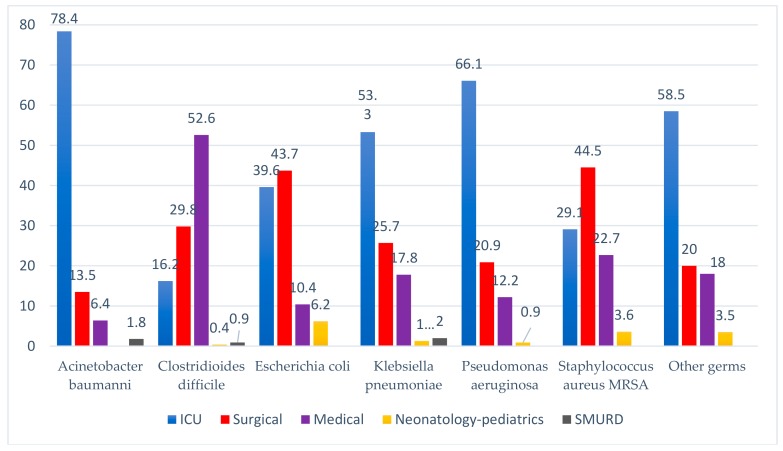
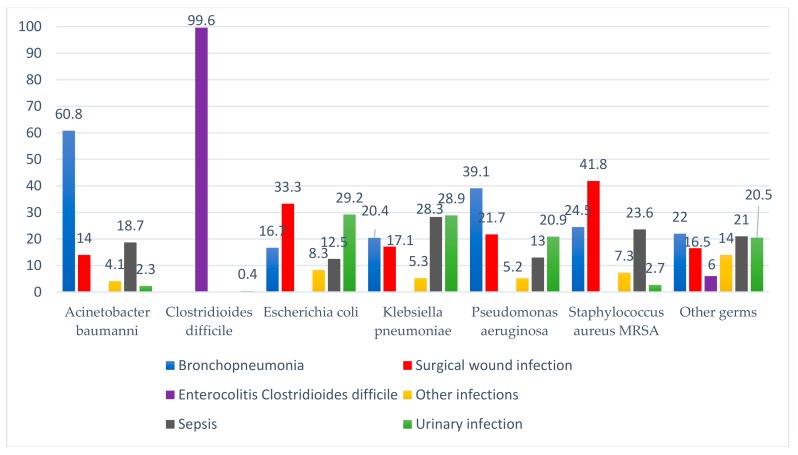
Background: Hospital-acquired infections (HAI) contribute to the emotional stress and functional disorders of the patient and in some cases, can lead to a state of disability that reduces quality of life. Often, HAI are one of the factors that lead to death. The purpose of this study was to analyze the cases of HAI identified in public hospitals at the county level, through case report sheets, as they are reported according to the Romanian legislation. Methods: We performed a cross sectional study design based on the case law of the data reported to the Mures Public Health Directorate, by all the public hospitals belonging to this county. We tracked hospital-acquired infections reported for 2017-2018, respectively, a number of 1024 cases, which implies a prevalence rate of 0.44%, 1024/228,782 cases discharged from these hospitals during the studied period. Results: The most frequent HAIs were reported by the intensive care units (48.4%), the most common infections being the following: bronchopneumonia (25.3%), enterocolitis with Clostridioidesdifficile (23.3%), sepsis, surgical wound infections and urinary tract infections. At the basis of HAI were 22 pathogens, but the five most common germs were Clostridioidesdifficile, Acinetobacterbaumannii, Klebsiella pneumoniae, Pseudomonas aeruginosa and Staphylococcus aureus. Bronchopneumonia have been most frequently reported in intensive care units, the most common being identified the Acinetobacterbaumannii agent. Sepsis and central catheter infections also appeared predominantly in intensive care units, more often with Klebsiella pneumoniae. The enterocolitis with Clostridioidesdifficile, were the apanage of the medical sections. Infections with Staphylococcus aureus have been identified predominantly in the surgical sections at the level of the surgical wounds. Urinary infections had a similar distribution in the intensive care units, the medical and surgical sections, with Klebsiella pneumoniae being the most commonly incriminated agent. Conclusions: We showed a clear correspondence between the medical units and the type of HAI: what recommends the rapid, vigilant and oriented application of the prevention and control strategies of the HAI.
Keywords: bacterial resistance; hospital acquired infections; prevention and control strategies.
Conflict of interest statement
The authors declare no conflict of interest.
Figures
References
-
- Zimlichman E., Henderson D., Tamir O., Franz C., Song P., Yamin C.K., Keohane C., Denham C.R., Bates D.W. Health care-associated infections: A meta-analysis of costs and financial impact on the US health care system. JAMA Int. Med. 2013;173:2039–2046. doi: 10.1001/jamainternmed.2013.9763. - DOI - PubMed
-
- Cassini A., Plachouras D., Eckmanns T., Abu Sin M., Blank H.-P., Ducomble T., Haller S., Harder M., Velasco E., Edward W., et al. Burden of Six Healthcare-Associated Infections on European Population Health: Estimating Incidence-Based Disability-Adjusted Life Years through a Population Prevalence-Based Modelling Study. PLoS Med. 2016;13:e1002150. doi: 10.1371/journal.pmed.1002150. - DOI - PMC - PubMed
-
- World Health Organization Health Care-Associated Infections. [(accessed on 8 December 2019)];Fact Sheet. Available online: http://www.who.int/gpsc/country_work/gpsc_ccisc_fact_sheet_en.pdf.
MeSH terms
LinkOut - more resources
Full Text Sources
