


Gender differences in quality of life among community-dwelling older adults in low- and middle-income countries: results from the Study on global AGEing and adult health (SAGE)
- PMID: 31992264
- PMCID: PMC6988191
- DOI: 10.1186/s12889-020-8212-0
Gender differences in quality of life among community-dwelling older adults in low- and middle-income countries: results from the Study on global AGEing and adult health (SAGE)
Abstract
Background: Quality of life (QoL) is an important component of individuals' general well-being, particularly in older adults. However, factors influencing QoL among older adults in low- and middle-income countries (LMICs) have not been fully examined. Furthermore, the role of gender differences in relation to QoL in multiple LMICs has also not been examined in detail.
Methods: This study used data from the World Health Organization's Study on global AGEing and adult health (SAGE), Wave-1. Based on a literature review of existing works, a set of variables-an independent variable and covariates-were selected. The study sample consisted of 33,019 participants aged 50 years and above from China, Ghana, India, Russia, and South Africa. Multivariate linear regression models were estimated with the World Health Organization QoL scores as the dependent variable. To preserve the analytical sample size, multiple imputation was used to account for missing data.
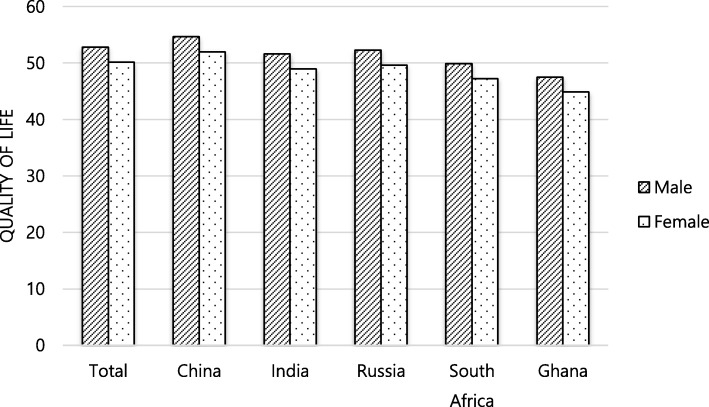
Results: The results showed that generally, male older adults reported a better QoL than female older adults across all of the countries. The associations between QoL and sociodemographic factors, health-related factors, and social support factors among older adults differed according to country.
Conclusions: This study provides a better understanding of QoL among older adults in LMICs, which can help prepare LMICs to better address the QoL of older adults. The results of this study can be used to develop programs to promote better living standards and services to reduce gender disparities and ultimately, to improve the QoL among older adults in LMICs.
Keywords: Gender inequality; Low- and middle-income country; Older adults; Quality of life.
Conflict of interest statement
The authors declare that they have no competing interests.
Figures
References
-
- United Nations: World Population Prospects: The 2015 Revision, Key Findings and Advances Tables. https://esa.un.org/unpd/wpp/publications/files/key_findings_wpp_2015.pdf (2015). .
-
- World Health Organization: Ageing and Health. http://www.who.int/mediacentre/factsheets/fs404/en/ (2015). Accessd 10 June 2019.
-
- Nielsen L.: Classifications of countries based on their level of development: how it is done and how it could be done. http://www.imf.org/external/pubs/ft/wp/2011/wp1131.pdf (2011). Acessed 10 June 2019.
MeSH terms
Grants and funding
LinkOut - more resources
Full Text Sources
