Multisite validation of a simple electronic health record algorithm for identifying diagnosed obstructive sleep apnea
- PMID: 31992429
- PMCID: PMC7053021
- DOI: 10.5664/jcsm.8160
Multisite validation of a simple electronic health record algorithm for identifying diagnosed obstructive sleep apnea
Abstract
Study objectives: We examined the performance of a simple algorithm to accurately distinguish cases of diagnosed obstructive sleep apnea (OSA) and noncases using the electronic health record (EHR) across six health systems in the United States.
Methods: Retrospective analysis of EHR data was performed. The algorithm defined cases as individuals with ≥ 2 instances of specific International Classification of Diseases (ICD)-9 and/or ICD-10 diagnostic codes (327.20, 327.23, 327.29, 780.51, 780.53, 780.57, G4730, G4733 and G4739) related to sleep apnea on separate dates in their EHR. Noncases were defined by the absence of these codes. Using chart reviews on 120 cases and 100 noncases at each site (n = 1,320 total), positive predictive value (PPV) and negative predictive value (NPV) were calculated.
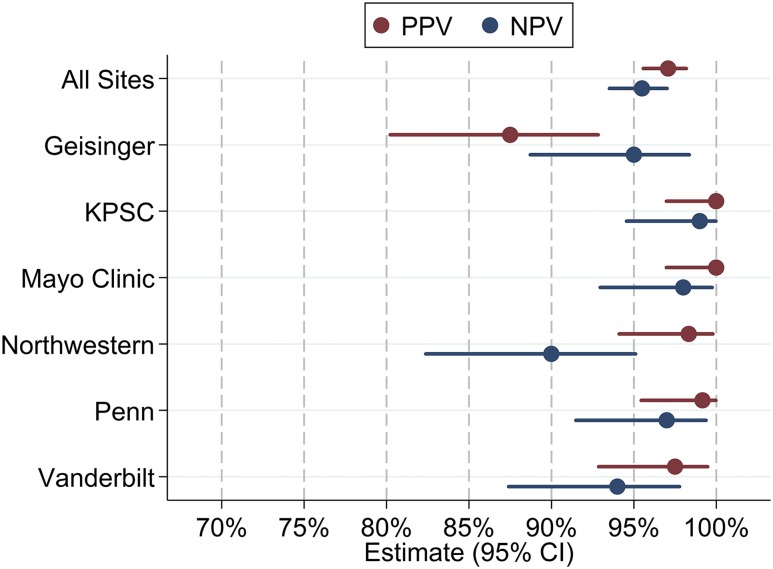
Results: The algorithm showed excellent performance across sites, with a PPV (95% confidence interval) of 97.1 (95.6, 98.2) and NPV of 95.5 (93.5, 97.0). Similar performance was seen at each site, with all NPV and PPV estimates ≥ 90% apart from a somewhat lower PPV of 87.5 (80.2, 92.8) at one site. A modified algorithm of ≥ 3 instances improved PPV to 94.9 (88.5, 98.3) at this site, but excluded an additional 18.3% of cases. Thus, performance may be further improved by requiring additional codes, but this reduces the number of determinate cases.
Conclusions: A simple EHR-based case-identification algorithm for diagnosed OSA showed excellent predictive characteristics in a multisite sample from the United States. Future analyses should be performed to understand the effect of undiagnosed disease in EHR-defined noncases. This algorithm has wide-ranging applications for EHR-based OSA research.
Keywords: case-identification algorithm; diagnostic codes; electronic health record; obstructive sleep apnea; phenotype.
© 2020 American Academy of Sleep Medicine.
Figures
Comment in
-
Big data: mind your Ps and Qs-the importance of precision and quality in data validation.J Clin Sleep Med. 2020 Feb 15;16(2):161-162. doi: 10.5664/jcsm.8260. Epub 2020 Jan 13. J Clin Sleep Med. 2020. PMID: 31992426 Free PMC article.
References
-
- American Academy of Sleep Medicine . International Classification of Sleep Disorders. 3rd ed. Darien, IL: American Academy of Sleep Medicine; 2014.
-
- Institute of Medicine . Sleep Disorders and Sleep Deprivation: An Unmet Public Health Problem. Washington, DC: The National Academies Press; 2006. - PubMed
-
- Loke YK, Brown JW, Kwok CS, Niruban A, Myint PK. Association of obstructive sleep apnea with risk of serious cardiovascular events: a systematic review and meta-analysis. Circ Cardiovasc Qual Outcomes. 2012;5(5):720–728. - PubMed
Publication types
MeSH terms
Grants and funding
LinkOut - more resources
Full Text Sources