. 2020 Jan 28;5(1):e00853-19.
doi: 10.1128/mSystems.00853-19.

Adaptation of Lactobacillus plantarum to Ampicillin Involves Mechanisms That Maintain Protein Homeostasis

Affiliations

Adaptation of Lactobacillus plantarum to Ampicillin Involves Mechanisms That Maintain Protein Homeostasis

Chenxia Cao et al. mSystems. .

Abstract

The widespread use of antibiotics has caused great concern in the biosafety of probiotics. In this study, we conducted a 12-month adaptive laboratory evolution (ALE) experiment to select for antibiotics-adapted Lactobacillus plantarum P-8, a dairy-originated probiotic bacterium. During the ALE process, the ampicillin MIC for the parental L. plantarum P-8 strain increased gradually and reached the maximum level of bacterial fitness. To elucidate the molecular mechanisms underlying the ampicillin-resistant phenotype, we comparatively analyzed the genomes and proteomes of the parental strain (L. plantarum P-8) and two adapted lines (L. plantarum 400g and L. plantarum 1600g). The adapted lines showed alterations in their carbon, amino acid, and cell surface-associated metabolic pathways. Then, gene disruption mutants were created to determine the role of six highly expressed genes in contributing to the enhanced ampicillin resistance. Inactivation of an ATP-dependent Clp protease/the ATP-binding subunit ClpL, a small heat shock protein, or a hypothetical protein resulted in partial but significant phenotypic reversion, confirming their necessary roles in the bacterial adaptation to ampicillin. Genomic analysis confirmed that none of the ampicillin-specific differential expressed genes were flanked by any mobile genetic elements; thus, even though long-term exposure to ampicillin upregulated their expression, there is low risk of spread of these genes and adapted drug resistance to other bacteria via horizontal gene transfer. Our study has provided evidence of the biosafety of probiotics even when used in the presence of antibiotics.IMPORTANCE Antibiotic resistance acquired by adaptation to certain antibiotics has led to growing public concerns. Here, a long-term evolution experiment was used together with proteomic analysis to identify genes/proteins responsible for the adaptive phenotype. This work has provided novel insights into the biosafety of new probiotics with high tolerance to antibiotics.

Keywords: Lactobacillus; Lactobacillus plantarum P-8; adaptive laboratory evolution; ampicillin; antibiotics; parallel reaction monitoring; proteomics.


Figures

FIG 1
FIG 1
Changes in the drug MICs for L. plantarum P-8 during the 12-month adaptive laboratory evolution experiment. A-1 and C-1, A-2 and C-2, and A-3 and C-3 represent bacterial line 1, line 2, and line 3, respectively. The three cell lines were derived from three individual colonies as indicated. Each assay was repeated three times.
FIG 2
FIG 2
Distribution of SNPs on the genomes of L. plantarum 400g and L. plantarum 1600g. The inner circle illustrates the nucleotide position of the genome. The violet and yellow circles represent the genomes of L. plantarum 400g and L. plantarum 1600g, respectively. Specific genes are denoted by gene locus tags. The mutation occurring at an intergenic region is indicated in red.
FIG 3
FIG 3
Volcano plot of the proteomic data of L. plantarum 400g (a) and L. plantarum 1600g (b). The x axis indicates the differential levels of protein expression (fold ratio between the parental L. plantarum P-8 and the adapted strains, 400g and 1600g, in a log-2 scale). The y axis indicates the statistical significance for the differential expression levels (P value generated from t test in log10 scale).
FIG 4
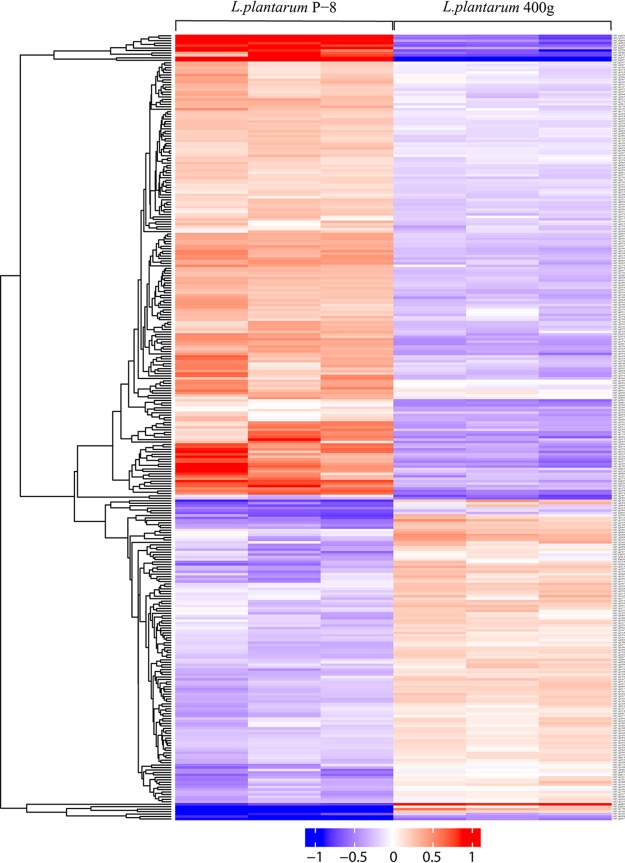
FIG 4
Hierarchical clustering of differentially expressed proteins of L. plantarum 400g relative to L. plantarum P-8. Each row represents a differentially expressed protein, while data of each of the three biological replicates are plotted in one column. The color scale represents the protein expression level, ranging from −1 (minimal expression) to 1 (maximal expression).
FIG 5
FIG 5
Hierarchical clustering of differentially expressed proteins of L. plantarum 1600g relative to L. plantarum P-8. Each row represents a differentially expressed protein, while data of each of the three biological replicates are plotted in one column. The color scale represents the protein expression level, ranging from −1 (minimal expression) to 1 (maximal expression).
FIG 6
FIG 6
Functional distribution of differentially expressed proteins of ampicillin-adapted strains. Data represent upregulated (a) and downregulated (b) proteins of L. plantarum 400g and L. plantarum 1600g. Enrichment analyses were performed based on the protein expression of each COG functional category of L. plantarum 400g and L. plantarum 1600g relative to L. plantarum parental strain P-8. Significant enhancement is indicated by single and double asterisks (* represents P values of <0.05; ** represents P values of <0.01; Fisher’s exact test). COG functional categories are indicated as follows: C, energy production and conversion; D, cell cycle control, cell division, chromosome partitioning; E, amino acid transport and metabolism; F, nucleotide transport and metabolism; G, carbohydrate transport and metabolism; H, coenzyme transport and metabolism; I, lipid transport and metabolism; J, translation, ribosomal structure, and biogenesis; K, transcription; L, replication, recombination, and repair; M, cell wall/membrane/envelope biogenesis; O, posttranslational modification, protein turnover, chaperones; P, inorganic ion transport and metabolism; Q, secondary metabolites biosynthesis, transport, and catabolism; R, general function prediction only; S, function unknown; T, signal transduction mechanisms; V, defense mechanisms.
FIG 7
FIG 7
Correlation between expression patterns of 10 selected proteins detected by TMT and PRM analyses. (a) L. plantarum 400g. (b) L. plantarum 1600g. For both the TMT and PRM analyses, peptides from three biological replicates of the protein samples were analyzed. The strength and statistical significance of Pearson’s correlations between fold changes found by TMT and PRM analyses are represented by the R and P values, respectively. Confidence intervals are illustrated by the gray area. LBP_cg0397, l-serine dehydratase, beta subunit; LBP_cg0885, malate dehydrogenase; LBP_cg1290, enoyl-(acyl carrier protein) reductase; LBP_cg1294, acyl-CoA thioester hydrolase; LBP_cg1793, penicillin binding protein 2B; LBP_cg0109, sHSP; LBP_cg0720, hypothetical protein; LBP_cg0721, alkaline shock protein; LBP_cg0722, alkaline shock protein; LBP_cg2905, ClpL.
FIG 8
FIG 8
Ampicillin MICs for L. plantarum 400g and L. plantarum 1600g and their mutants. Each assay was repeated three times, and identical results were obtained in all cases.
FIG 9
FIG 9
Amoxicillin MICs for L. plantarum 400g and L. plantarum 1600g and their mutants. Each assay was repeated three times, and identical results were obtained in all cases.

References

    1. Normark BH, Normark S. 2002. Evolution and spread of antibiotic resistance. J Intern Med 252:91–106. doi: 10.1046/j.1365-2796.2002.01026.x. - DOI - PubMed
    1. Waclaw B. 2016. Evolution of drug resistance in bacteria. Adv Exp Med Biol 915:49–67. doi: 10.1007/978-3-319-32189-9_5. - DOI - PubMed
    1. Seigal A, Mira P, Sturmfels B, Barlow M. 2017. Does antibiotic resistance evolve in hospitals? Bull Math Biol 79:191–208. doi: 10.1007/s11538-016-0232-7. - DOI - PubMed
    1. Guven GS, Uzun O. 2003. Principles of good use of antibiotics in hospitals. J Hosp Infect 53:91–96. doi: 10.1053/jhin.2002.1353. - DOI - PubMed
    1. Love MJ, Bhandari D, Dobson RCJ, Billington C. 27 February 2018, posting date Potential for bacteriophage endolysins to supplement or replace antibiotics in food production and clinical care. Antibiotics (Basel) doi: 10.3390/antibiotics7010017. - DOI - PMC - PubMed

LinkOut - more resources