. 2020 May;73(5):290-298.
doi: 10.1038/s41429-019-0275-8. Epub 2020 Jan 28.

Synergistic anti-methicillin-resistant Staphylococcus aureus (MRSA) activity and absolute stereochemistry of 7,8-dideoxygriseorhodin C

Affiliations

Synergistic anti-methicillin-resistant Staphylococcus aureus (MRSA) activity and absolute stereochemistry of 7,8-dideoxygriseorhodin C

Bailey W Miller et al. J Antibiot (Tokyo). 2020 May.

Abstract

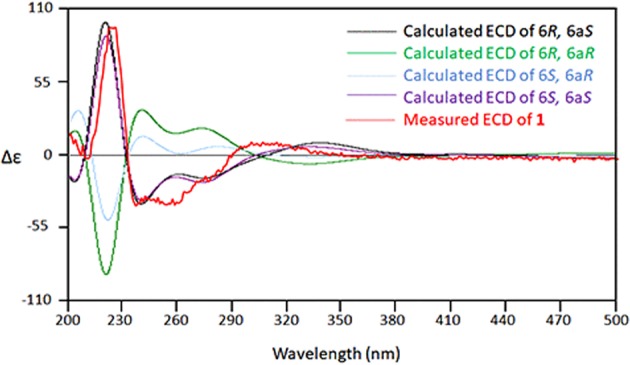
The emergence of antibiotic resistance necessitates not only the identification of new compounds with antimicrobial properties, but also new strategies and combination therapies to circumvent this growing problem. Here, we report synergistic activity against methicillin-resistant Staphylococcus aureus (MRSA) of the β-lactam antibiotic oxacillin combined with 7,8-dideoxygriseorhodin C in vitro. Ongoing efforts to identify antibiotics from marine mollusk-associated bacteria resulted in the isolation of 7,8-dideoxygriseorhodin C from a Streptomyces sp. strain cultivated from a marine gastropod tissue homogenate. Despite the long history of 7,8-dideoxygriseorhodin C in the literature, the absolute configuration has never been previously reported. A comparison of measured and calculated ECD spectra resolved the configuration of the spiroketal carbon C6, and 2D ROESY NMR spectroscopy established the absolute configuration as 6s,6aS. The compound is selective against Gram-positive bacteria including MRSA and Enterococcus faecium with an MIC range of 0.125-0.5 μg ml-1. Moreover, the compound synergizes with oxacillin against MRSA as observed in the antimicrobial microdilution and time-kill assays. Simultaneous treatment of the compound with oxacillin resulted in an approximately tenfold decrease in MIC with a combination index of <0.5, indicating synergistic anti-MRSA activity.


Conflict of interest statement

The authors declare that they have no conflict of interest.

Figures
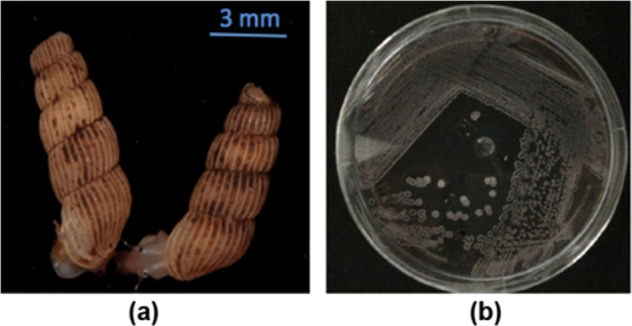
Fig. 1
Fig. 1
Animal and microbial sources of 1. a Truncatella guerinii collected in Cebu, Philippines. b Streptomyces sp. (1425S.R.1a.1) grown on R2A agar with 2% NaCl isolated from the body tissue homogenate
Fig. 2
Fig. 2
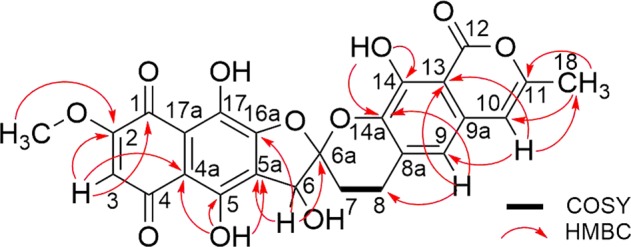
Key NMR correlations for the structural assignment of 1
Fig. 3
Fig. 3
Experimentally derived (red) vs. calculated ECD spectra of each possible diastereomer of 7,8-dideoxygriseorhodin C. 6R,6aS (black) and 6S,6aS (purple) both match the experimental data, but are not distinguishable from one another
Fig. 4
Fig. 4
ROESY correlations for determination of absolute stereochemistry. a Spectrum centered on the relevant protons. Both H7a and H7b have clear ROESY cross-peaks with the hydroxyl proton 6-OH (green). These signals were in phase with cross-peaks between protons on C7 and C8, and out of phase with signals arising from exchangeable phenolic protons, indicating real ROESY correlations. Only one, however, shows a correlation to H6. b 3D spatial orientation of H6, 6-OH, H7a, and H7b from Gaussian generated model for 6S,6aS stereoconfiguration. In this orientation, the 6-OH is positioned close to and approximately equidistant from the two methylene protons on carbon 7, while H6 is oriented further from both, especially H7b. c Absolute configuration of 1 with supporting NOE correlations
Fig. 5
Fig. 5
Synergistic anti-MRSA activity of 7,8-dideoxygriseorhodin C and oxacillin using the time-kill assay. MRSA was treated singly or in combination with subinhibitory concentrations of 7,8-dideoxygriseorhodin C (1) and oxacillin (oxa) and CFU/mL were determined at 0, 2, 4, 8, 20, and 30 h

References

    1. Lin Z, Zachariah MM, Marett L, Hughen RW, Teichert RW, Concepcion GP, et al. Griseorhodins D–F, neuroactive intermediates and end products of post-PKS tailoring modification in griseorhodin biosynthesis. J Nat Prod. 2014;77:1224–30. doi: 10.1021/np500155d. - DOI - PMC - PubMed
    1. Lin Z, Torres JP, Ammon MA, Marett L, Teichert RW, Reilly CA, et al. A bacterial source for mollusk pyrone polyketides. Chem Biol. 2013;20:73–81. doi: 10.1016/j.chembiol.2012.10.019. - DOI - PMC - PubMed
    1. Lin Z, Flores M, Forteza I, Henriksen NM, Concepcion GP, Rosenberg G, et al. Totopotensamides, polyketide–cyclic peptide hybrids from a mollusk-associated Bacterium Streptomyces sp. J Nat Prod. 2012;75:644–9. doi: 10.1021/np200886x. - DOI - PMC - PubMed
    1. Lin Z, Reilly CA, Antemano R, Hughen RW, Marett L, Concepcion GP, et al. Nobilamides A–H, long-acting transient receptor potential vanilloid-1 (TRPV1) antagonists from mollusk-associated bacteria. J Med Chem. 2011;54:3746–55. doi: 10.1021/jm101621u. - DOI - PMC - PubMed
    1. Eckardt K, Tresselt D, Ihn W. The structure of the antibiotic griseorhodin C. J Antibiot. 1978;31:970–3. doi: 10.7164/antibiotics.31.970. - DOI - PubMed

Publication types

MeSH terms