


Kv1.3 Channel as a Key Therapeutic Target for Neuroinflammatory Diseases: State of the Art and Beyond
- PMID: 31992966
- PMCID: PMC6971160
- DOI: 10.3389/fnins.2019.01393
Kv1.3 Channel as a Key Therapeutic Target for Neuroinflammatory Diseases: State of the Art and Beyond
Erratum in
-
Corrigendum: Kv1.3 Channel as a Key Therapeutic Target for Neuroinflammatory Diseases: State of the Art and Beyond.Front Neurosci. 2020 Feb 28;14:163. doi: 10.3389/fnins.2020.00163. eCollection 2020. Front Neurosci. 2020. PMID: 32184707 Free PMC article.
Abstract
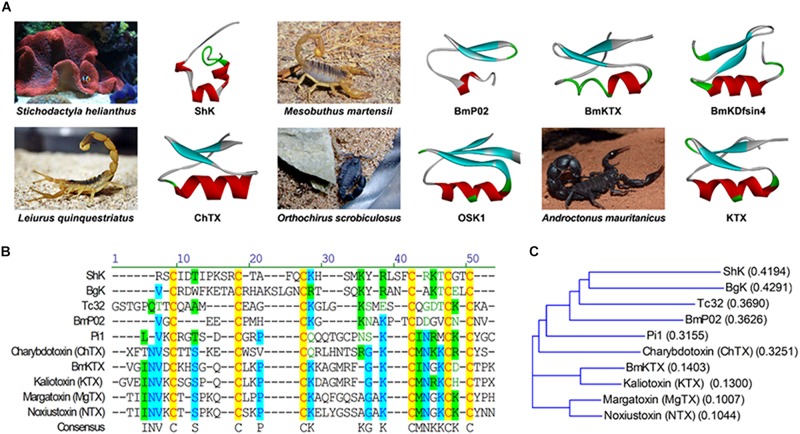
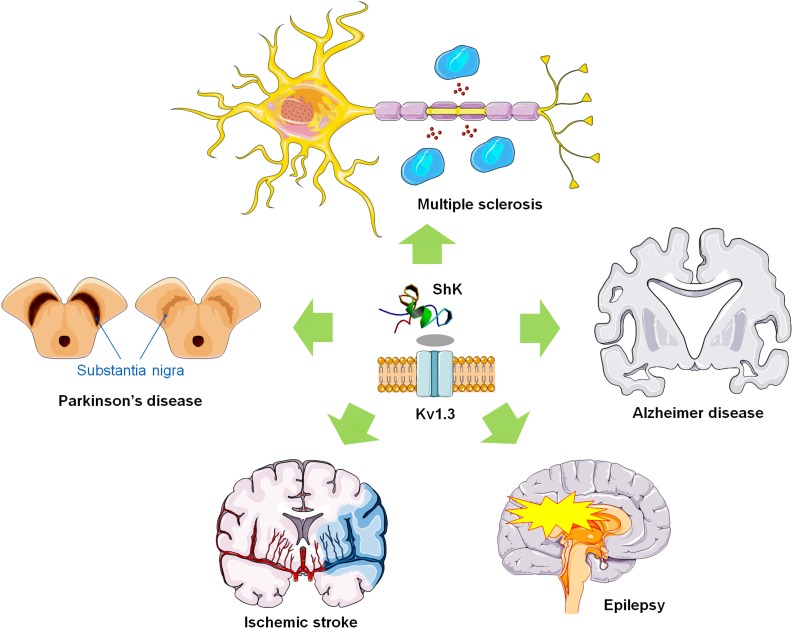
It remains a challenge for the effective treatment of neuroinflammatory disease, including multiple sclerosis (MS), stroke, epilepsy, and Alzheimer's and Parkinson's disease. The voltage-gated potassium Kv1.3 channel is of interest, which is considered as a novel therapeutic target for treating neuroinflammatory disorders due to its crucial role in subsets of T lymphocytes as well as microglial cells. Toxic animals, such as sea anemones, scorpions, spiders, snakes, and cone snails, can produce a variety of toxins that act on the Kv1.3 channel. The Stichodactyla helianthus K+ channel blocking toxin (ShK) from the sea anemone S. helianthus is proved as a classical blocker of Kv1.3. One of the synthetic analogs ShK-186, being developed as a therapeutic for autoimmune diseases, has successfully completed first-in-man Phase 1 trials. In addition to addressing the recent progress on the studies underlying the pharmacological characterizations of ShK on MS, the review will also explore the possibility for clinical treatment of ShK-like Kv1.3 blocking polypeptides on other neuroinflammatory diseases.
Keywords: Alzheimer’s disease; Kv1.3; Parkinson’s disease; ShK; epilepsy; multiple sclerosis; neuroinflammatory disease; stroke.
Copyright © 2020 Wang, Li, Guo, Zhang, Zhang, Zhu, Cheng, Yu, Ji and Tao.
Figures
References
-
- Aneiros A., Garcia I., Martinez J. R., Harvey A. L., Anderson A. J., Marshall D. L., et al. (1993). A potassium channel toxin from the secretion of the sea anemone Bunodosoma granulifera. Isolation, amino acid sequence and biological activity. Biochim. Biophys. Acta 1157 86–92. 10.1016/0304-4165(93)90082-j - DOI - PubMed
Publication types
LinkOut - more resources
Full Text Sources
Other Literature Sources
