


Locomotor Muscles in COPD: The Rationale for Rehabilitative Exercise Training
- PMID: 31992992
- PMCID: PMC6971045
- DOI: 10.3389/fphys.2019.01590
Locomotor Muscles in COPD: The Rationale for Rehabilitative Exercise Training
Abstract
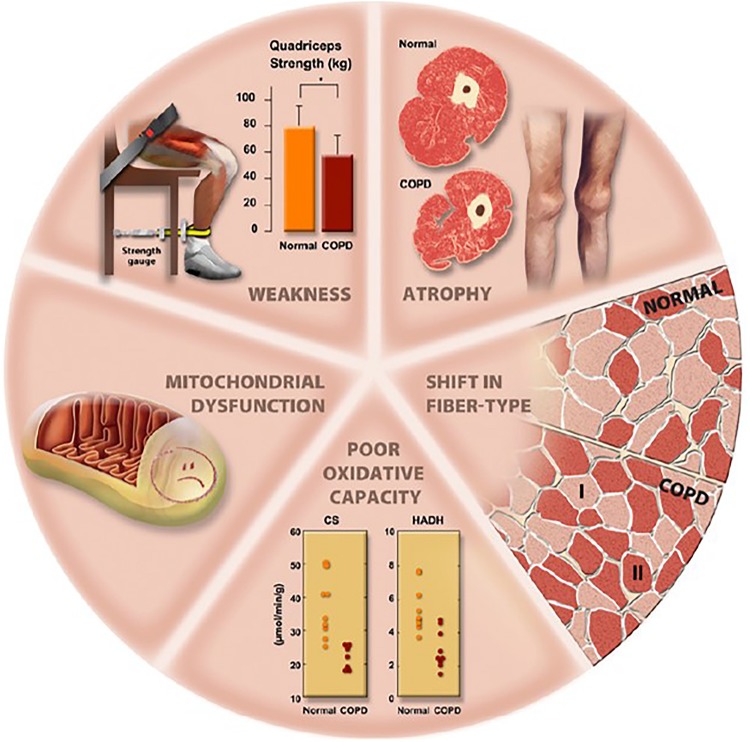
Exercise training as part of pulmonary rehabilitation is arguably the most effective intervention to improve tolerance to physical exertion in patients with chronic obstructive pulmonary disease (COPD). Owing to the fact that exercise training has modest effects on exertional ventilation, operating lung volumes and respiratory muscle performance, improving locomotor muscle structure and function are key targets for pulmonary rehabilitation in COPD. In the current concise review, we initially discuss whether patients' muscles are exposed to deleterious factors. After presenting corroboratory evidence on this regard (e.g., oxidative stress, inflammation, hypoxemia, inactivity, and medications), we outline their effects on muscle macro- and micro-structure and related functional properties. We then finalize by addressing the potential beneficial consequences of different training strategies on these muscle-centered outcomes. This review provides, therefore, an up-to-date outline of the rationale for rehabilitative exercise training approaches focusing on the locomotor muscles in this patient population.
Keywords: chronic obstructive pulmonary disease; exercise training; muscle function; pulmonary rehabilitation; skeletal muscle.
Copyright © 2020 Marillier, Bernard, Vergès and Neder.
Figures
References
-
- Abbiss C. R., Karagounis L. G., Laursen P. B., Peiffer J. J., Martin D. T., Hawley J. A., et al. (2011). Single-leg cycle training is superior to double-leg cycling in improving the oxidative potential and metabolic profile of trained skeletal muscle. J. Appl. Physiol. 110 1248–1255. 10.1152/japplphysiol.01247.2010 - DOI - PubMed
Publication types
LinkOut - more resources
Full Text Sources
