Review
. 2020 Jan 14:9:1419.
doi: 10.3389/fonc.2019.01419. eCollection 2019.

Regulation Networks Driving Vasculogenic Mimicry in Solid Tumors

Affiliations
Review

Regulation Networks Driving Vasculogenic Mimicry in Solid Tumors

Olga N Hernández de la Cruz et al. Front Oncol. .

Abstract

Vasculogenic mimicry (VM) is a mechanism whereby cancer cells form microvascular structures similar to three-dimensional channels to provide nutrients and oxygen to tumors. Unlike angiogenesis, VM is characterized by the development of new patterned three-dimensional vascular-like structures independent of endothelial cells. This phenomenon has been observed in many types of highly aggressive solid tumors. The presence of VM has also been associated with increased resistance to chemotherapy, low survival, and poor prognosis. MicroRNAs (miRNAs) and long non-coding RNAs (lncRNAs) are non-coding RNAs that regulate gene expression at the post-transcriptional level through different pathways. In recent years, these tiny RNAs have been shown to be expressed aberrantly in different human malignancies, thus contributing to the hallmarks of cancer. In this context, miRNAs and lncRNAs can be excellent biomarkers for diagnosis, prognosis, and the prediction of response to therapy. In this review, we discuss the role that the tumor microenvironment and the epithelial-mesenchymal transition have in VM. We include an overview of the mechanisms of VM with examples of diverse types of tumors. Finally, we describe the regulation networks of lncRNAs-miRNAs and their clinical impact with the VM. Knowing the key genes that regulate and promote the development of VM in tumors with invasive, aggressive, and therapy-resistant phenotypes will facilitate the discovery of novel biomarker therapeutics against cancer as well as tools in the diagnosis and prognosis of patients.

Keywords: cancer; epithelial-mesenchymal transition; long non-coding RNAs; microRNAs; tumor microenvironment; vasculogenic mimicry.


Figures

Figure 1
Figure 1
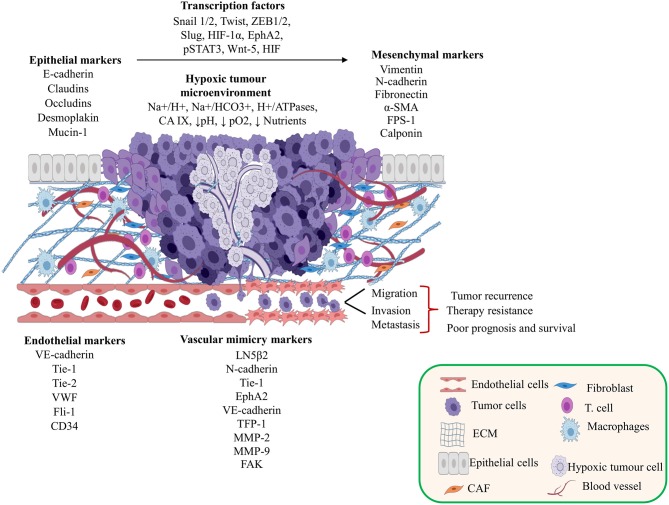
Contribution of the tumor microenvironment and epithelial-mesenchymal transition (EMT) in vasculogenic mimicry (VM) formation. This figure shows the tumor microenvironment effects and the relationships between transcriptional factors, EMT, and endothelial cell markers during the development of VM. Created with Biorender.com.
Figure 2
Figure 2
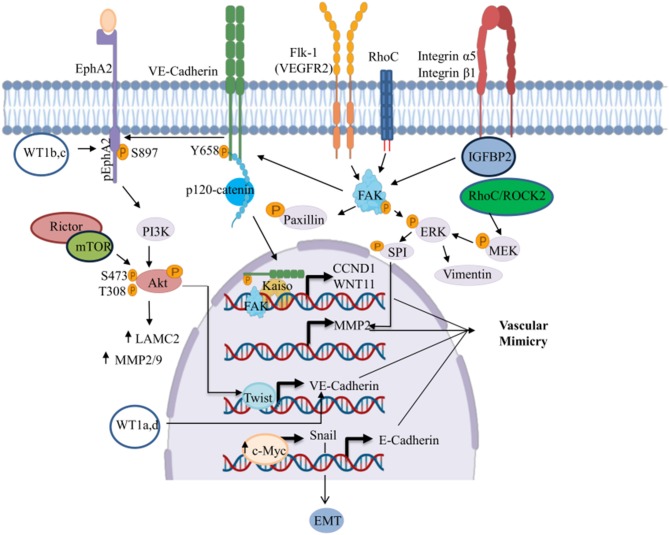
Signaling pathways involved in the regulation of VM. This figure shows the signaling pathways triggering the transcriptional activation of genes involved in the development of VM. ↑, Increased; formula image, phosphorylated. Created with Biorender.com.
Figure 3
Figure 3
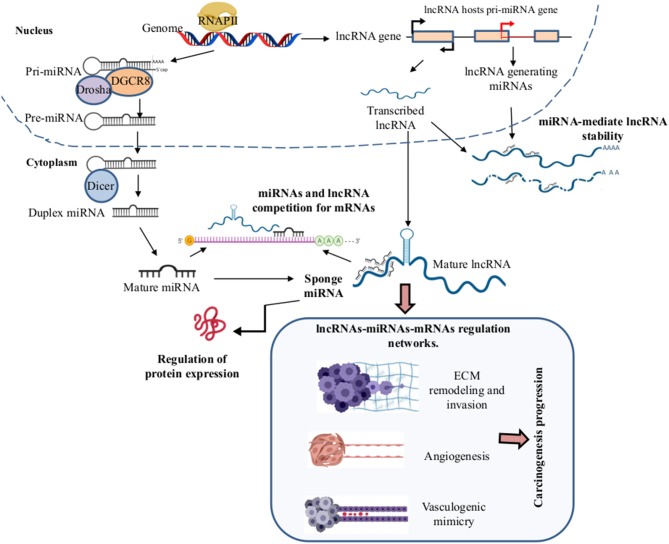
Long non-coding RNAs (lncRNAlncRNAs)–microRNAs (miRNAs)–mRNAs regulation networks in the VM development. During the biogenesis of the miRNAs and lncRNAs in the nucleus by the RNAPII, the pri-miRNA and lncRNAs are exported to the cytoplasm where the mature miRNAs and lncRNAs are formed, respectively. In the cytoplasm, LncRNAs can function as sponges of miRNAs by competition for the binding to mRNA target genes, leading to the formation of complex regulatory networks of lncRNAs-miRNAs-mRNAs, promoting angiogenesis, extracellular matrix (ECM) remodeling, invasion, migration, EMT, metastasis, and VM formation in solid tumors. Created with Biorender.com.
Figure 4
Figure 4
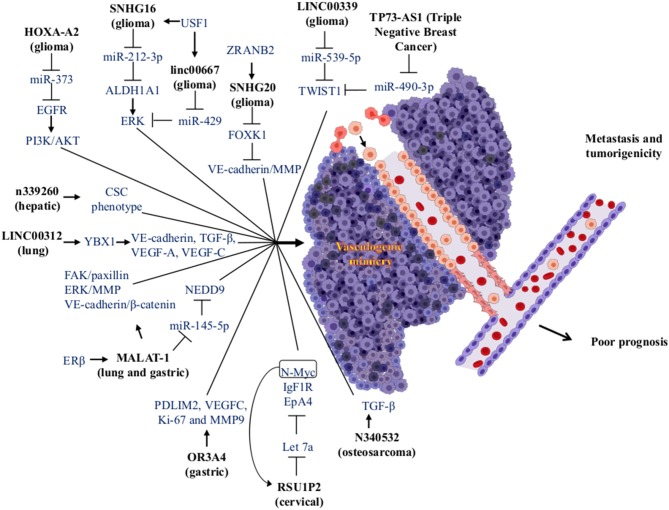
Modulation of miRNAs and lncRNAs associated with VM formation. The lncRNAs (bold letters) can interact with miRNAs or proteins, impacting various signaling pathways, which in turn trigger the formation of VM structures in tumors. The VM has been associated with an increase in metastasis and tumorigenicity, being factors that cause a poor prognosis in cancer patients. Created with Biorender.com.

References

    1. Cao Z, Shang B, Zhang G, Miele L, Sarkar FH, Wang Z, et al. Tumor cell-mediated neovascularization and lymphangiogenesis contrive tumor progression and cancer metastasis. Biochim Biophys Acta. (2013) 1836:273–86. 10.1016/j.bbcan.2013.08.001 - DOI - PubMed
    1. Furuya M, Nishiyama M, Kasuya Y, Kimura S, Ishikura H. Pathophysiology of tumor neovascularization. Vasc Health Risk Manag. (2005) 1:277–90. 10.2147/vhrm.2005.1.4.277 - DOI - PMC - PubMed
    1. Katayama Y, Uchino J, Chihara Y, Tamiya N, Kaneko Y, Yamada T, et al. Tumor neovascularization and developments in therapeutics. Cancers. (2019) 11:316. 10.3390/cancers11030316 - DOI - PMC - PubMed
    1. Delgado-Bellido D, Serrano-Saenz S, Fernandez-Cortes M, Oliver FJ. Vasculogenic mimicry signaling revisited: focus on non-vascular VE-cadherin. Mol Cancer. (2017) 16:65. 10.1186/s12943-017-0631-x - DOI - PMC - PubMed
    1. Kirschmann DA, Seftor EA, Hardy KM, Seftor RE, Hendrix MJ. Molecular pathways:vasculogenic mimicry in tumor cells:diagnostic and therapeutic implications. Clin Cancer Res. (2012) 18:2726–32. 10.1158/1078-0432.CCR-11-3237 - DOI - PMC - PubMed

LinkOut - more resources