Review
. 2020 Jan 9;5(1):11-21.
doi: 10.1016/j.ncrna.2020.01.001. eCollection 2020 Mar.

MicroRNA-486-5p and microRNA-486-3p: Multifaceted pleiotropic mediators in oncological and non-oncological conditions

Affiliations
Review

MicroRNA-486-5p and microRNA-486-3p: Multifaceted pleiotropic mediators in oncological and non-oncological conditions

Aisha M ElKhouly et al. Noncoding RNA Res. .

Erratum in

Abstract

Despite historically known as "junk" DNA, nowadays non-coding RNA transcripts (ncRNAs) are considered as fundamental players in various physiological and pathological conditions. Nonetheless, any alteration in their expression level has been reported to be directly associated with the incidence and aggressiveness of several diseases. MicroRNAs (miRNAs) are the well-studied members of the ncRNAs family. Several reports have highlighted their crucial roles in the post-transcriptional manipulation of several signaling pathways in different pathological conditions. In this review, our main focus is the multifaceted microRNA-486 (miR-486). miR-486-5p and miR-486-3p have been reported to have central roles in several types oncological and non-oncological conditions such as lung, liver, breast cancers and autism, intervertebral disc degeneration and metabolic syndrome, respectively. Moreover, we spotted the light onto the pleiotropic role of miR-486-5p in acting as competing endogenous RNA with other members of ncRNAs family such as long non-coding RNAs.

Keywords: Breast cancer; Liver cancer; Lung cancer; Xist; long non-coding RNAs; miR-486-3p; miR-486-5p.


Figures

Fig. 1
Fig. 1
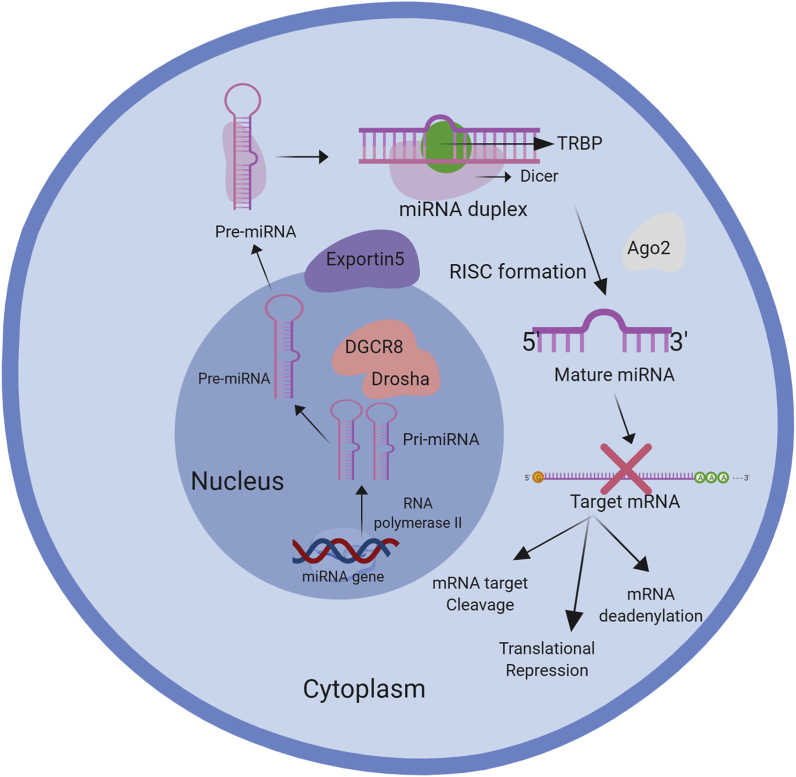
Biogenesis of miRNA's Canonical Pathway and mechanism of action. The biogenesis of Canonical miRNA is the chief path by which miRNAs are processed. miRNA gene is transcribed in the nucleus to produce primary microRNA (pri-miRNA) that goes through nuclear cleavage to generate a precursor (pre-miRNA). Pre-miRNA is transported to the cytoplasm to be cleaved resulting in miRNA duplex formation. Formerly, the unwinding of miRNA duplex takes place followed by binding to the RISC complex to form a mature miRNA. Each base-pair of a mature miRNA binds to its target mRNA leading to a direct gene silencing through inhibiting translation or mRNA cleavage or mRNA deadenylation.
Fig. 2
Fig. 2
Chromosomal location of miR-486-5p. Schematic representation of miR-486-5p gene locus; chromosomal mapping showed that miR-486 gene is located on somatic chromosome 8, long arm, region 11, band 21 (8p11.21).
Fig. 3
Fig. 3
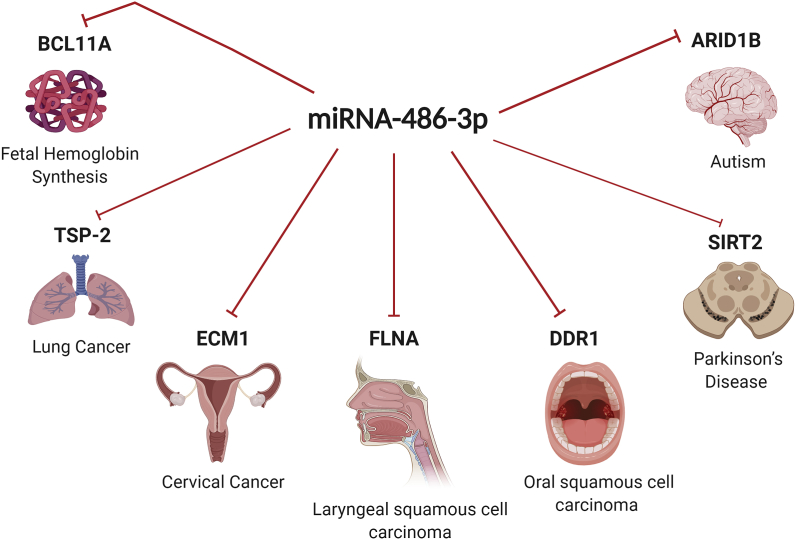
Multi-functional Role of miR-486-3p in simultaneously targeting several targets in different cellular contexts. miR-486-3p has several targets in different malignant and non-malignant conditions. It modulates the expression of several target proteins such as BCL11A, TSP-2, ECM1, FLNA, DDR1, SIRT2 and ARID1B in different body compartments as indicated in the diagram.
Fig. 4
Fig. 4
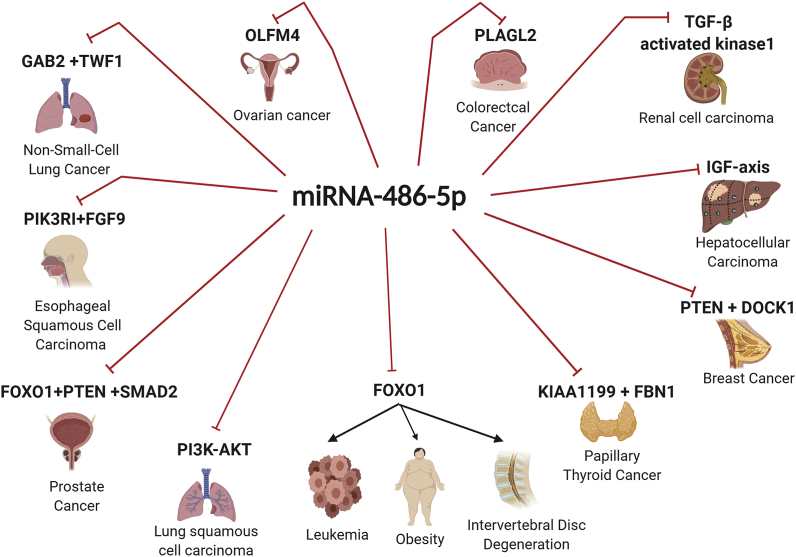
The pleiotropic role of miR-486-5p in manipulating several target genes in different cellular contexts. miR-486-5p has several targets in different malignant and non-malignant conditions. It modulates the expression of several target proteins such as TGF-β activated kinase1, PTEN, DOCK1,IGF- signaling pathway, KIAA1199, FBN1, FOXO1, PI3K-AKT,SMAD2, FGF9, PIK3RI, TWF1, GAB2, OLFM4 and PLAGL2.

References

    1. Delihas N. Discovery and characterization of the first non-coding RNA that regulates gene expression, micF RNA: a historical perspective. World J. Biol. Chem. 2015;6(4):272–280. - PMC - PubMed
    1. Anastasiadou E., Jacob L.S., Slack F.J. Non-coding RNA networks in cancer. Nat. Rev. Cancer. 2018;18(1):5–18. - PMC - PubMed
    1. Mizuno T., Chou M.Y., Inouye M. A unique mechanism regulating gene expression: translational inhibition by a complementary RNA transcript (micRNA) Proc. Natl. Acad. Sci. U. S. A. 1984;81(7):1966–1970. - PMC - PubMed
    1. Waters L.S., Storz G. Regulatory RNAs in bacteria. Cell. 2009;136(4):615–628. - PMC - PubMed
    1. O'Brien J. Overview of MicroRNA biogenesis, mechanisms of actions, and circulation. Front. Endocrinol. 2018;9:402. - PMC - PubMed

LinkOut - more resources