Review
. 2020 Nov;17(11):1560-1575.
doi: 10.1080/15476286.2020.1722449. Epub 2020 Feb 7.

RNA modifications and cancer

Affiliations
Review

RNA modifications and cancer

Phensinee Haruehanroengra et al. RNA Biol. 2020 Nov.

Abstract

RNA plays essential roles in not only translating nucleic acids into proteins, but also in gene regulation, environmental interactions and many human diseases. Nature uses over 150 chemical modifications to decorate RNA and diversify its functions. With the fast-growing RNA research in the burgeoning field of 'epitranscriptome', a term describes post-transcriptional RNA modifications that can dynamically change the transcriptome, it becomes clear that these modifications participate in modulating gene expression and controlling the cell fate, thereby igniting the new interests in RNA-based drug discovery. The dynamics of these RNA chemical modifications is orchestrated by coordinated actions of an array of writer, reader and eraser proteins. Deregulated expression of these RNA modifying proteins can lead to many human diseases including cancer. In this review, we highlight several critical modifications, namely m6A, m1A, m5C, inosine and pseudouridine, in both coding and non-coding RNAs. In parallel, we present a few other cancer-related tRNA and rRNA modifications. We further discuss their roles in cancer promotion or tumour suppression. Understanding the molecular mechanisms underlying the biogenesis and turnover of these RNA modifications will be of great significance in the design and development of novel anticancer drugs.

Keywords: RNA modifications; cancer; epitranscriptome.


Conflict of interest statement

No potential conflict of interest was reported by the authors.

Figures
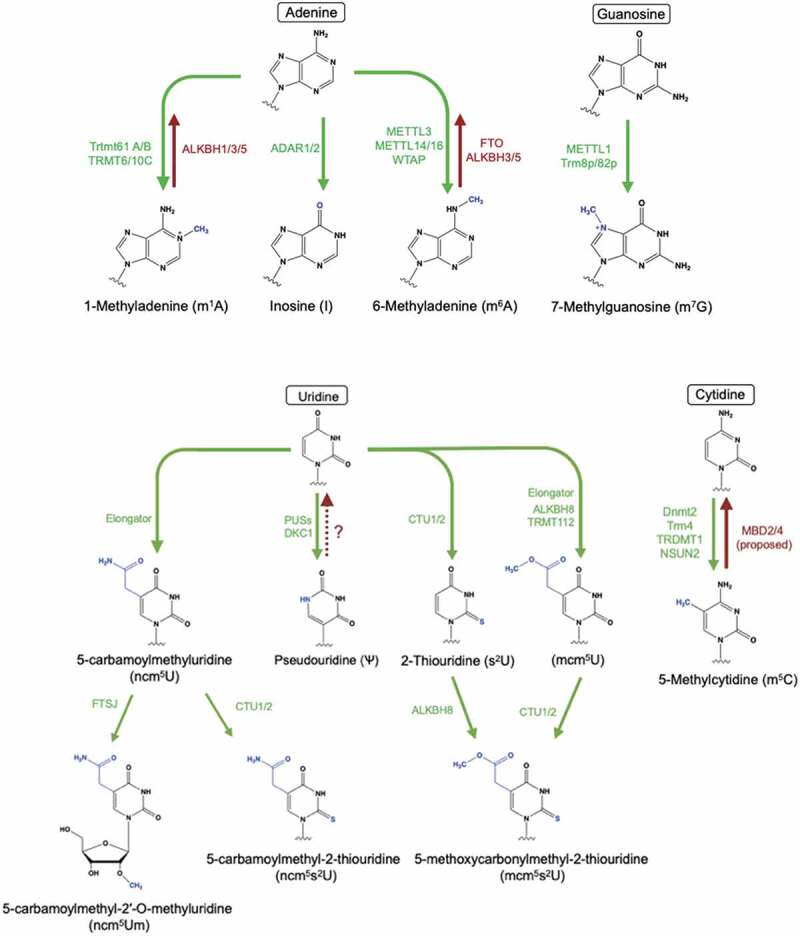
Figure 1.
Figure 1.
Chemical structures of RNA modifications on adenosine, cytosine and uridine. In green are the enzymes catalysing the reaction of the modification (writer) and in red are the putative enzymes removing the modification (erasers). The modification sites are coloured in blue. The abbreviations of the modified nucleosides are shown in the parenthesis.
Figure 2.
Figure 2.
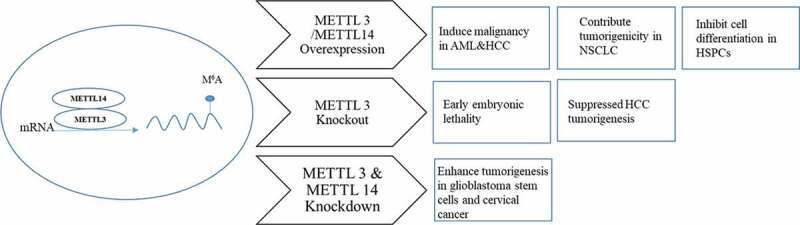
METTL3 is the main writer protein and works together with the substrate-recognizing subunit METTL14 to catalyse the methylation of m6A on mRNA. Overexpression of METTL3 was observed in acute myeloid leukaemia (AML), human hepatocellular carcinoma (HCC) and NSCLC (non-small cell lung carcinoma). Overexpression of both METTL3 and METTL4 was found in human haematopoietic stem and progenitor cells (HSPCs). Knockout of METTL3 in vivo causes early embryonic lethality and suppresses HCC tumorigenesis. By contrast, knockdown of both METTL3 and METTL 14 promoted tumorigenesis in brain and cervical cancers.
Figure 3.
Figure 3.
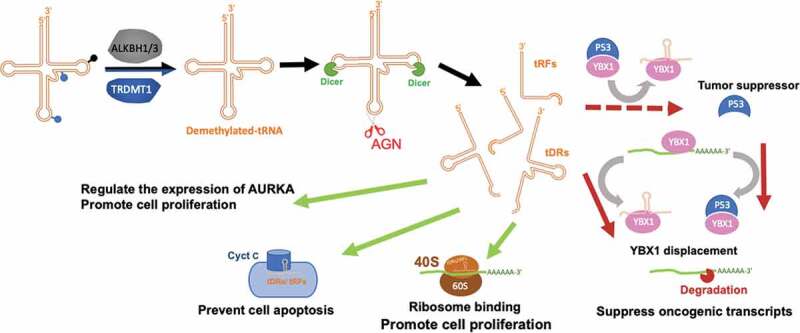
tRNA-derived small RNAs (tDRs) and tRNA-derived fragment (tRFs) affect multiple pathways to regulate gene expression and cell fate. The m6A, m1A and m3C on tRNA can be demethylated by ALKBH1 and ALKBH3 while TRDMT1 catalyzes 5mC demethylation. Demethylated-tRNA is prone to the formation of tDRs/tRFs through dicer and angiogenin (AGN) pathways. The tDRs promote cancer cell proliferation through three possible mechanisms (green arrows). On the contrary, the red arrow shows the modulation of invasion and metastatic lung colonization through tDRs-YBX1 binding, which tends to suppress oncogenic transcripts.
Figure 4.
Figure 4.
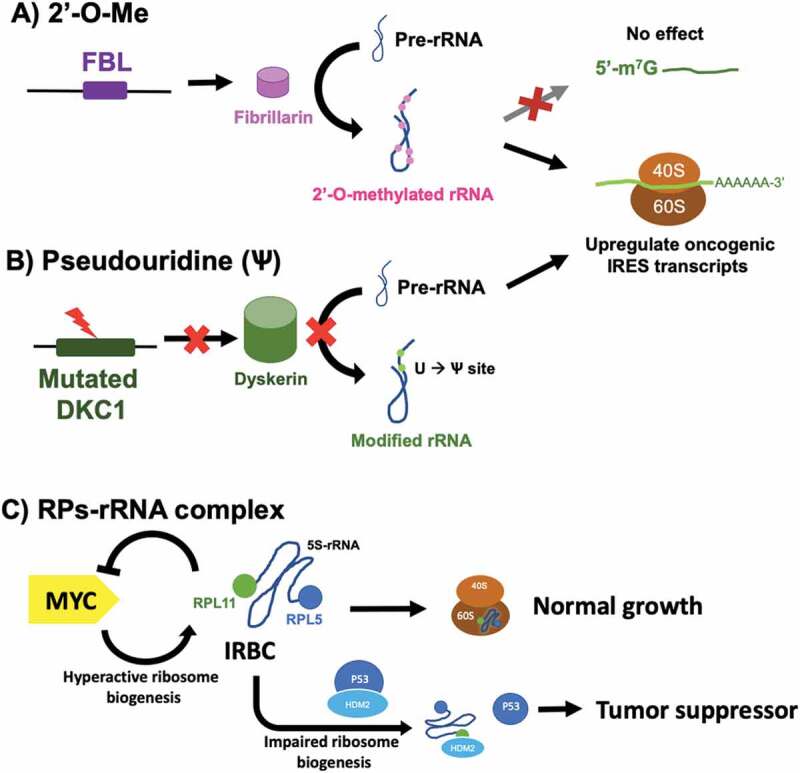
2ʹ-O-methylated rRNA showed direct correlation to cancer progression while pseudouridine modification was reported to have a negative correlation with cancer progression. (A) FBL regulates the methylation on rRNA leading to the upregulation of IRES-containing oncogenic transcripts, but has limited effects on m7G cap-dependent translation. (B) Pseudouridine on rRNA is regulated by DKC1. The knockdown DKC1 gene downregulates tumour suppressor proteins (P53 and P27) while upregulates the translation of VEGF. (C) The ribosomal protein complex with 5S-rRNA (IRBC) to regulate tumour proliferation by binding to HDM2 of the p53-HDM2 complex [220].
Figure 5.
Figure 5.
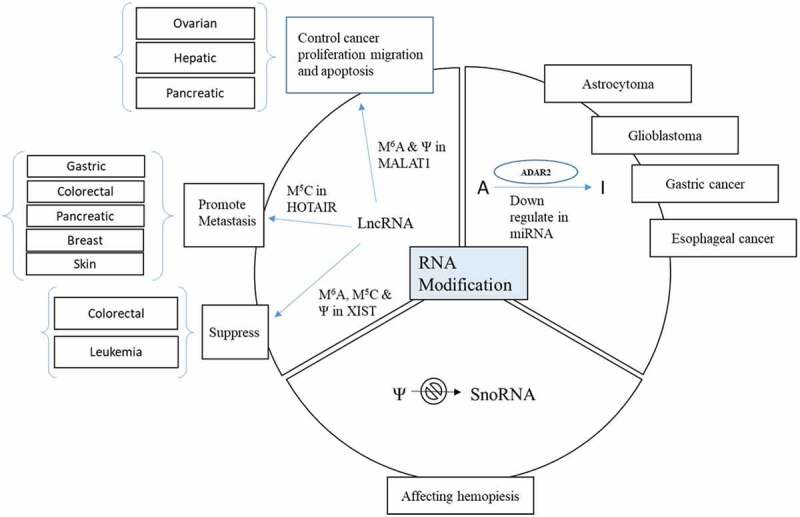
Examples of aberrant RNA modifications in cancer-related lncRNAs. M6A and Ψ in MALAT1 were reported to function as a regulator of metastasis to control cancer cell proliferation, migration and apoptosis in pancreatic, hepatic and ovarian cancers. M5C in HOTAIR can promote metastasis in gastric, colorectal, pancreatic, hepatic, breast and skin cancers.

References

    1. Jia G, Fu Y, He C.. Reversible RNA adenosine methylation in biological regulation. Trends Genet. 2013;29(2):108–115. - PMC - PubMed
    1. Noh JH, Kim KM, McClusky WG, et al. Cytoplasmic functions of long noncoding RNAs. Wiley Interdiscip Rev RNA. 2018;9(3):e1471. - PMC - PubMed
    1. Yin X, Liang C, Feng Y, et al. Research progress on synthetic scaffold in metabolic engineering - a review. Sheng Wu Gong Cheng Xue Bao. 2019;35(3):363–374. - PubMed
    1. den Boon JA, Ahlquist P.. Organelle-like membrane compartmentalization of positive-strand RNA virus replication factories. Annu Rev Microbiol. 2010;64:241–256. - PubMed
    1. Howard MJ, Liu X, Lim WH, et al. RNase P enzymes: divergent scaffolds for a conserved biological reaction. RNA Biol. 2013;10(6):909–914. - PMC - PubMed

Publication types