


Interpersonal life stress, inflammation, and depression in adolescence: Testing Social Signal Transduction Theory of Depression
- PMID: 31995664
- PMCID: PMC7000138
- DOI: 10.1002/da.22987
Interpersonal life stress, inflammation, and depression in adolescence: Testing Social Signal Transduction Theory of Depression
Abstract
Background: Depression rates increase markedly for girls across the adolescent transition, but the social-environmental and biological processes underlying this phenomenon remain unclear. To address this issue, we tested a key hypothesis from Social Signal Transduction Theory of Depression, which posits that individuals who mount stronger inflammatory responses to social stress should exhibit greater increases in depressive symptoms following interpersonal life stress exposure than those who mount weaker inflammatory responses to such stress.
Method: Participants were 116 adolescent girls (Mage = 14.71) at risk for psychopathology, defined as having a history of mental health concerns (e.g., psychiatric treatment, significant symptoms) over the past 2 years. At baseline, we characterized their inflammatory reactivity to social stress by quantifying their salivary proinflammatory cytokine responses to a laboratory-based social stressor. Then, 9 months later, we assessed the interpersonal and noninterpersonal stressful life events that they experienced over the prior 9 months using an interview-based measure of life stress.
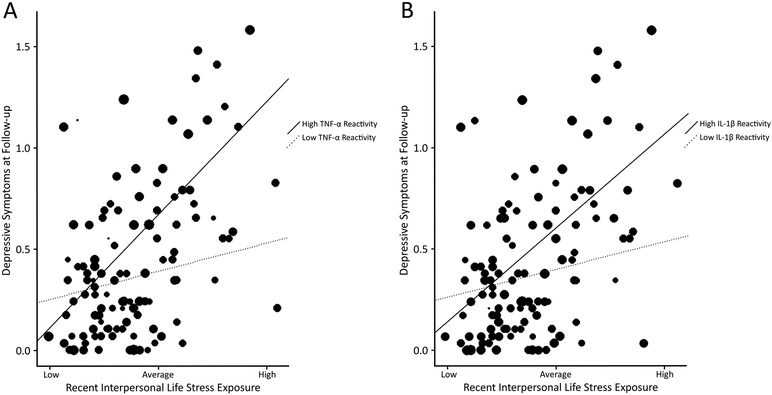
Results: As hypothesized, greater interpersonal life stress exposure was associated with significant increases in depression over time, but only for girls exhibiting stronger salivary tumor necrosis factor-α and interleukin-1β reactivity to social stress. In contrast, noninterpersonal stress exposure was unrelated to changes in depression longitudinally, both alone and when combined with youths' cytokine reactivity scores.
Discussion: These results are consistent with Social Signal Transduction Theory of Depression and suggest that heightened inflammatory reactivity to social stress may increase adolescents' risk for depression. Consequently, it may be possible to reduce depression risk by modifying inflammatory responses to social stress.
Keywords: cytokines; development; disease; inflammation; major depressive disorder; risk; social stress; vulnerability.
© 2020 Wiley Periodicals, Inc.
Figures
References
-
- Avenevoli S, Swendsen J, He JP, Burstein M, & Merikangas KR (2015). Major depression in the National Comorbidity Survey-Adolescent Supplement: Prevalence, correlates, and treatment. Journal of the American Academy of Child and Adolescent Psychiatry, 54, 37–44. 10.1016/j.jaac.2014.10.010 - DOI - PMC - PubMed
-
- Burt KB, & Obradović J (2013). The construct of psychophysiological reactivity: Statistical and psychometric issues. Developmental Review, 33, 29–57. 10.1016/j.dr.2012.10.002 - DOI
-
- Byrne ML, O’Brien-Simpson NM, Reynolds EC, Walsh KA, Laughton K, Waloszek JM, … & Allen NB (2013). Acute phase protein and cytokine levels in serum and saliva: A comparison of detectable levels and correlations in a depressed and healthy adolescent sample. Brain, Behavior, and Immunity, 34, 164–175. 10.1016/j.bbi.2013.08.010 - DOI - PubMed
MeSH terms
Substances
Grants and funding
LinkOut - more resources
Full Text Sources
Other Literature Sources
Medical
Research Materials
Miscellaneous
