


An integrated intervention for chronic care management in rural Nepal: protocol of a type 2 hybrid effectiveness-implementation study
- PMID: 31996250
- PMCID: PMC6990567
- DOI: 10.1186/s13063-020-4063-3
An integrated intervention for chronic care management in rural Nepal: protocol of a type 2 hybrid effectiveness-implementation study
Abstract
Background: In Nepal, the burden of noncommunicable, chronic diseases is rapidly rising, and disproportionately affecting low and middle-income countries. Integrated interventions are essential in strengthening primary care systems and addressing the burden of multiple comorbidities. A growing body of literature supports the involvement of frontline providers, namely mid-level practitioners and community health workers, in chronic care management. Important operational questions remain, however, around the digital, training, and supervisory structures to support the implementation of effective, affordable, and equitable chronic care management programs.
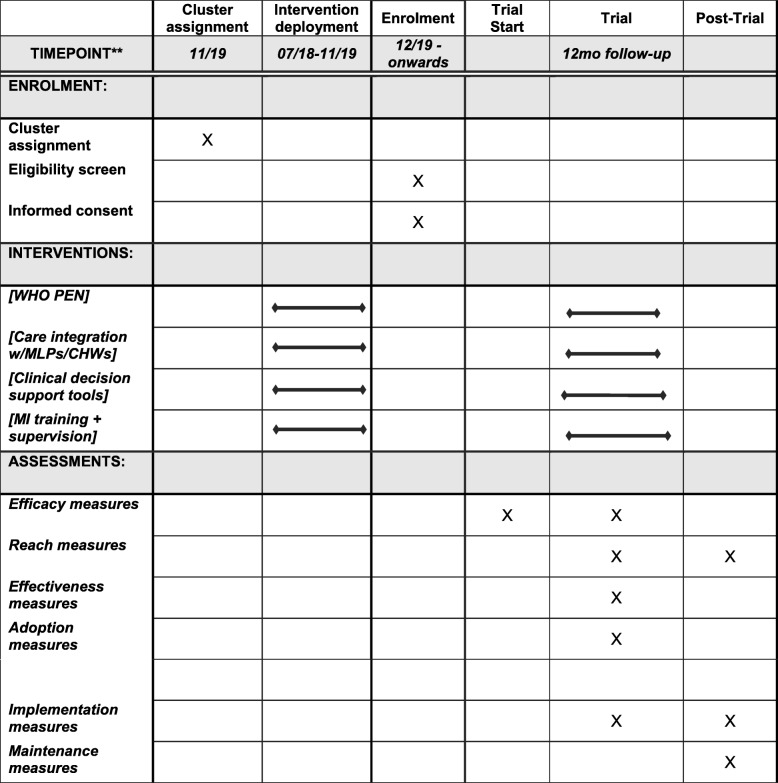
Methods: A 12-month, population-level, type 2 hybrid effectiveness-implementation study will be conducted in rural Nepal to evaluate an integrated noncommunicable disease care management intervention within Nepal's new municipal governance structure. The intervention will leverage the government's planned roll-out of the World Health Organization's Package of Essential Noncommunicable Disease Interventions (WHO-PEN) program in four municipalities in Nepal, with a study population of 80,000. The intervention will leverage both the WHO-PEN and its cardiovascular disease-specific technical guidelines (HEARTS), and will include three evidence-based components: noncommunicable disease care provision using mid-level practitioners and community health workers; digital clinical decision support tools to ensure delivery of evidence-based care; and training and digitally supported supervision of mid-level practitioners to provide motivational interviewing for modifiable risk factor optimization, with a focus on medication adherence, and tobacco and alcohol use. The study will evaluate effectiveness using a pre-post design with stepped implementation. The primary outcomes will be disease-specific, "at-goal" metrics of chronic care management; secondary outcomes will include alcohol and tobacco consumption levels.
Discussion: This is the first population-level, hybrid effectiveness-implementation study of an integrated chronic care management intervention in Nepal. As low and middle-income countries plan for the Sustainable Development Goals and universal health coverage, the results of this pragmatic study will offer insights into policy and programmatic design for noncommunicable disease care management in the future.
Trial registration: ClinicalTrials.gov, NCT04087369. Registered on 12 September 2019.
Keywords: Chronic illness; Community health workers; Decision support systems; Motivational interviewing; Nepal; Noncommunicable diseases; Rural health.
Conflict of interest statement
This study has been approved by the Ethical Review Board of the Nepal Health Research Council (#177/2018). Within the study, all patients will provide verbal informed consent to have their de-identified data analyzed and published. Care provision will be unrelated to consent, and there will be no difference in care provision based on consent status. Verbal informed consent will also be provided by all KII and FGD participants. No incentives will be provided to study participants, to avoid any conflict of interest or coercion to participate.
PA, AA, DC, BD, BG, TG, UK, PR, SS, and AT are employed by, and DS, BA, NC, SH, SM, RS, and DM work in partnership with, a nonprofit healthcare company (Nyaya Health Nepal, with support from the US-based nonprofit organization, Possible) that delivers free healthcare in rural Nepal using funds from the Government of Nepal and other public, philanthropic, and private foundation sources. DS and RS are employed at an academic medical center (Brigham and Women’s Hospital) that receives public-sector research funding, as well as revenue through private-sector fee-for-service medical transactions and private foundation grants. DS and RS are faculty members at a private medical school (Harvard Medical School). DS is employed at an academic medical center (Beth Israel Deaconess Medical Center) that receives public-sector research funding, as well as revenue through private-sector fee-for-service medical transactions and private foundation grants. DS is employed at an academic research center (Ariadne Labs) that is jointly supported by an academic medical center (Brigham and Women’s Hospital) and a private university (Harvard T.H. Chan School of Public Health) via public-sector research funding and private philanthropy. SD is a medical resident at a private academic medical center (Hurley Medical Center) that receives revenue through private-sector fee-for-service medical transactions and a charitable private foundation. AK is a medical resident at a private academic medical center (NYU Langone Health) that receives public-sector research funding, as well as revenue through private-sector fee-for-service medical transactions and private foundation grants. BA is a faculty member at a public university (University of California, San Francisco). AA is a fellow supported by a public-sector research fellowship affiliated at, and BKa and AS are faculty members at, a private university (Kathmandu University). DC is a faculty member at, SH is a graduate student at, and DC and SH are employed part-time at a public university (University of Washington). AB, DC, SK, SM, SS, and DM are faculty members at, and NC, SH, and EL are employed by, a private medical school (Icahn School of Medicine at Mount Sinai). MD is employed by the Government of Nepal (Ministry of Health and Population, Nepal Health Research Council). TG is a fellow with a bidirectional fellowship program (HEAL Initiative) that is affiliated with a public university (University of California, San Francisco) that receives funding from public, philanthropic, and private foundation sources. BKa is a faculty member at a public research university (Sun Yat-sen University). SK is the founding Executive Director at an advocacy and leadership network (Young Professionals Chronic Disease Network) that receives funding from individual philanthropy. SK serves as a consultant for Resolve To Save Lives on hypertension treatment and leads a partnership on multiple chronic conditions through his institution and Teva Pharmaceuticals. BKo is a faculty member at a public university (Tribhuvan University, Institute of Medicine). SM is a voting member on the Board of Directors with Group Care Global, a position for which she receives no compensation. RS is employed at an academic medical center (Massachusetts General Hospital) that receives public-sector research funding, as well as revenue through private-sector fee-for-service medical transactions and private foundation grants. AS is a faculty member at a private university (Yale School of Public Health). DM is a nonvoting member on Possible’s Board of Directors, a position for which he receives no compensation. All authors have read and understood
Figures
References
-
- Kyu HH, Abate D, Abate KH, Abay SM, Abbafati C, Abbasi N, et al. Global, regional, and national disability-adjusted life-years (DALYs) for 359 diseases and injuries and healthy life expectancy (HALE) for 195 countries and territories, 1990–2017: a systematic analysis for the Global Burden of Disease Study 2017. Lancet. 2018;392(10159):1859–1922. doi: 10.1016/S0140-6736(18)32335-3. - DOI - PMC - PubMed
-
- Roth GA, Abate D, Abate KH, Abay SM, Abbafati C, Abbasi N, et al. Global, regional, and national age-sex-specific mortality for 282 causes of death in 195 countries and territories, 1980–2017: a systematic analysis for the Global Burden of Disease Study 2017. Lancet. 2018;392(10159):1736–1788. doi: 10.1016/S0140-6736(18)32203-7. - DOI - PMC - PubMed
-
- Global status report on noncommunicable diseases 2014. Geneva: World Health Organization; 2014.
-
- Bloom DE, Cafiero ET, Jané-Llopis E, Abrahams-Gessel S, Bloom LR, Fathima S, et al. The global economic burden of noncommunicable diseases. Geneva: World Economic Forum and Harvard School of Public Health; 2011.
MeSH terms
Associated data
Grants and funding
LinkOut - more resources
Full Text Sources
Medical
Research Materials
