Review
. 2020 Jan 29;11(1):41.
doi: 10.1186/s13287-020-1552-y.

TGF-β/SMAD signaling regulation of mesenchymal stem cells in adipocyte commitment

Affiliations
Review

TGF-β/SMAD signaling regulation of mesenchymal stem cells in adipocyte commitment

Sheng-Nan Li et al. Stem Cell Res Ther. .

Abstract

Adipocytes arising from mesenchymal stem cells (MSCs) requires MSC adipocyte commitment and differentiation of preadipocytes to mature adipocytes. Several signaling and some cytokines affect the adipogenesis of MSCs. This review focuses on the roles of TGF-β/SMAD signaling in adipocyte commitment of MSCs. BMP4 and BMP7 signaling are sufficient to induce adipocyte lineage determination of MSCs. The roles of BMP2, TGF-β, and myostatin signaling in this process are unclear. Other TGF-β/SMAD signaling such as BMP3 and BMP6 signaling have almost no effect on commitment because of limited research available, while GDF11 signaling inhibits adipocyte commitment in human MSCs. In this review, we summarize the available information on TGF-β/SMAD signaling regulation of MSCs in adipocyte commitment. Deeper study of this commitment mechanism will offer new approaches in treating obesity, diabetes mellitus, and obesity-related metabolism syndrome.

Keywords: Commitment; Mesenchymal stem cells (MSCs); TGF-β/SMAD signaling.


Conflict of interest statement

The authors declare that they have no competing interests.

Figures
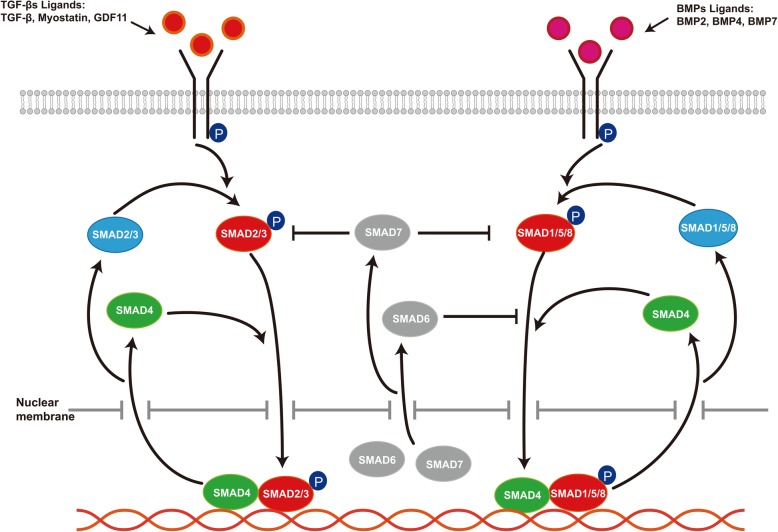
Fig. 1
Fig. 1
TGF-β/SMAD signaling. TGF-βs ligands such as TGF-β, Myostatin, and GDF11 in TGF-β/SMAD signaling bind to cell membrane receptors to phosphorylate the intracellular downstream SMAD2/3 (R-SMADs), and BMPs ligands such as BMP2, BMP4, and BMP7 phosphorylate the SMAD1/5/8 (R-SMADs). Activated R-SMADs form a complex with SMAD4 and then translocates to the nucleus to regulate the expression of specific genes. After the genes respond to the TGF-β/SMAD signaling, the R-SMADs–SMAD4 complex in the nucleus is depolymerized and they re-enter the cytoplasm. I-SMADs comprise SMAD6 and SMAD7, which negatively regulate TGF-β/SMAD signaling. In the resting state, I-SMADs mainly tend to be in the nucleus. Transcriptionally activated by TGF-β/SMAD signaling, SMAD7 shuttling from the nucleus to the cytoplasm prevents R-SMAD phosphorylation. SMAD6 competes with SMAD1 for binding to SMAD4
Fig. 2
Fig. 2
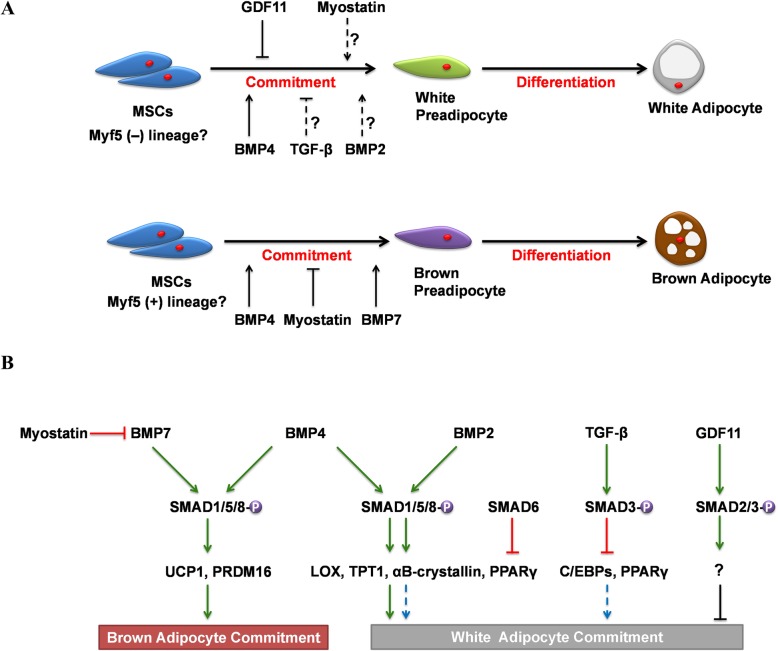
Schematic summary of TGF-β/SMAD signaling action on the adipocyte commitment of MSCs. a Adipocytes arise from MSCs by two steps: MSCs commit to preadipocytes and these preadipocytes differentiate into adipocytes. The adipocyte origin is more complex. The Myf5 lineage mainly gives rise to white preadipocytes, and the Myf5+ lineage gives rise to brown preadipocytes, but may not be absolute. BMP4 and BMP7 signaling are sufficient to induce adipocyte lineage determination. GDF11 inhibits the commitment of human MSCs. The roles of BMP2, TGF-β, and myostatin signaling in this process are unclear. It is uncertain whether they promote adipocyte commitment or inhibit it. b The major regulating mechanism of TGF-β/SMAD signaling in adipocyte commitment in MSCs

References

    1. Friedenstein AJ, Petrakova KV, Kurolesova AI, Frolova GP. Heterotopic of bone marrow. Analysis of precursor cells for osteogenic and hematopoietic tissues. Transplantation. 1968;6:230–247. doi: 10.1097/00007890-196803000-00009. - DOI - PubMed
    1. Friedenstein AJ, Deriglasova UF, Kulagina NN, Panasuk AF, Rudakowa SF, Luria EA, et al. Precursors for fibroblasts in different populations of hematopoietic cells as detected by the in vitro colony assay method. Exp Hematol. 1974;2:83–92. - PubMed
    1. Mushahary D, Spittler A, Kasper C, Weber V, Charwat V. Isolation, cultivation, and characterization of human mesenchymal stem cells. Cytometry A. 2018;93:19–31. doi: 10.1002/cyto.a.23242. - DOI - PubMed
    1. Compte M, Cuesta AM, Sanchez-Martin D, Alonso-Camino V, Vicario JL, Sanz L, et al. Tumor immunotherapy using gene-modified human mesenchymal stem cells loaded into synthetic extracellular matrix scaffolds. Stem Cells. 2009;27:753–760. doi: 10.1634/stemcells.2008-0831. - DOI - PMC - PubMed
    1. Pittenger MF, Mackay AM, Beck SC, Jaiswal RK, Douglas R, Mosca JD, et al. Multilineage potential of adult human mesenchymal stem cells. Science. 1999;284:143–147. doi: 10.1126/science.284.5411.143. - DOI - PubMed

Substances

LinkOut - more resources