


Staphylococcus aureus facilitates its survival in bovine macrophages by blocking autophagic flux
- PMID: 31997584
- PMCID: PMC7131951
- DOI: 10.1111/jcmm.15027
Staphylococcus aureus facilitates its survival in bovine macrophages by blocking autophagic flux
Abstract
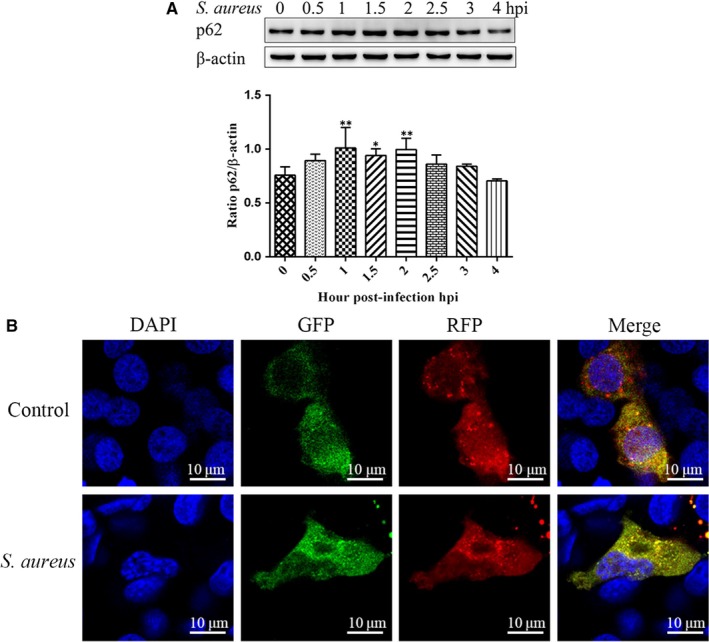
Staphylococcus aureus is a pathogen that is the causative agent of several human and veterinary infections and plays a critical role in the clinical and subclinical mastitis of cattle. Autophagy is a conserved pathogen defence mechanism in eukaryotes. Studies have reported that S aureus can subvert autophagy and survive in cells. Staphylococcus aureus survival in cells is an important cause of chronic persistent mastitis infection. However, it is unclear whether S aureus can escape autophagy in innate immune cells. In this study, initiation of autophagy due to the presence of S aureus was detected in bovine macrophages. We observed autophagic vacuoles increased after S aureus infection of bovine macrophages by transmission electron microscopy (TEM). It was also found that S aureus-infected bovine macrophages increased the expression of LC3 at different times(0, 0.5, 1, 1.5, 2, 2.5, 3 and 4 hours). Data also showed the accumulation of p62 induced by S aureus infection. Application of autophagy regulatory agents showed that the degradation of p62 was blocked in S aureus induced bovine macrophages. In addition, we also found that the accumulation of autophagosomes promotes S aureus to survive in macrophage cells. In conclusion, this study indicates that autophagy occurs in S aureus-infected bovine macrophages but is blocked at a later stage of autophagy. The accumulation of autophagosomes facilitates the survival of S aureus in bovine macrophages. These findings provide new insights into the interaction of S aureus with autophagy in bovine macrophages.
Keywords: Staphylococcus aureus; autophagy; bovine macrophage.
© 2020 The Authors. Journal of Cellular and Molecular Medicine published by Foundation for Cellular and Molecular Medicine and John Wiley & Sons Ltd.
Conflict of interest statement
The author(s) declare no potential conflicts of interests with respect to the research, authorship and/or publication of this article.
Figures




References
-
- Viguier C, Arora S, Gilmartin N, et al. Mastitis detection: current trends and future perspectives. Trends Biotechnol. 2009;27:486‐493. - PubMed
-
- Hogeveen H, Huijps K, Lam TJ. Economic aspects of mastitis: new developments. N Z Vet J. 2011;59:16‐23. - PubMed
-
- Vliegher SD, Fox LK, Piepers S, et al. Invited review: mastitis in dairy heifers: nature of the disease, potential impact, prevention, and control. J Dairy Sci. 2012;95:1025‐1040. - PubMed
-
- Dufour S, Dohoo IR, Barkema HW, et al. Manageable risk factors associated with the lactational incidence, elimination, and prevalence of Staphylococcus aureus intramammary infections in dairy cows. J Dairy Sci. 2012;95:1283‐1300. - PubMed
-
- Finlay BB, Cossart P. Exploitation of mammalian host cell functions by bacterial pathogens. Science. 1997;276(5313):718‐725. - PubMed
Publication types
MeSH terms
Substances
LinkOut - more resources
Full Text Sources
Medical
