


Virtual Reality (VR) in Assessment and Treatment of Addictive Disorders: A Systematic Review
- PMID: 31998066
- PMCID: PMC6965009
- DOI: 10.3389/fnins.2019.01409
Virtual Reality (VR) in Assessment and Treatment of Addictive Disorders: A Systematic Review
Abstract
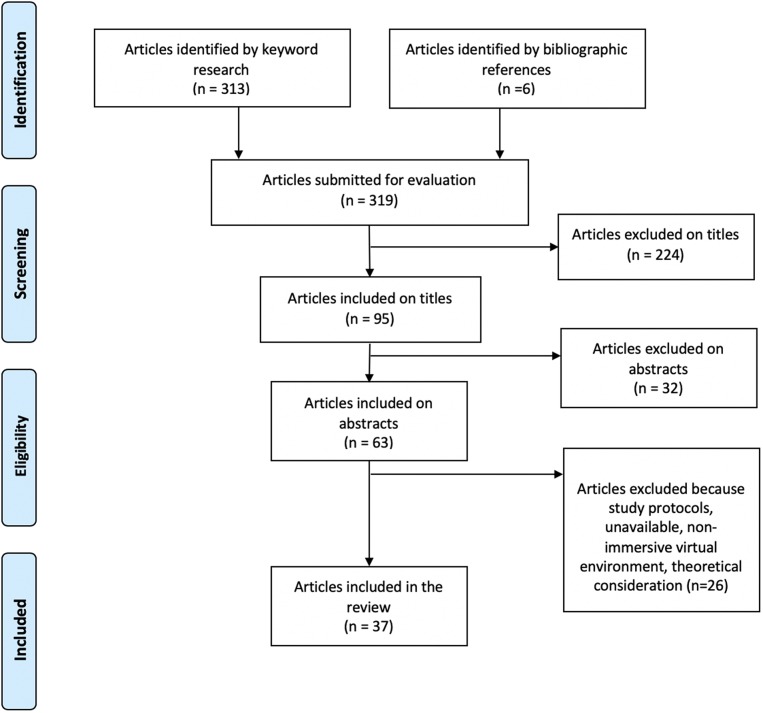
Background: Substance Use Disorder (SUD) and behavioral addictions are common and require a multidisciplinary approach. New technologies like Virtual Reality could have the potential to improve assessment and treatment of these disorders. Objective: In the present paper, we therefore present an overview of Virtual Reality (Head Mounted Devices) in the field of addiction medicine for craving assessment and treatment. Method: We conducted a systematic review by querying PubMed database for the titles of articles published up to March 2019 with the terms [virtual] AND [addictive] OR [addiction] OR [substance] OR [alcohol] OR [cocaine] OR [cannabis] OR [opioid] OR [tobacco] OR [nicotine] OR [methamphetamine] OR [gaming] OR [gambling]. Results: We screened 319 abstracts and analyzed 37 articles, dividing them into two categories, the first for assessment of cue reactivity (craving, psychophysiological response and attention to cue) and the second for intervention, each drug (nicotine, cocaine, alcohol, cannabis, gambling) being detailed within each category. Conclusions: This overview suggest that VR provide benefits in the assessment and treatment of substance use disorders and behavior addictions and achieve high levels of ecological validity. While, craving provocation in VR is effective across addiction disorders, treatments based exclusively on virtual exposure to drug related cues as shown heterogenous results.
Keywords: addictive behavior; alcohol; cocain; nicotine; virtual reality.
Copyright © 2020 Segawa, Baudry, Bourla, Blanc, Peretti, Mouchabac and Ferreri.
References
Publication types
LinkOut - more resources
Full Text Sources
Other Literature Sources
Medical
