


Can Academic Achievement in Primary School Students Be Improved Through Teacher Training on Emotional Intelligence as a Key Academic Competency?
- PMID: 31998203
- PMCID: PMC6967735
- DOI: 10.3389/fpsyg.2019.02976
Can Academic Achievement in Primary School Students Be Improved Through Teacher Training on Emotional Intelligence as a Key Academic Competency?
Abstract
Background: The primary aim of the current study was to develop a multi-methodological teacher training program based on emotional intelligence (EI) as a key competency in order to improve student academic achievement based on two methods: face-to-face instruction and game-based e-learning instruction.
Methods: Seventy-four primary education teachers and their 2069 students were randomly assigned to three groups. The first group of teachers (n = 23) were trained to use a face-to-face method. The objective of the training was that the teachers would be able to implement EI into their teaching to improve academic achievement in their students (n = 645) using face-to-face instruction. For the second group (n = 28), the teachers were trained to use an e-learning gamification method. Similar to the first group, the objective of the training was that the teachers would be able to implement EI into their teaching to improve academic achievement in their students (n = 758) using e-learning gamification instruction. The third group of teachers (n = 23) served as the controls and did not receive any special training, nor did they implement EI into their teaching (n = 666).
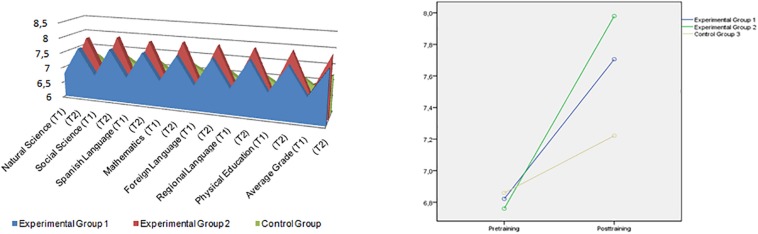
Results: Implementation of EI into classroom teaching effectively improved academic achievement in primary school students using both methods. However, there was a greater increase in academic achievement and higher teacher satisfaction in the game-based e-learning group. No significant differences in student achievement were observed in the control group.
Conclusion: Emotional intelligence as a key academic competency.
Keywords: academic achievement; emotional intelligence; methodology and didactics; primary school; satisfaction; teacher continued training.
Copyright © 2020 Pozo-Rico and Sandoval.
Figures
References
-
- Aslam M. (2018). Current trends and issues affecting academic libraries and leadership skills. Libr. Manag. 39 78–92. 10.1108/Lm-10-2016-0076 - DOI
-
- Barmpouti I., Vrettou M., Oungrinis K. A. (2015). “The role of phenomenology in education procedure,” in Proceedings of ADVED15 International Conference on Advances in Education and Social Sciences, Istanbul, 656–665.
-
- Baumeister A. E. E., Rindermann H., Barnett W. S. (2014). Creche attendance and children’s intelligence and behavior development. Learn. Individ. Differ. 30 1–10. 10.1016/j.lindif.2013.11.002 - DOI
-
- Boyatzis R. E. (2006). An overview of intentional change from a complexity perspective. J. Manag. Dev. 25 607–623. 10.1108/02621710610678445 - DOI
-
- Boyatzis R. E. (2008). Competencies in the 21st century. J. Manag. Dev. 27 5–12.
LinkOut - more resources
Full Text Sources
