


New Insights on the Role of Lipid Metabolism in the Metabolic Reprogramming of Macrophages
- PMID: 31998297
- PMCID: PMC6966486
- DOI: 10.3389/fimmu.2019.02993
New Insights on the Role of Lipid Metabolism in the Metabolic Reprogramming of Macrophages
Abstract
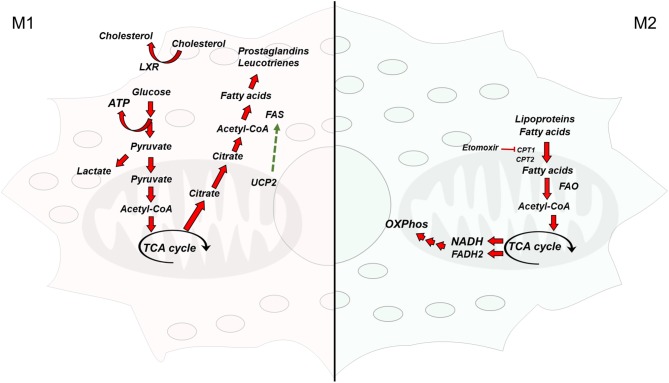
Macrophage activation is intimately linked to metabolic reprogramming. Inflammatory (M1) macrophages are able to sustain inflammatory responses and to kill pathogens, mostly by relying on aerobic glycolysis and fatty acid biosynthesis. Glycolysis is a fast way of producing ATP, and fatty acids serve as precursors for the synthesis of inflammatory mediators. On the opposite side, anti-inflammatory (M2) macrophages mediate the resolution of inflammation and tissue repair, switching their metabolism to fatty acid oxidation and oxidative phosphorylation. Over the years, this classical view has been challenged by recent discoveries pointing to a more complex metabolic network during macrophage activation. Lipid metabolism plays a critical role in the activation of both M1 and M2 macrophages. Recent evidence shows that fatty acid oxidation is also essential for inflammasome activation in M1 macrophages, and glycolysis is now known to fuel fatty acid oxidation in M2 macrophages. Ultimately, targeting lipid metabolism in macrophages can improve the outcome of metabolic diseases. Here, we review the main aspects of macrophage immunometabolism from the perspective of the metabolism of lipids. Building a reliable metabolic network during macrophage activation will bring us closer to targeting macrophages for improving human health.
Keywords: fatty acid oxidation; lipid metabolism; macrophages; metabolic reprogramming; oxidative phosphorylation.
Copyright © 2020 Batista-Gonzalez, Vidal, Criollo and Carreño.
Figures
References
-
- Munder M, Eichmann K, Modolell M. Alternative metabolic states in murine macrophages reflected by the nitric oxide synthase/arginase balance: competitive regulation by CD4+ T cells correlates with Th1/Th2 phenotype. J Immunol. (1998) 160:5347–54. - PubMed
Publication types
MeSH terms
LinkOut - more resources
Full Text Sources
Medical
