


Validation of the NoSAS Score for the Screening of Sleep-Disordered Breathing in a Sleep Clinic
- PMID: 31998424
- PMCID: PMC6977329
- DOI: 10.1155/2020/4936423
Validation of the NoSAS Score for the Screening of Sleep-Disordered Breathing in a Sleep Clinic
Abstract
Background: There is a growing number of patients with sleep-disordered breathing (SDB) referred to sleep clinics. Therefore, a simple but useful screening tool is urgent. The NoSAS score, containing only five items, has been developed and validated in population-based studies.
Aim: To evaluate the performance of the NoSAS score for the screening of SDB patients from a sleep clinic in China, and to compare the predictive value of the NoSAS score with the STOP-Bang questionnaire.
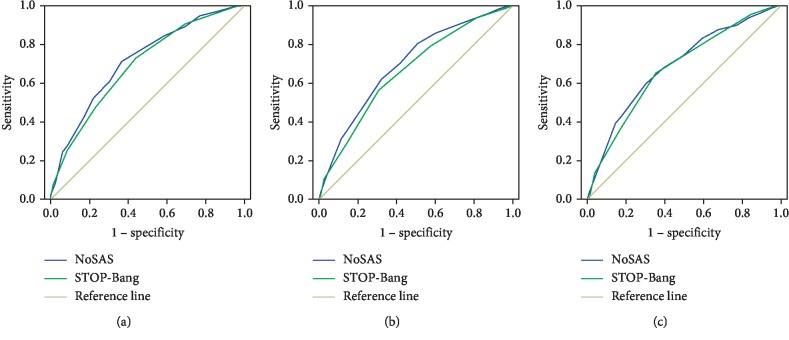
Methods: We enrolled consecutive patients from a sleep clinic who had undergone apnea-hypopnea index (AHI) testing by type III portable monitor device at the hospital and completed the STOP-Bang questionnaire. The NoSAS score was assessed by reviewing medical records. Sensitivity, specificity, positive predictive value, negative predictive value, and area under the receiver operating characteristic curve (AUC) of both screening tools were calculated at different AHI cutoffs to compare the performance of SDB screening.
Results: Of the 596 eligible patients (397 males and 199 female), 514 were diagnosed with SDB. When predicting overall (AHI ≥ 5), moderate-to-severe (AHI ≥ 15), and severe (AHI ≥ 30) SDB, the sensitivity and specificity of the NoSAS score were 71.2, 80.4, and 83.1% and 62.4, 49.3, and 40.7%, respectively. At all AHI cutoffs, the AUC ranged from 0.688 to 0.715 for the NoSAS score and from 0.663 to 0.693 for the STOP-Bang questionnaire. The NoSAS score had the largest AUC (0.715, 95% CI: 0.655-0.775) of diagnosing SDB at AHI cutoff of ≥5 events/h. NoSAS performed better in discriminating moderate-to-severe SDB than STOP-Bang with a marginally significantly higher AUC (0.697 vs. 0.663, P=0.046).
Conclusion: The NoSAS score had good performance on the discrimination of SDB patients in sleep clinic and can be utilized as an effective screening tool in clinical practice.
Copyright © 2020 Yi Rong et al.
Conflict of interest statement
The authors declare no conflicts of interest.
Figures
References
MeSH terms
LinkOut - more resources
Full Text Sources
Medical
