


Abdominal aortic calcification (AAC) and ankle-brachial index (ABI) predict health care costs and utilization in older men, independent of prevalent clinical cardiovascular disease and each other
- PMID: 32000096
- PMCID: PMC7026763
- DOI: 10.1016/j.atherosclerosis.2020.01.012
Abdominal aortic calcification (AAC) and ankle-brachial index (ABI) predict health care costs and utilization in older men, independent of prevalent clinical cardiovascular disease and each other
Abstract
Background and aims: Abdominal aortic calcification (AAC) and low ankle-brachial index (ABI) are markers of multisite atherosclerosis. We sought to estimate their associations in older men with health care costs and utilization adjusted for each other, and after accounting for CVD risk factors and prevalent CVD diagnoses.
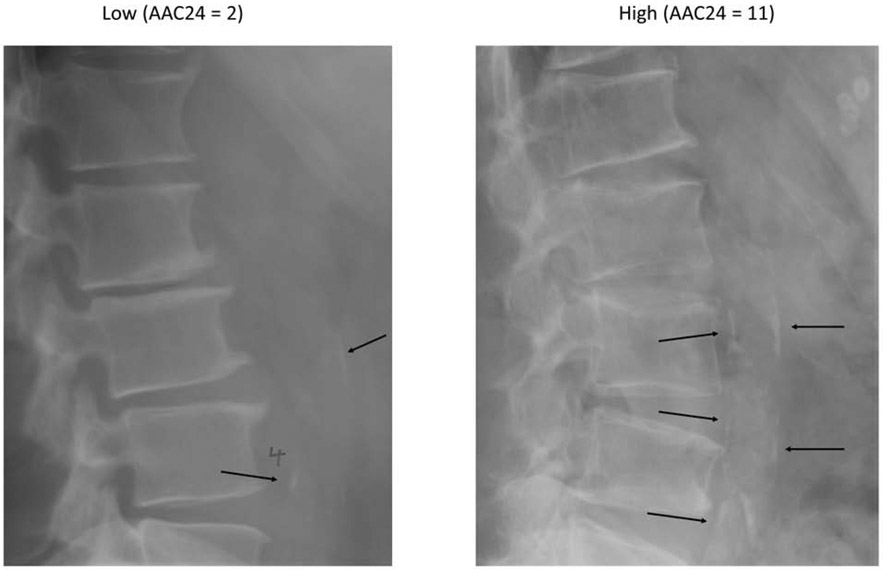
Methods: This was an observational cohort study of 2393 community-dwelling men (mean age 73.6 years) enrolled in the Osteoporotic Fractures in Men (MrOS) study and U.S. Medicare Fee for Service (FFS). AAC was scored on baseline lateral lumbar spine X-rays using a 24-point scale. ABI was measured as the lowest ratio of arm to right or left ankle blood pressure. Health care costs, hospital stays, and SNF stays were identified from Medicare FFS claims over 36 months following the baseline visit.
Results: Men with AAC score ≥9 (n = 519 [21.7% of analytic cohort]) had higher annualized total health care costs of $1473 (95% C.I. 293, 2654, 2017 U S. dollars) compared to those with AAC score 0-1, after multivariable adjustment. Men with ABI <0.90 (n = 154 [6.4% of analytic cohort]) had higher annualized total health care costs of $2705 (95% CI 634, 4776) compared to men with normal ABI (≥0.9 and < 1.4), after multivariable adjustment.
Conclusions: High levels of AAC and low ABI in older men are associated with higher subsequent health care costs, after accounting for clinical CVD risk factors, prevalent CVD diagnoses, and each other. Further investigations of whether preventing progression of peripheral vascular disease and calcification reduces subsequent health care costs are warranted.
Keywords: Abdominal aortic calcification; Ankle-brachial index; Atherosclerosis; Health care costs; Peripheral arterial disease.
Copyright © 2020 Elsevier B.V. All rights reserved.
Conflict of interest statement
Conflict of Interest Disclosures
Dr. Adabag has received research grant support from the American Heart Association and Medtronic Inc. for work unrelated to this manuscript. All of the other authors have no conflicts of interest to disclose.
Figures
Comment in
-
Increase in health care costs due to aorta calcification and low ABI in older men.Atherosclerosis. 2020 May;300:54-55. doi: 10.1016/j.atherosclerosis.2020.02.019. Epub 2020 Feb 29. Atherosclerosis. 2020. PMID: 32164926 No abstract available.
-
Reply to: "Increase in health care costs due to aorta calcification and low ABI in older men".Atherosclerosis. 2020 May;300:56-57. doi: 10.1016/j.atherosclerosis.2020.03.017. Epub 2020 Mar 23. Atherosclerosis. 2020. PMID: 32245540 No abstract available.
References
-
- Wilson PW, Kauppila LI, O'Donnell CJ, et al. , Abdominal aortic calcific deposits are an important predictor of vascular morbidity and mortality, Circulation, 2001;103:1529–1534. - PubMed
-
- Schousboe JT, Taylor BC, Kiel DP, et al. , Abdominal aortic calcification detected on lateral spine images from a bone densitometer predicts incident myocardial infarction or stroke in older women, Journal of bone and mineral research : the official journal of the American Society for Bone and Mineral Research, 2008;23:409–416. - PubMed
-
- Levitzky YS, Cupples LA, Murabito JM, et al. , Prediction of intermittent claudication, ischemic stroke, and other cardiovascular disease by detection of abdominal aortic calcific deposits by plain lumbar radiographs, Am J Cardiol, 2008;101:326–331. - PubMed
-
- Tatami Y, Yasuda Y, Suzuki S, et al. , Impact of abdominal aortic calcification on long-term cardiovascular outcomes in patients with chronic kidney disease, Atherosclerosis, 2015;243:349–355. - PubMed
Publication types
MeSH terms
Grants and funding
LinkOut - more resources
Full Text Sources
