


Who is willing to participate in research? A screening model for an anxiety and depression trial in the epilepsy clinic
- PMID: 32000099
- PMCID: PMC7282472
- DOI: 10.1016/j.yebeh.2020.106907
Who is willing to participate in research? A screening model for an anxiety and depression trial in the epilepsy clinic
Abstract
Objective: Anxiety and depression in epilepsy are prevalent, associated with poor outcomes, underrecognized, undertreated, and thus a key area of need for treatment research. The objective of this study was to assess factors associated with research participation among epilepsy clinic patients who screened positive for anxiety or depression. This was accomplished by characterizing clinical and psychiatric factors among patients seen in an epilepsy clinic and evaluating which factors were associated with consent for potential research participation, via a combined clinical and research screening model.
Methods: In a pragmatic trial of anxiety and depression treatment in epilepsy, individuals with a positive screen for anxiety and/or depression at a routine epilepsy clinic visit were invited to opt-in (via brief electronic consent) to further eligibility assessment for a randomized treatment study. Information on psychiatric symptoms and treatment characteristics were collected for dual clinical care and research screening purposes. Cross-sectional association of demographic, clinical, and psychiatric factors with opting-in to research was analyzed by multiple logistic regression.
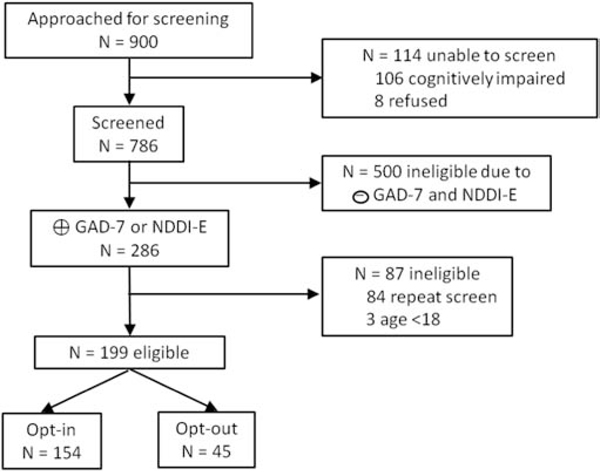
Results: Among N = 199 unique adults with a first positive screen for anxiety and/or depression among 786 total screening events, 154 (77.4%) opted-in to further potential research assessment. Higher depression scores and current treatment with an antidepressant were independently associated with opting-in to research (depression odds ratio (OR) = 1.13 per 1-point increase in Neurological Disorders Depression Inventory-Epilepsy (NDDI-E) score, p = 0.028, 95% confidence interval (CI): 1.01-1.26; antidepressant OR = 2.37, p = 0.041, CI: 1.04-5.41). Nearly half of the 199 individuals (43.7%) with anxiety and/or depression symptoms were already being treated with an antidepressant, and 46.7% were receiving neither antidepressant therapy nor mental health specialty care. One-quarter (24.1%) reported a past psychiatric hospitalization, yet only half of these individuals were receiving mental health specialty care.
Significance: Our results demonstrate a high willingness to participate in research using a brief electronic consent approach at a routine clinic visit. Adults with persistent anxiety or depression symptoms despite antidepressant therapy and those with higher depression scores were more willing to consider a randomized treatment study. This has implications for future study design, as individuals already on treatment or those with more severe symptoms are often excluded from traditional research designs. We also found a high burden of psychiatric disease and high prevalence of persistent symptoms despite ongoing antidepressant treatment.
Keywords: Anxiety; Depression; Epilepsy; Pragmatic trial; Research participation; Treatment.
Copyright © 2020 Elsevier Inc. All rights reserved.
Conflict of interest statement
Declaration of competing interest Kelly Conner has served as a paid consultant for SK Life Sciences. Pamela Duncan has received support from the following entities: Moleac, Duke-NUS Singapore Medical School, Care Directions, Woods-Duncan, University of Kansas for SIS-impact license, University of Pittsburgh-PRIMA DSMB, Maine Medical Center Research Institute's COBRE, CoHstar, and she serves as Chair of the NINDS Stroke Common Data Elements-Outcomes. The remaining authors have nothing to report.
Figures
Comment in
-
Improving participation in research is first about truly informed consent.Epilepsy Behav. 2020 Jun;107:107042. doi: 10.1016/j.yebeh.2020.107042. Epub 2020 Apr 1. Epilepsy Behav. 2020. PMID: 32245573 No abstract available.
-
Reply to Braillon.Epilepsy Behav. 2020 Jun;107:107049. doi: 10.1016/j.yebeh.2020.107049. Epub 2020 Apr 4. Epilepsy Behav. 2020. PMID: 32253146 Free PMC article. No abstract available.
References
-
- Kwan P, Yu E, Leung H, Leon T, Mychaskiw MA. Association of subjective anxiety, depression, and sleep disturbance with quality-of-life ratings in adults with epilepsy. Epilepsia 2009;50: 1059–66. - PubMed
-
- Choi H, Hamberger MJ, Munger Clary H, Loeb R, Onchiri FM, Baker G, Hauser WA, Wong JB. Seizure frequency and patient-centered outcome assessment in epilepsy. Epilepsia 2014;55: 1205–12. - PubMed
-
- Kanner AM, Barry JJ, Gilliam F, Hermann B, Meador KJ. Depressive and anxiety disorders in epilepsy: do they differ in their potential to worsen common antiepileptic drug-related adverse events? Epilepsia 2012;53: 1104–8. - PubMed
Publication types
MeSH terms
Substances
Grants and funding
LinkOut - more resources
Full Text Sources
Medical
Miscellaneous
