


Efficacy and safety of early prone positioning combined with HFNC or NIV in moderate to severe ARDS: a multi-center prospective cohort study
- PMID: 32000806
- PMCID: PMC6993481
- DOI: 10.1186/s13054-020-2738-5
Efficacy and safety of early prone positioning combined with HFNC or NIV in moderate to severe ARDS: a multi-center prospective cohort study
Abstract
Background: Previous studies suggest that prone positioning (PP) can increase PaO2/FiO2 and reduce mortality in moderate to severe acute respiratory distress syndrome (ARDS). The aim of our study was to determine whether the early use of PP combined with non-invasive ventilation (NIV) or high-flow nasal cannula (HFNC) can avoid the need for intubation in moderate to severe ARDS patients.
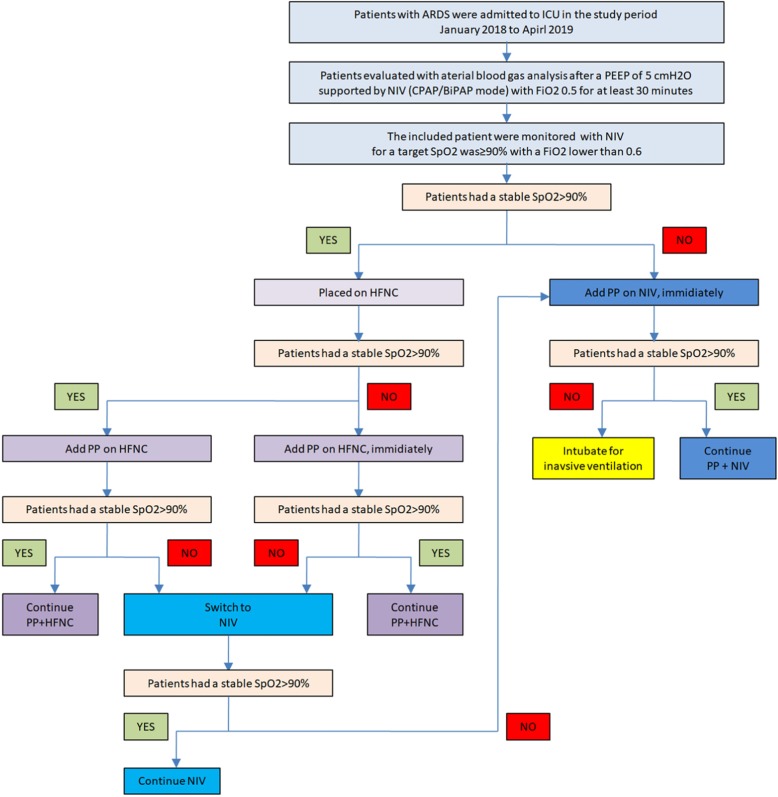
Methods: This prospective observational cohort study was performed in two teaching hospitals. Non-intubated moderate to severe ARDS patients were included and were placed in PP with NIV or with HFNC. The efficacy in improving oxygenation with four support methods-HFNC, HFNC+PP, NIV, NIV+PP-were evaluated by blood gas analysis. The primary outcome was the rate of intubation.
Results: Between January 2018 and April 2019, 20 ARDS patients were enrolled. The main causes of ARDS were pneumonia due to influenza (9 cases, 45%) and other viruses (2 cases, 10%). Ten cases were moderate ARDS and 10 cases were severe. Eleven patients avoided intubation (success group), and 9 patients were intubated (failure group). All 7 patients with a PaO2/FiO2 < 100 mmHg on NIV required intubation. PaO2/FiO2 in HFNC+PP were significantly higher in the success group than in the failure group (125 ± 41 mmHg vs 119 ± 19 mmHg, P = 0.043). PaO2/FiO2 demonstrated an upward trend in patients with all four support strategies: HFNC < HFNC+PP ≤ NIV < NIV+PP. The average duration for PP was 2 h twice daily.
Conclusions: Early application of PP with HFNC, especially in patients with moderate ARDS and baseline SpO2 > 95%, may help avoid intubation. The PP was well tolerated, and the efficacy on PaO2/FiO2 of the four support strategies was HFNC < HFNC+PP ≤ NIV < NIV+PP. Severe ARDS patients were not appropriate candidates for HFNC/NIV+PP.
Trial registration: ChiCTR, ChiCTR1900023564. Registered 1 June 2019 (retrospectively registered).
Keywords: Acute respiratory distress syndrome (ARDS); High-flow nasal cannula (HFNC); Non-invasive ventilation (NIV); Prone positioning (PP).
Conflict of interest statement
The authors declare that they have no competing interests.
Figures

Comment in
-
Prone positioning combined with high-flow nasal cannula in severe noninfectious ARDS.Crit Care. 2020 Mar 23;24(1):114. doi: 10.1186/s13054-020-2821-y. Crit Care. 2020. PMID: 32204726 Free PMC article. No abstract available.
-
Effects of prone and lateral position in non-intubated patients with 2019 Novel Coronavirus (COVID-19) pneumonia.Pulmonology. 2021 Mar-Apr;27(2):167-171. doi: 10.1016/j.pulmoe.2020.10.015. Epub 2020 Nov 25. Pulmonology. 2021. PMID: 33262075 Free PMC article. No abstract available.
References
-
- Munshi L, Del Sorbo L, Adhikari NKJ, Hodgson CL, Wunsch H, Meade MO, Uleryk E, Mancebo J, Pesenti A, Ranieri VM, et al. Prone position for acute respiratory distress syndrome. A systematic review and meta-analysis. Ann Am Thorac Soc. 2017;14(Supplement_4):S280–S288. doi: 10.1513/AnnalsATS.201704-343OT. - DOI - PubMed
Publication types
MeSH terms
Associated data
LinkOut - more resources
Full Text Sources
Other Literature Sources
Medical
Miscellaneous
