


Regulation of actin isoforms in cellular and developmental processes
- PMID: 32001148
- PMCID: PMC7214208
- DOI: 10.1016/j.semcdb.2019.12.003
Regulation of actin isoforms in cellular and developmental processes
Abstract
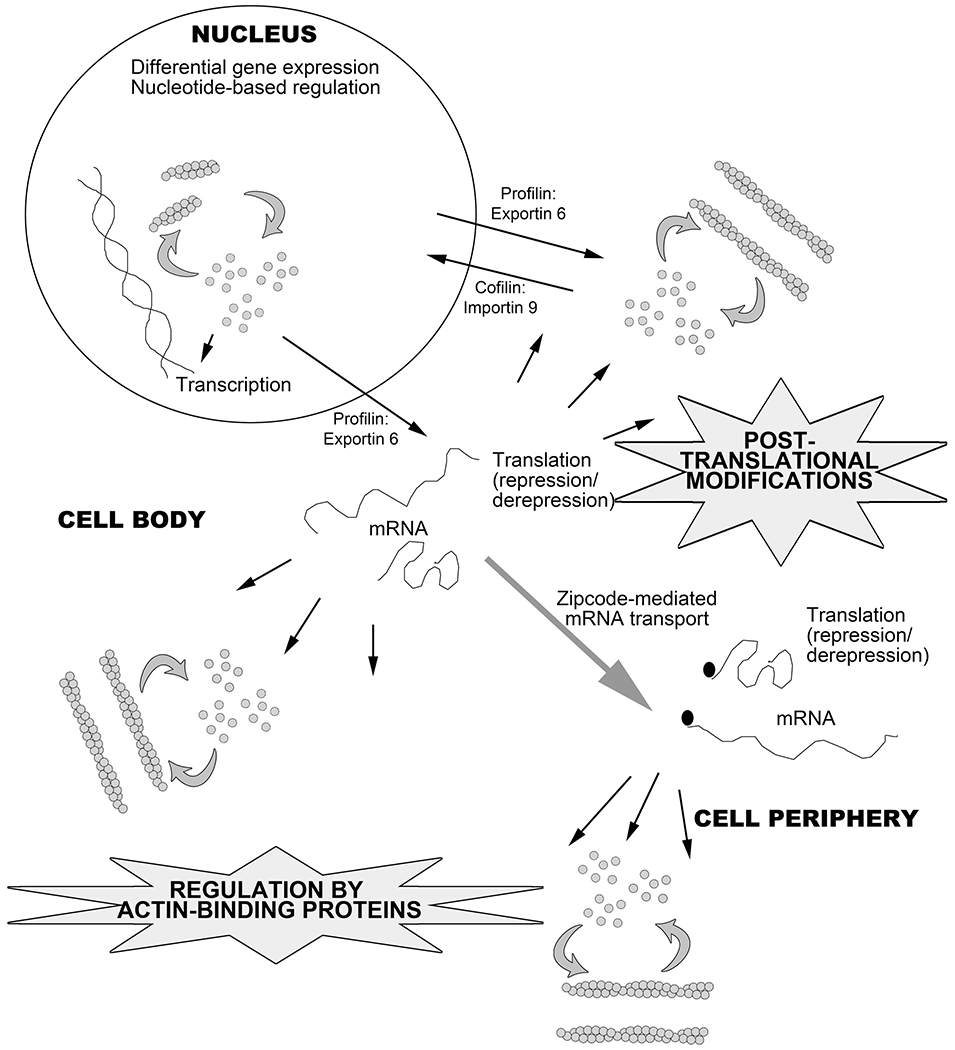
Actin is one of the most abundant and essential intracellular proteins that mediates nearly every form of cellular movement and underlies such key processes as embryogenesis, tissue integrity, cell division and contractility of all types of muscle and non-muscle cells. In mammals, actin is represented by six isoforms, which are encoded by different genes but produce proteins that are 95-99 % identical to each other. The six actin genes have vastly different functions in vivo, and the small amino acid differences between the proteins they encode are rigorously maintained through evolution, but the underlying differences behind this distinction, as well as the importance of specific amino acid sequences for each actin isoform, are not well understood. This review summarizes different levels of actin isoform-specific regulation in cellular and developmental processes, starting with the nuclear actin's role in transcription, and covering the gene-level, mRNA-level, and protein-level regulation, with a special focus on mammalian actins in non-muscle cells.
Keywords: Actin; Coding sequence; Posttranslational modifications; Regulation of cytoskeleton; Translation rate.
Copyright © 2020 Elsevier Ltd. All rights reserved.
Figures

References
-
- Abe A, Saeki K, Yasunaga T, and Wakabayashi T (2000). Acetylation at the N-terminus of actin strengthens weak interaction between actin and myosin. Biochemical and biophysical research communications 268, 14–19. - PubMed
-
- Ampe C, and Van Troys M (2017). Mammalian Actins: Isoform-Specific Functions and Diseases. Handbook of experimental pharmacology 235, 1–37. - PubMed
-
- Anthony Akkari P, Nowak KJ, Beckman K, Walker KR, Schachat F, and Laing NG (2003). Production of human skeletal alpha-actin proteins by the baculovirus expression system. Biochemical and biophysical research communications 307, 74–79. - PubMed
Publication types
MeSH terms
Substances
Grants and funding
LinkOut - more resources
Full Text Sources
