. 2020 Jan 30;11(1):601.
doi: 10.1038/s41467-020-14328-7.

Pattern generation and symbolic dynamics in a nanocontact vortex oscillator

Affiliations

Pattern generation and symbolic dynamics in a nanocontact vortex oscillator

Myoung-Woo Yoo et al. Nat Commun. .

Abstract

Harnessing chaos or intrinsic nonlinear behaviours of dynamical systems is a promising avenue toward unconventional information processing technologies. In this light, spintronic devices are promising because of the inherent nonlinearity of magnetization dynamics. Here, we demonstrate experimentally the potential for chaos-based schemes using nanocontact vortex oscillators by unveiling and characterizing their waveform patterns and symbolic dynamics using time-resolved electrical measurements. We dissociate nonlinear deterministic patterns from thermal fluctuations and show that the emergence of chaos results in the unpredictable alternation of well-defined patterns. With phase-space reconstruction techniques, we perform symbolic analyses of the time series and show that the oscillator exhibits maximal entropy and complexity at the centre of its incommensurate region. This suggests that such vortex-based systems are promising nanoscale sources of entropy that could be exploited for information processing.


Conflict of interest statement

The authors declare no competing interests.

Figures
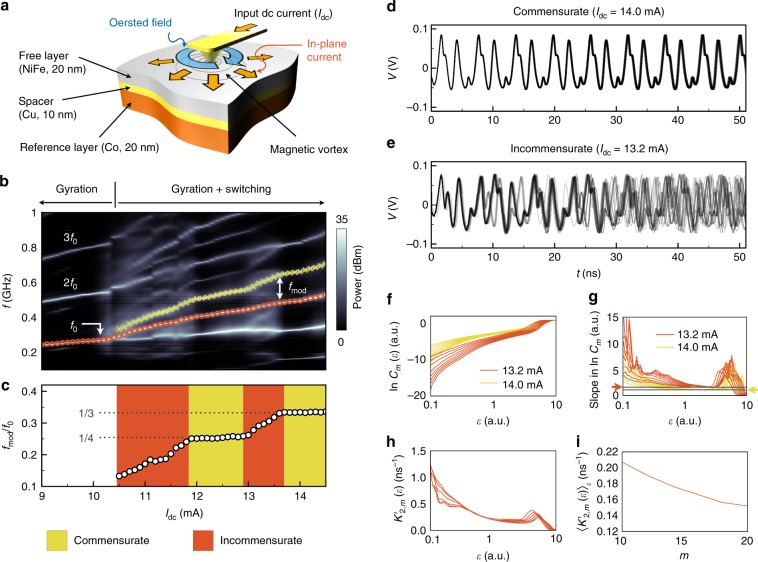
Fig. 1
Fig. 1. Chaotic characteristics of the output time traces.
a A schematic of a nanocontact vortex oscillator. b A map of the power spectra as a function of input current amplitudes, Idc. The red circles and yellow cross marks indicate a fundamental frequency, f0, and its upper sideband at f0+fmod, respectively. fmod is a modulation frequency. c fmodf0 as a function of Idc. The yellow and red regions represent the commensurate and the incommensurate states, respectively. The dotted horizontal lines indicate plateaus in which the self-phase-locking occurs. d Eighteen different time traces which have identical initial conditions in the commensurate state (Idc = 14.0 mA). e As in d but in the incommensurate state at Idc = 13.2 mA. f Correlation integrals Cm(ϵ) as a function of a geometric scaling ϵ and g its derivatives of lnCm(ϵ)lnϵ for embedding dimensions from m=10 (bottom curve) to m=24 (top curve) by increment of 2. The red and yellow curves are for Idc = 13.2 and 14.0 mA, respectively. The horizontal lines indicated by red and yellow arrows correspond to estimate of Dc based on the flats in the scaling ϵ-interval [1,100.3]. h Metric K2,m(ϵ) as a function of ϵ for embedding dimensions from m=10 (top curve) to m=24 (bottom curve) by increment of 2 at Idc=13.2mA and i K2,m(ϵ)ϵ in the scaling range [1,100.3] for the asymptotic determination of the K2-entropy.
Fig. 2
Fig. 2. Pattern generation from time series.
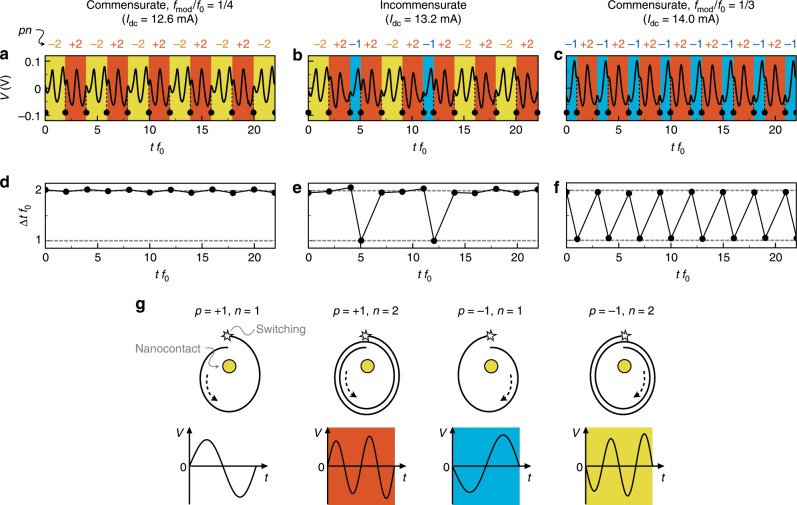
ac Representatives of experimentally measured time series at Idc = 12.6, 13.2, and 14.0 mA. The black dots with dotted lines indicate the core-polarity switching events. We normalized the time axes tf0 which is identical with a number of core gyrations. The yellow, blue, and red regions indicate waveform patterns denoted by pn=2,1,and+2, respectively, where p is a core polarity and n is a required gyration number for the core-polarity switching. df Time evolutions of a required gyration number for the core switching, n=Δtf0, obtained from ac by calculating intervals between the black dots. g Schematics of the possible core-polarity switching scenarios. The core trajectories (top panels) and expected output waveforms (bottom panels) are shown for different p and n combinations. The colours of the oscillatory patterns (red, blue, and yellow) correspond with those in ac.
Fig. 3
Fig. 3. Reconstructed attractor geometries and symbolic dynamics.
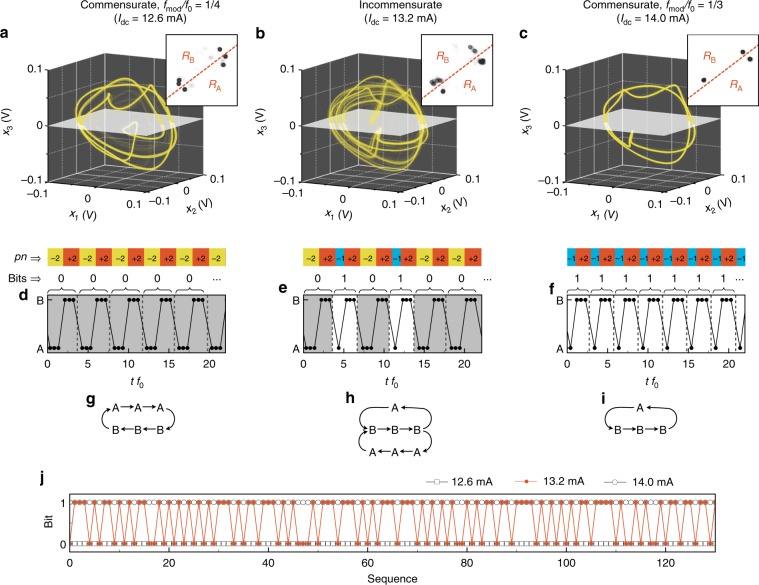
ac Reconstructed attractor geometries by a method of delay from the measured time traces at Idc = 12.6, 13.2, and 14.0 mA, respectively. The white plane is arbitrarily chosen Poincaré surface of section (see Methods). (Inset) Poincaré maps at the surfaces. The red dashed lines indicate a simple partition to divide the plane into two regions, RA and RB, for encoding symbols, A and B. The Poincaré surface of section and partitions are identical for all Idc in these figures. df Dynamics of symbols defined from the partition on the Poincaré' maps. Above the graphs, corresponding pn patterns and generated bit sequences are represented. The bits are defined as 0 [A,A,A,B,B,B] and 1 [A,B,B,B]. gi Rules of the symbolic dynamics at Idc = 12.6, 13.2, and 14.0 mA. j Generated bit sequences for long term at Idc = 12.6, 13.2, and 14.0 mA.
Fig. 4
Fig. 4. Complexity and control of bit sequences.
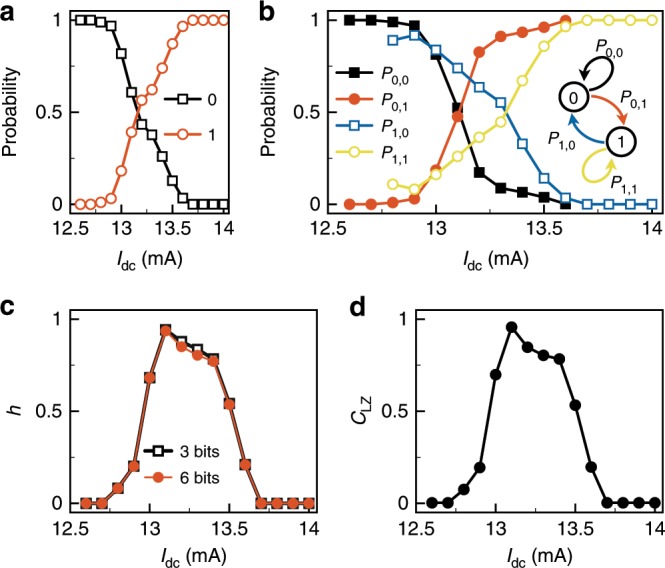
a Probability of 0 and 1 in the generated bit sequences as a function of Idc. b Probability of moving from the current state, i, to the next state, j, Pi,j. The inset shows the Markov chain for a 1 bit information. c Shannon block entropy rate, h, as a function of Idc for different block lengths, 3 bits and 6 bits. d Normalized Lempel–Ziv complexity, CLZ, as a function of Idc.

References

    1. Strogatz SH. Nonlinear Dynamics and Chaos: With Applications to Physics, Biology, Chemistry, and Engineering. 2nd edn. Philadelphia: Westview Press; 2015.
    1. Sciamanna M, Shore KA. Physics and applications of laser diode chaos. Nat. Photonics. 2015;9:151–162. doi: 10.1038/nphoton.2014.326. - DOI
    1. Argyris A, et al. Chaos-based communications at high bit rates using commercial fibre-optic links. Nature. 2005;438:343–346. doi: 10.1038/nature04275. - DOI - PubMed
    1. Uchida A, et al. Fast physical random bit generation with chaotic semiconductor lasers. Nat. Photonics. 2008;2:728–732. doi: 10.1038/nphoton.2008.227. - DOI
    1. Li W, et al. Fast physical random-number generation based on room-temperature chaotic oscillations in weakly coupled superlattices. Phys. Rev. Lett. 2013;111:044102–5. doi: 10.1103/PhysRevLett.111.044102. - DOI - PubMed