


Assessing the Co-Curriculum by Mapping Student Organization Involvement to Curricular Outcomes Using Mixed Methods
- PMID: 32001875
- PMCID: PMC6983881
- DOI: 10.5688/ajpe7354
Assessing the Co-Curriculum by Mapping Student Organization Involvement to Curricular Outcomes Using Mixed Methods
Abstract
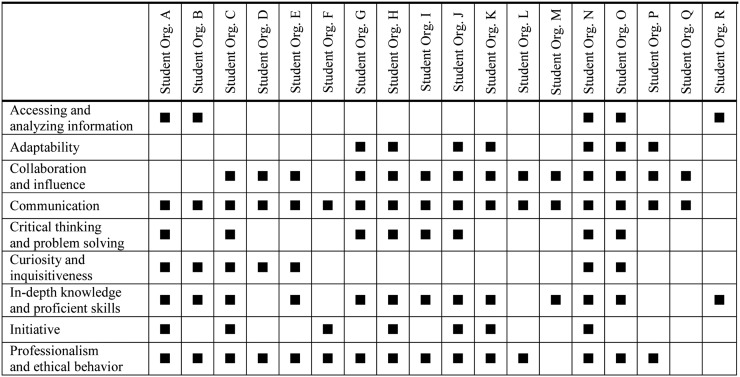
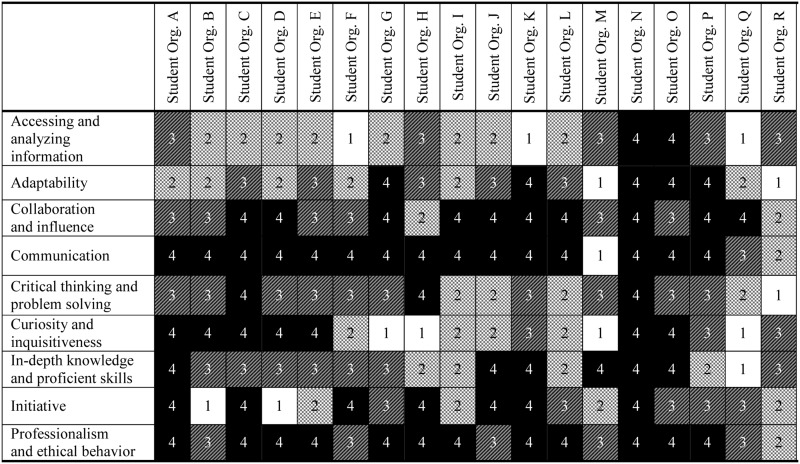
Objective. To use institution-specific curricular outcomes as a framework to map skill development opportunities available through cocurricular involvement in pharmacy student organizations. Methods. Participants completed a modified Extracurricular Involvement Inventory individually to measure the intensity of their involvement in each student organization. Participants also completed the Co-Curriculum Outcomes Assessment Mapping Survey (COAMS) instrument as a group to indicate what skills (ie, curricular outcomes) they developed through involvement in a student organization and student organization activities, programs, and events, and to provide examples of these skills. Data sources were triangulated to map skill development opportunities in the co-curriculum to curricular outcomes. Results. The COAMS identified all curricular outcomes as skills students have the opportunity to develop through student organization involvement in the co-curriculum. Communication was the most common skill identified. Other common skills included professionalism and ethical behavior, collaboration and influence, and in-depth knowledge and proficient skills. A co-curriculum heat map was used to illustrate the degree to which students reported these skills were emphasized through student organization involvement in the co-curriculum. Conclusion. Evaluation of activities in the context of curricular outcomes can provide a more comprehensive understanding of how the co-curriculum complements the curriculum, thereby complying with accreditation expectations. Cocurricular mapping provides valuable information regarding student skill development opportunities to multiple stakeholders (eg, students, faculty, curriculum leadership). This process can be applied to diverse programs, adapted to measure institution-specific experiences, and measure various constructs of interest.
Keywords: co-curriculum; cocurricular; mapping; skill development; student organizations.
© 2019 American Association of Colleges of Pharmacy.
Figures
References
-
- Bodey KJ. Join the club: perceived benefits of participating in professional student organizations. IAHPERD Journal 2008;37(2):8-11.
-
- Cox ER, Krueger KP, Murphy JE. Pharmacy student involvement in student organizations. J Pharm Teach. 1998;6(3):9-18.
MeSH terms
LinkOut - more resources
Full Text Sources
